Overview
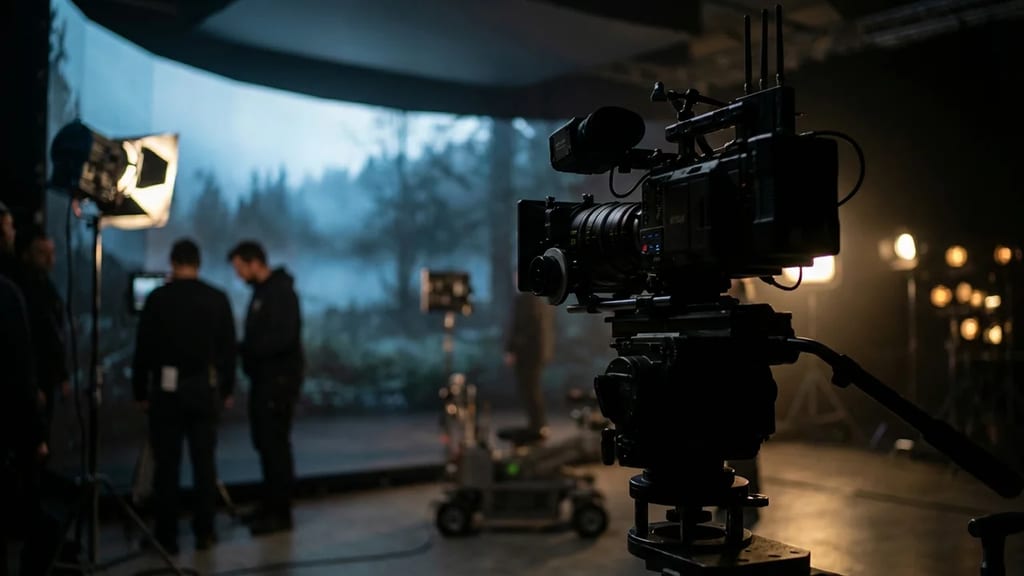
An LED Volume (also called "Volume" or "LED wall stage") is a shooting stage whose walls – and often the ceiling – are made of modular, high-resolution LED panels. Instead of a greenscreen, the wall displays real-time rendered, photorealistic environments that move perspectively correctly with camera movement via camera tracking. The process is called ICVFX (In-Camera Visual Effects): the finished image – including the background – is created directly in the camera, not in post-production.
The concept became known through the Disney+ series The Mandalorian (StageCraft, Industrial Light & Magic). The Volume used there was an approximately 6 m high LED wall, encircling about 270 degrees, with an additional LED ceiling. A significant advantage over greenscreen is the interactive lighting: the LED wall casts real, color- and directionally accurate light and reflections (e.g., in eyes, paint, glass) onto actors and set – meaning the scene is lit by its own virtual environment.
Principle of Operation: Inner & Outer Frustum
The wall surface is divided into two areas:
- Inner Frustum – the section captured by the camera's field of view. It is rendered in the highest quality and precisely follows the camera's position, focal length, and viewing direction via real-time tracking, ensuring correct parallax and perspective.
- Outer Frustum – the remaining wall area not directly in the image. It is rendered in lower quality and primarily serves as a light source and reflection surface.
The background content is usually generated in a game engine (predominantly Unreal Engine), played out by media servers, and displayed on the wall via LED processors. For the camera, processors, and render system to run together without flicker or tearing, all components must be synchronized via Genlock.
Technical Specifications
The following values are typical industry magnitudes; specific values depend on the manufacturer (e.g., ROE Visual) and processor (e.g., Brompton, Megapixel).
| Parameter | Typical Range |
|---|
| Pixel Pitch | for VP recommended approx. 2.3–2.8 mm (trend towards finer pitches for closer shots) |
| Refresh Rate (Panel) | frequently 3840 Hz or 7680 Hz |
| Frame Rate (Image Source) | 24 / 50 / 60 Hz, tendency towards higher rates |
| Color Space | e.g., up to approx. 95% DCI-P3 (ROE Visual) |
| Bit Depth / HDR | up to 16 Bit, 10-/12-Bit HDR workflows |
The Pixel Pitch (distance between the centers of adjacent pixels) determines how close the camera can get to the wall without individual pixels or a moiré pattern becoming visible: the finer the pitch, the shorter the minimum distance.
On-Set Usage
The LED Volume shifts effort from post-production to preparation: background worlds must be finished and runnable in the engine before shooting. On set, in addition to camera and lighting crews, extra trades are needed, including a Brain Bar/VP team for engine operation and tracking calibration. Typical challenges include moiré at too short a wall distance or unfavorable aperture, color matching between LED wall light and set strobes, and tracking stability, on which credible parallax depends.