Cinematographer
Aus DoP-Perspektive ist dieses Element essentiell für die visuelle Gestaltung. Es ermöglicht mir die gewünschte Farbstimmung und das ästhetische Bild konsistent umzusetzen.
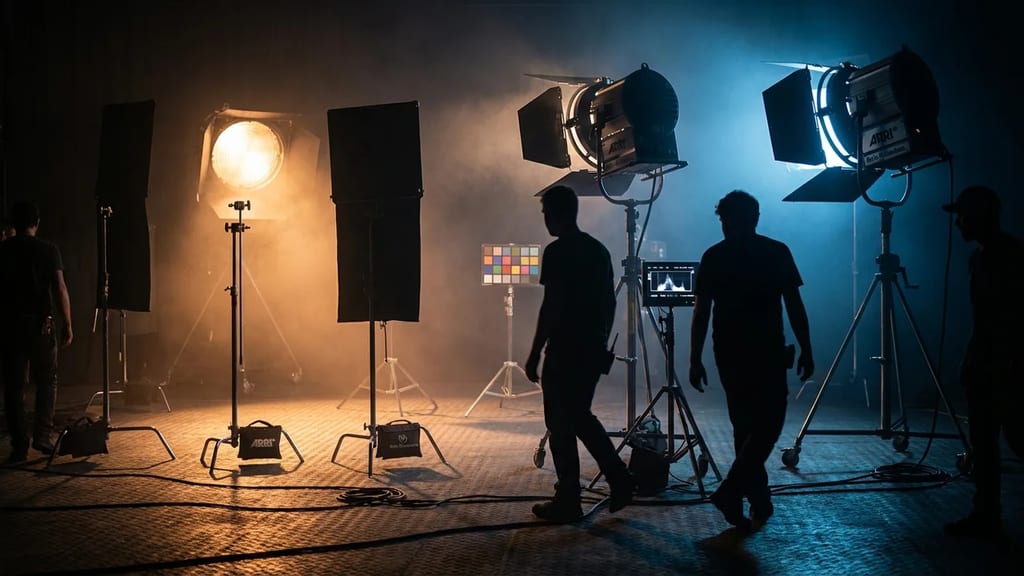
Color Pipeline: the color-managed workflow that conveys color information consistently from light source and camera through working color space to display and delivery.
The Color Pipeline (German: color-managed processing chain, color workflow) refers to the continuous management of color information across all stages of a film or TV production—from lighting setup and camera capture through post-production to final display and delivery. The goal is to ensure that a color effect designed on set is maintained and reproducible through editing, VFX, and color grading to the final product.
It is not a single device but a technical and organizational concept. It defines which color spaces are used and through which transformations image data is converted between stages. The Color Pipeline is relevant for lighting because light sources—especially RGB/full-color LED spotlights and LED walls in Virtual Production—provide the source material whose color characteristics the pipeline carries forward.
In ACES-based pipelines (Academy Color Encoding System), image data typically goes through the following stages:
| Stage | Function |
|---|---|
| IDT (Input Device Transform) | Converts camera data from the manufacturer-specific format into the ACES working color space |
| Working Color Space | Scene-referred space for editing and VFX (e.g., ACES2065-1, ACEScg, ACEScct) |
| LMT (Look Modification Transform) | Optional, overarching look adjustment |
| RRT (Reference Rendering Transform) | Converts scene-referred data into a display-referred range |
| ODT (Output Device Transform) | Final step: adapts the data to the respective output device (monitor, projector, delivery format) |
As an open color management system, OpenColorIO (OCIO) often links the individual tools to ensure color spaces and transformations remain consistent across applications. LUTs (Look-Up Tables) are used instead of or in addition to OCIO to map defined color transformations.
The quality of the Color Pipeline begins with the light source. Since modern LED spotlights with RGBW/RGBA/RGBWW engines mix color directly at the chip, their color accuracy and spectrum are crucial for later editability. Metrics used for evaluation include CRI (Color Rendering Index), the TLCI (Television Lighting Consistency Index, specifically geared towards camera reproduction) developed by the EBU, and TM-30 (with Fidelity Index Rf and Gamut Index Rg).
In Virtual Production, the calibration of the LED wall is an integral part of the Color Pipeline because the wall serves as both background and light source, and its color reproduction must be synchronized with the camera and display. A well-defined pipeline reduces errors at the interfaces between departments (e.g., between VFX and color grading) and ensures a consistent look throughout the entire production.
Aus DoP-Perspektive ist dieses Element essentiell für die visuelle Gestaltung. Es ermöglicht mir die gewünschte Farbstimmung und das ästhetische Bild konsistent umzusetzen.
Diese professionelle Lösung erhöht die Produktionseffizienz und reduziert Post-Production-Anforderungen. Sie ermöglicht flexible, schnelle Anpassungen während des Drehs.
Als Gaffer ist dies ein unverzichtbares Werkzeug meines täglichen Handwerkszeugs. Es ermöglicht mir professionelle Lichtkontrolle und schnelle Anpassungen auf Set, was Zeit spart und Qualität sichert.
1. Was beschreibt „Farb-Pipeline" am besten?
2. Zu welchem Department gehört „Farb-Pipeline"?
3. Wie viele verschiedene Fachperspektiven bietet dieser Eintrag?
The Lexikon is part of the Filmfarm ecosystem — alongside budgeting (FilmBalance), an industry magazine (FilmCircus) and crew networking (FilmCall, CrewMesh). One shared vocabulary for the whole production.