Filmlexikon.
Support
Joker Bug
Lighting · Equipment

Joker Bug

Murnau AI illustration
color temperature flow joker roll take

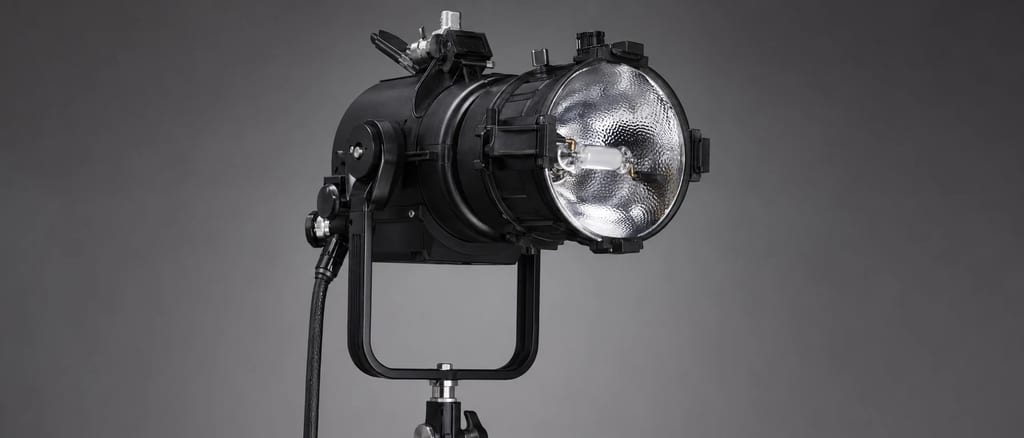
Compact HMI or LED fixture with concentrated beam. Places highlights exactly where needed on faces or objects—precise accent light, minimal rigging required.

Technical Details

The Joker Bug 400W produces a light output of 8,500 lux at 3 meters with the standard reflector at a color temperature of 5600K. The fixture head weighs only 1.2 kg, while the separate electronic ballast weighs 6.8 kg. The cooling system uses an integrated 12V fan that generates a noise level of 35 dB at 2,400 rpm. The fixture head features a Bowens S-mount for light modifiers and can be dimmed from 50% to 100% with an electronic dimmer.

History & Development

K5600 Lighting developed the first Joker Bug in 1995 in France in response to the demand for mobile HMI lights for exterior shoots. The revolutionary design separated the heavy ballast from the fixture head for the first time, opening up new mounting possibilities. The Bug-Lite series for 12V battery operation followed in 2003, and the waterproof Underwater version for dives up to 50 meters deep in 2008.

Practical Use in Film

Emmanuel Lubezki extensively used Joker Bugs for "The Revenant" (2015) to simulate and enhance natural daylight in the Canadian wilderness. The compact units could be easily mounted on tree branches or rigging points where conventional HMI lights would have been too heavy. In "Mad Max: Fury Road" (2015), John Seale used the 800W version as a backlight for vehicle shots, with the lights directly attached to the car rig.

Comparison & Alternatives

Compared to conventional 575W HMI lights, the Joker Bug 400W offers nearly identical light output at 30% less power consumption. LED alternatives like the ARRI SkyPanel S30-C achieve similar lux values but allow for color temperature adjustments from 2800K to 10,000K without conversion filters. Modern battery systems like the V-mount compatible Joker Bug 400W enable up to 45 minutes of continuous operation with a 290Wh battery.

From the crafts

Perspectives

Cinematographer

Ich setze den Joker Bug hauptsächlich als Aufhell- oder Backlight ein, wenn ich mit schwerem Equipment nicht an die gewünschte Position komme. Das 7,5m-Kabel gibt mir genug Spielraum, um den Leuchtenkopf hoch zu rigging, während das Ballast sicher am Boden steht. Bei Handheld-Sequenzen kann mein Gaffer die 800W-Variante problemlos mit einem Teleskoparm führen.

Director

Der Joker Bug erlaubt mir, natürliches Tageslicht auch bei schwierigen Lichtverhältnissen zu imitieren und Gesichter freizustellen, ohne dass die Crew sichtbare Lichtquellen aufbauen muss. Bei Verfolgungsszenen oder improvisierten Dialogen kann ich spontan Akzente setzen, da die Leuchte binnen Minuten einsatzbereit ist. Die konstante 5600K-Farbtemperatur garantiert mir nahtlose Schnittfolgen.

Producer

Ein Joker-Bug-Set kostet etwa 3.500€, verbraucht aber 40% weniger Strom als vergleichbare HMI-Systeme und reduziert damit Generatorkosten an Remote-Locations. Die kompakte Bauform spart Transportvolumen und ermöglicht kleinere Crew-Größen, da ein Beleuchter mehrere Units gleichzeitig bedienen kann. Defekte am Leuchtenkopf sind seltener kostengünstig zu reparieren als Schäden am teuren Ballast.

More in the lexikon

Related terms

Test your knowledge

Quiz

1. Was beschreibt „Joker Bug" am besten?

2. Zu welchem Department gehört „Joker Bug"?

3. Wie viele verschiedene Fachperspektiven bietet dieser Eintrag?

Report an error
From the Filmfarm ecosystem

Understand visual language, budget productions, connect crew.

The Lexikon is part of the Filmfarm ecosystem — alongside budgeting (FilmBalance), an industry magazine (FilmCircus) and crew networking (FilmCall, CrewMesh). One shared vocabulary for the whole production.

FilmFarm FilmRadarComing soonFilmPulseComing soonFilmNumbersComing soonFilmCapitalComing soonFilmLabComing soonFilmBalanceComing soonFilmCircusComing soon