Technical Details
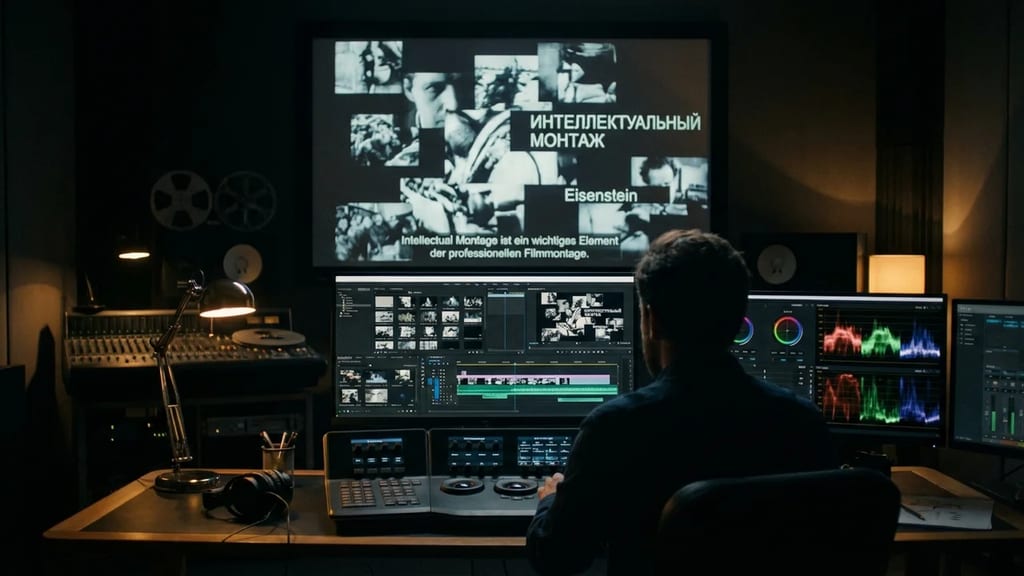
Eisenstein distinguished five montage types by increasing complexity: metric (rhythmic cuts every 2-4 seconds), rhythmic (corresponding to image movement), tonal (according to emotional mood), overtonal (combination of several factors), and intellectual montage. In intellectual montage, the cutting rhythms arise from conceptual contrasts – for example, a 3-second close-up of a worker is contrasted with a 2-second shot of slaughtered oxen. The cut points are not set according to motion flow but according to semantic fault lines. Modern editors often use jump cuts here with deliberately disharmonious cutting ratios of 1:3 or 2:5.
History & Development
Eisenstein developed the concept in 1929 for his unfinished film "Capital" after Marx. The first practical application occurred in "October" (1928), where he intercut Kerensky portraits with peacock feathers to visualize vanity. In "Battleship Potemkin" (1925), he had already contrasted machines with human bodies. The French Nouvelle Vague adopted the concept in the 1960s – Godard used intellectual montage for social criticism in "Weekend" (1967). Kubrick perfected the technique in "2001" (1968) with the famous match cut from the bone to the spaceship. Digital editing suites since the 1990s have enabled more complex frame-by-frame analysis for more precise conceptual cuts.
Practical Application in Film
In Coppola's "The Godfather" (1972), the baptism ceremony is intercut with parallel murder scenes – not chronologically, but to depict Michael's moral fall. Tarkovsky used intellectual montage more sparingly in "Stalker" (1979): black-and-white reality is contrasted with sepia zone shots. The workflow requires precise preparation in the screenplay – shots must already be conceived during filming for later conceptual connections. Disadvantages: Viewers can be overwhelmed if the metaphor becomes too abstract. The technique functions mainly in auteur film contexts, less so in commercial genre productions.
Comparison & Alternatives
Intellectual montage fundamentally differs from continuity editing through deliberate discontinuity. While parallel editing connects simultaneous actions, intellectual montage creates timeless layers of meaning. Cross-cutting follows causal links, while intellectual montage works with semantic associations. Modern alternatives include hyperlink cinema (Iñárritu, Nolan) and associative montage in music videos. For narratively complex material, classical montage is better suited; for experimental or political films, intellectual montage offers unsurpassed expressive possibilities for abstract concepts.