Technical Details
Eisenstein's metric montage follows mathematical proportions: In "Battleship Potemkin" (1925), he uses cutting frequencies of 2:1, 3:2, and 4:3 between shots. Rhythmic montage is based on movement patterns – rapid camera pans are contrasted with static shots, with the speed of movement determining the cut length. Tonal montage works with grayscale values: bright shots (70-90% white content) abruptly switch to dark ones (10-30% white content). In overtone montage, all parameters overlap simultaneously – rhythm, tone, metric, and intellectual content merge into a dialectical unit.
History & Development
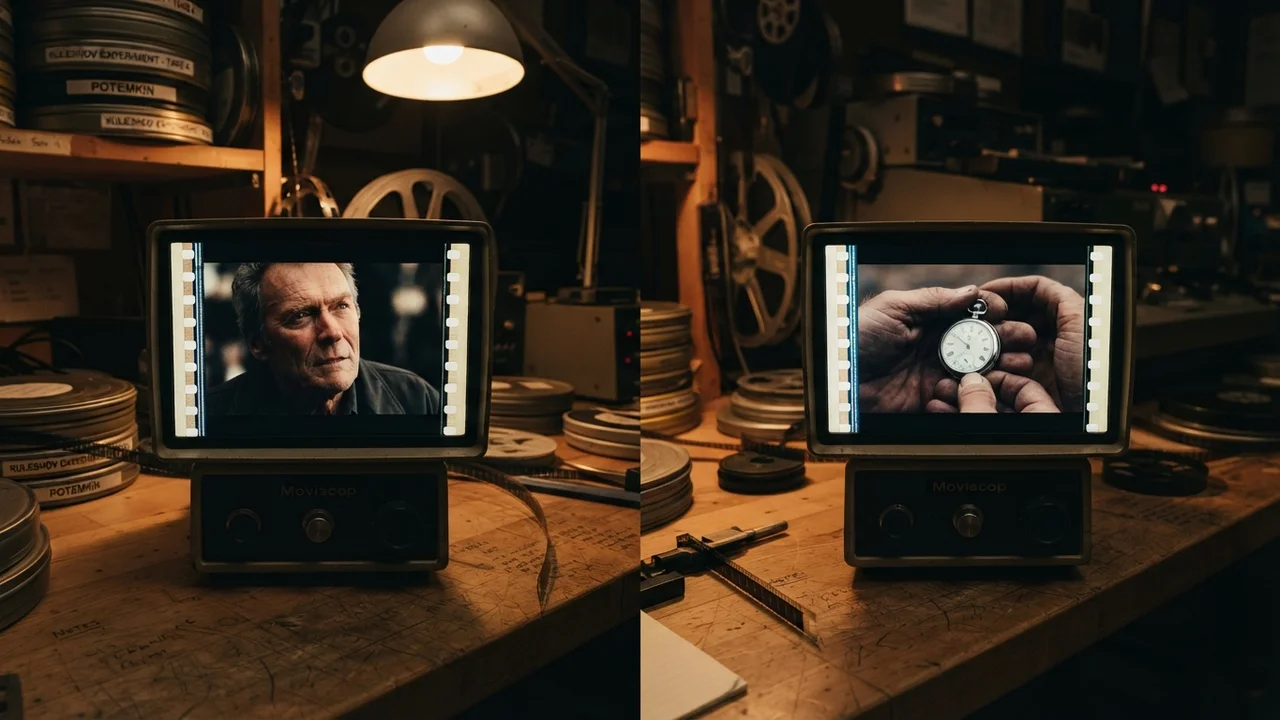
Eisenstein formulated his montage theory between 1923-1925 at the Moscow Proletkult Theatre and first applied it cinematically in "Strike" (1925). The method achieved its breakthrough with the Odessa Steps sequence in "Battleship Potemkin" (1925) – 155 shots in 6 minutes and 20 seconds. His intellectual montage reached its peak in 1928 in "October" with the famous God sequence, which contrasts religious icons from different cultures. After 1930, Godard further developed the method into "Cinéma Vérité," while Kuleshov simultaneously conducted the Kuleshov Experiment, which empirically supported Eisenstein's theories.
Practical Application in Film
Classic application can be found in war films: Scorsese's "Goodfellas" (1990) uses rhythmic montage in the helicopter sequence with 47 cuts in 3 minutes. Kubrick's "2001" (1968) demonstrates intellectual montage in the bone-to-spaceship transition. The method requires precise storyboarding – each shot must be composed according to its dialectical function. Disadvantages: High planning effort, difficulty in finding the right rhythm in the editing room, as digital timelines do not automatically visualize metric relationships. Modern editors use plugins like "Rhyme & Reason" for mathematical cut calculations.
Comparison & Alternatives
Eisenstein montage fundamentally differs from Griffith's continuity editing through deliberate discontinuity. While Hollywood montage aims to be invisible, Eisenstein makes every cut consciously perceptible. Pudovkin's montage connects shots additively like building blocks; Eisenstein creates new meaning through collision. Modern alternatives: MTV editing (purely rhythmic without dialectics), Chaos Cinema (visual excess without theoretical basis). French New Wave directors like Resnais adapted Eisenstein's intellectual montage for psychological narratives. For documentary formats, continuity editing is more suitable, while for experimental or political films, Eisenstein montage remains unsurpassed.