Filmlexikon.
Support
Hair Light
Lighting · Terms

Hair Light

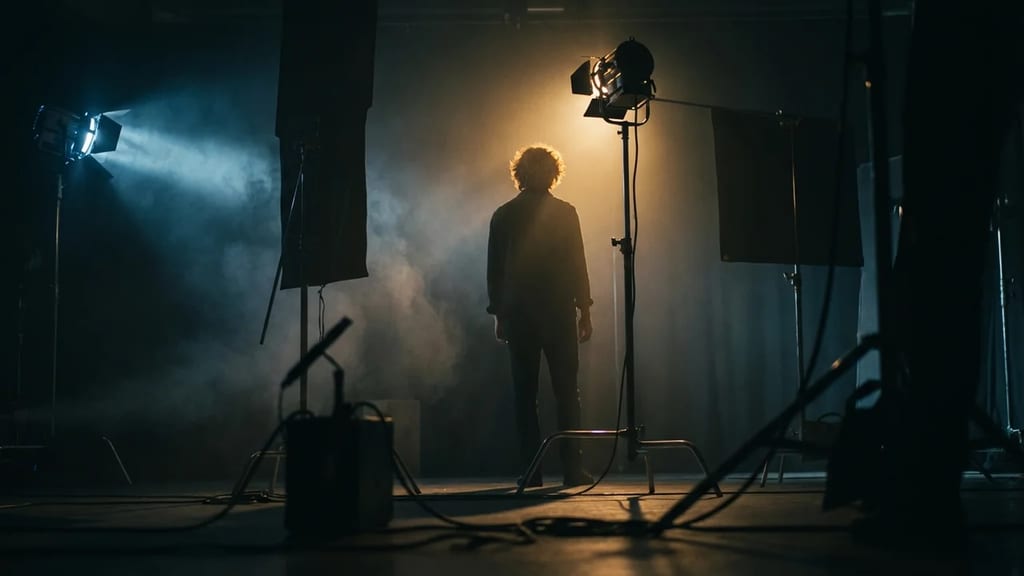
Murnau AI illustration
three point lighting high key lighting key light low key lighting fill light back light kicker

Focused light positioned above and behind the subject to sculpt hair and define head contours; typically uses Fresnel or spot reflectors at 12–25° beam angle.

Technical Details

Hair lights typically use Fresnel lenses or specialized spot reflectors to create a precisely controllable beam of light with an aperture angle of 12-25 degrees. Modern LED hair lights achieve color temperatures between 2700K and 6500K with a CRI value of at least 95. They are mounted using adjustable arms (boom arms) or C-stands at a height of 2.5-4 meters. Barndoors and snoots limit light spill to the desired area. Dimmers allow for stepless control from 0-100%.

History & Development

George Folsey systematically introduced hair lights into the three-point lighting system at MGM in 1932 to separate actresses like Greta Garbo from dark backgrounds. The technique quickly spread to all major studios and became an industry standard by 1940. The introduction of tungsten-halogen lamps in 1959 enabled the development of more compact hair light units. LED technology revolutionized the segment starting in 2010 with heat-free illumination and expanded color spectrums.

Practical Application in Film

Cinematographer Roger Deakins used orange hair lights in "Blade Runner 2049" (2017) to separate the protagonists from the bluish neon backgrounds. In portrait shots, the hair light enhances hair texture and adds three-dimensional depth to the head. The classic workflow places the hair light after the key light and fill light as the final step of basic illumination. For dark-haired actors, the required light intensity increases by 30-50%.

Comparison & Alternatives

The hair light differs from the backlight due to its focused application area and smaller surface coverage. Rim light illuminates the entire body contour, whereas hair light exclusively targets the head area. Modern alternatives include programmable LED panels with smartphone control and battery-powered mini-spots for handheld shoots. For extremely short shooting times, reflective diffusers (5-in-1 reflectors) replace the elaborate hair light setup.

From the crafts

Perspectives

Cinematographer

Ich setze Haarlichter primär ein, um bei Gegenlicht-Situationen die Haartextur vom überstrahlten Hintergrund zu trennen und meinem Bild mehr Tiefe zu geben. Besonders bei dunkelhaarigen Schauspielern dimme ich das Key Light um eine Blende runter und kompensiere mit einem starken Haarlicht – das gibt mir mehr Kontrolle über die Kontrastwerte im Gesicht.

Director

Für mich ist das Haarlicht ein subtiles Werkzeug, um Charaktere hervorzuheben oder ihre emotionale Verfassung zu unterstreichen. In Dialogszenen lasse ich oft nur den dominierenden Charakter mit Haarlicht ausleuchten, während andere Figuren flacher erscheinen – das lenkt die Aufmerksamkeit und verstärkt Machtdynamiken ohne explizite Kameraführung.

Producer

Ein dediziertes Haarlicht-Setup kostet mich täglich 2-3 Stunden Aufbau- und Umbauzeit, plus einen zusätzlichen Beleuchter im Team. Bei Low-Budget-Produktionen streiche ich Haarlichter bei Totalen und verwende sie nur in wichtigen Close-Ups – das spart etwa 15% der täglichen Beleuchtungszeit ohne großen visuellen Verlust.

More in the lexikon

Related terms

Test your knowledge

Quiz

1. Was beschreibt „Haarlicht" am besten?

2. Zu welchem Department gehört „Haarlicht"?

3. Wie viele verschiedene Fachperspektiven bietet dieser Eintrag?

Report an error
From the Filmfarm ecosystem

Understand visual language, budget productions, connect crew.

The Lexikon is part of the Filmfarm ecosystem — alongside budgeting (FilmBalance), an industry magazine (FilmCircus) and crew networking (FilmCall, CrewMesh). One shared vocabulary for the whole production.

FilmFarm FilmRadarComing soonFilmPulseComing soonFilmNumbersComing soonFilmCapitalComing soonFilmLabComing soonFilmBalanceComing soonFilmCircusComing soon