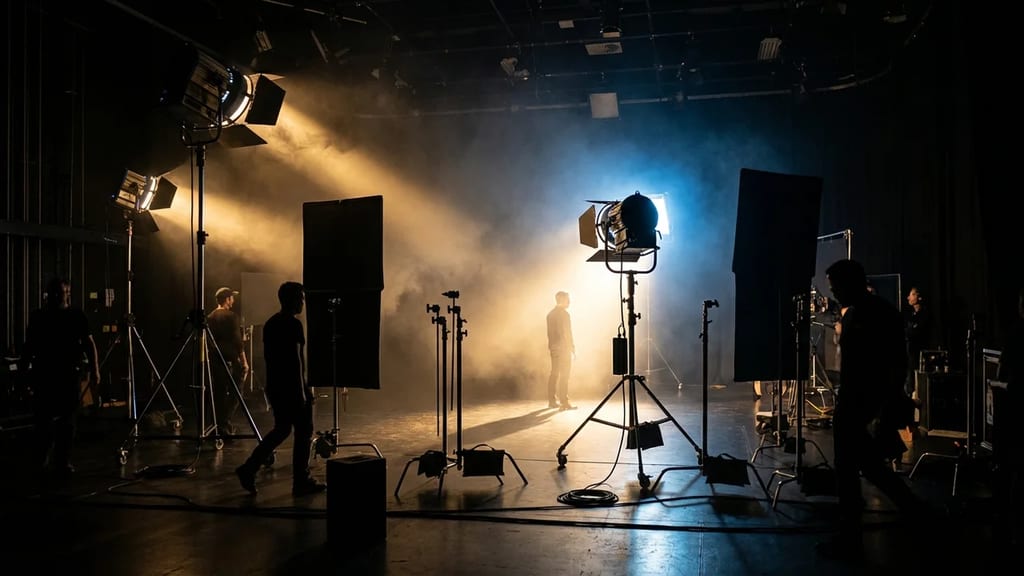
Back Light
Definition
Back light refers to the lighting technique where the primary light source is positioned between the subject and the camera, shining directly towards the lens axis. The light intensity typically ranges between 500-2000 Lux, depending on the desired effect and ambient light. The term was established in German film terminology in the 1920s as a direct translation of the American "Back Light".
Technical Details
Standardly, Fresnel lights with 1K-5K power are positioned at an angle of 180°±30° to the camera axis. The light source is placed 1.5-3 meters behind the subject and 0.5-2 meters above eye level. Three main variations exist: Rim Light (side-rear, 45° deviation), Hair Light (directly above the head), and Full Back Light (completely opposite the camera). Modern LED panels today enable stepless dimming from 0-100% and color temperature adjustment between 2700K-6500K.
History & Development
The systematic use of back light began in 1915 at Nestor Studios Hollywood, where Cecil B. DeMille and cinematographer Alvin Wyckoff first consciously used sunlight as a back light source. In 1927, Karl Freund revolutionized studio use with "Metropolis" through precisely controlled artificial light from behind. In the 1940s, Gregg Toland established the three-point lighting system, where back light functioned as a fixed component alongside key light and fill light. The digital era from 2010 onwards enabled new creative possibilities with extreme contrast ranges up to 14 f-stops through HDR cameras.
Practical Application in Film
In "Blade Runner 2049" (2017), Roger Deakins used back light to separate the characters from the foggy background, employing LED walls with 4000 nits brightness. Steven Spielberg characteristically uses back light for emotional climaxes – in "E.T." (1982), it visually separates the alien from the earthly environment. The technique requires precise exposure metering: the back light is measured 1-2 f-stops above the key light to avoid overexposure.
Comparison & Alternatives
Side light, in contrast to back light, creates horizontal rather than vertical separation between the subject and background. Practical lights simulate natural back light sources and appear less artificial, but require more elaborate lighting setups. Modern alternatives like LED Volumes (Virtual Production) project back light digitally, making traditional lights redundant in controlled environments. For exterior shots, the use of reflectors often replaces complex lighting setups.