Filmlexikon.
Support
Grid
Lighting · Equipment

Grid

Murnau AI illustration
216 diffusion 250 diffusion 251 diffusion artificial silk china silk diffusion filter diffusion gel diffusion

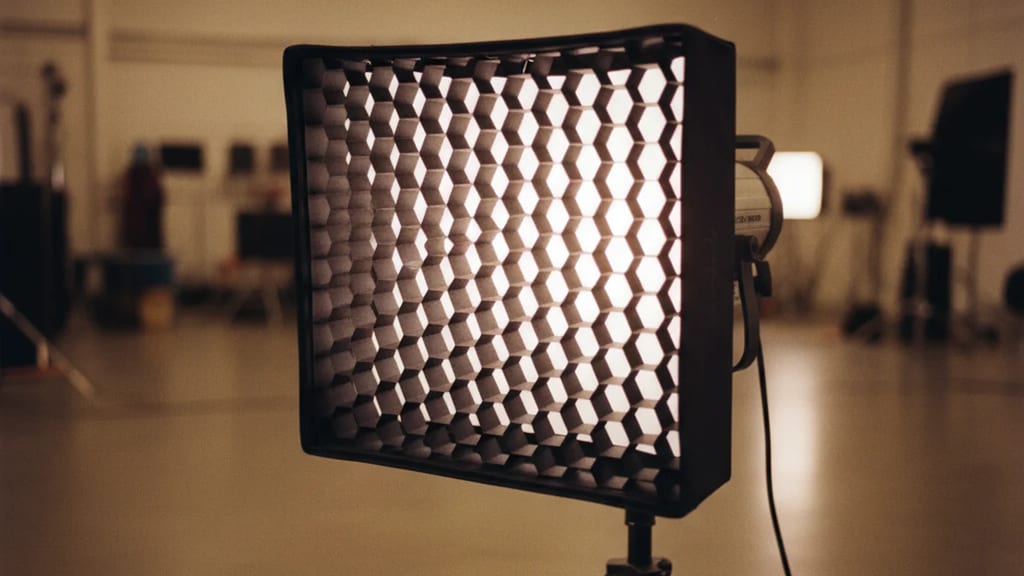
Honeycomb grid made of anodized aluminum for precise light beam control, with beam angles of 10° to 40°. Reduces spill light by 98% through black interior coating.

Technical Details

Standard grids are made of anodized aluminum with cell sizes between 6mm and 20mm and a depth of 15-40mm. The ratio of depth to aperture width determines the beam angle: 10°, 20°, 30°, or 40°. A 30° grid with 10mm cells and 30mm depth weighs approximately 180g for a 6-inch reflector. The black interior coating absorbs 98% of side light and prevents internal reflections. Magnetic mounting systems allow for tool-free attachment to Fresnel spotlights and LED panels.

History & Development

Grids were developed in 1962 by the company Arri in Munich, originally for television productions with low ceiling heights. The first application was in the ZDF production "Das Halstuch" (1962). In the 1970s, the technology became established in Hollywood through cinematographer Gordon Willis on "The Godfather" (1972). Modern variants have used carbon fiber composite materials since 2010, which are 40% lighter while offering the same stability.

Practical Application in Film

Roger Deakins extensively used grids in "Blade Runner 2049" (2017) for the characteristic light shafts in interior scenes. The grids eliminated lens flares in extreme wide-angle shots and controlled LED wall lighting. For portraits, 40° grids create soft key light without spill onto the background. The light loss is 0.8 stops, so the base lighting must be compensated accordingly.

Comparison & Alternatives

Barn doors offer variable shading, but with soft edges and less precision. Snoots create circular cones of light instead of the defined rectangular shape of a grid. Modern alternatives include digital gobo projectors and programmable LED arrays with electronic beam shaping. Softboxes with grids combine soft illumination with directed light control and are increasingly replacing separate grid systems for beauty shots.

From the crafts

Perspectives

Cinematographer

Ich setze 20°-Wabengitter bei Gegenlicht ein, um Lens Flares zu vermeiden und dennoch die Haarkante zu betonen. Bei LED-Panels verhindert das Gitter die typische Mehrfachschatten-Bildung und gibt mir saubere, durchzeichnete Schatten. Der Lichtverlust von knapp einer Blende ist kalkulierbar und wird durch die präzise Lichtführung mehr als kompensiert.

Director

Wabengitter helfen mir, Atmosphäre zu kontrollieren – ich kann Licht exakt dort platzieren, wo es die Stimmung verstärkt, ohne dass es in ungewollte Bildbereiche streut. Bei Verhör-Szenen erzeuge ich mit engen Gittern harte Lichtinseln, die Isolation vermitteln. Die sauberen Lichtkanten unterstützen die visuelle Dramaturgie ohne ablenkende Überstrahlungen.

Producer

Ein Wabengitter-Set kostet 800-1200 Euro, spart aber täglich 30-45 Minuten Setup-Zeit gegenüber komplexen Abschattungs-Konstruktionen. Die magnetische Befestigung reduziert Crew-Größe und Arbeitsschritte. Bei LED-Setups amortisiert sich die Investition bereits nach acht Drehtagen durch reduzierten Stromverbrauch und weniger benötigte Leuchten.

More in the lexikon

Related terms

Test your knowledge

Quiz

1. Was beschreibt „Wabengitter" am besten?

2. Zu welchem Department gehört „Wabengitter"?

3. Wie viele verschiedene Fachperspektiven bietet dieser Eintrag?

Report an error
From the Filmfarm ecosystem

Understand visual language, budget productions, connect crew.

The Lexikon is part of the Filmfarm ecosystem — alongside budgeting (FilmBalance), an industry magazine (FilmCircus) and crew networking (FilmCall, CrewMesh). One shared vocabulary for the whole production.

FilmFarm FilmRadarComing soonFilmPulseComing soonFilmNumbersComing soonFilmCapitalComing soonFilmLabComing soonFilmBalanceComing soonFilmCircusComing soon