Filmlexikon.
Support
Grid Clamp
Lighting · Equipment

Grid Clamp

Murnau AI illustration
216 diffusion 250 diffusion 251 diffusion artificial silk china silk diffusion filter diffusion gel diffusion

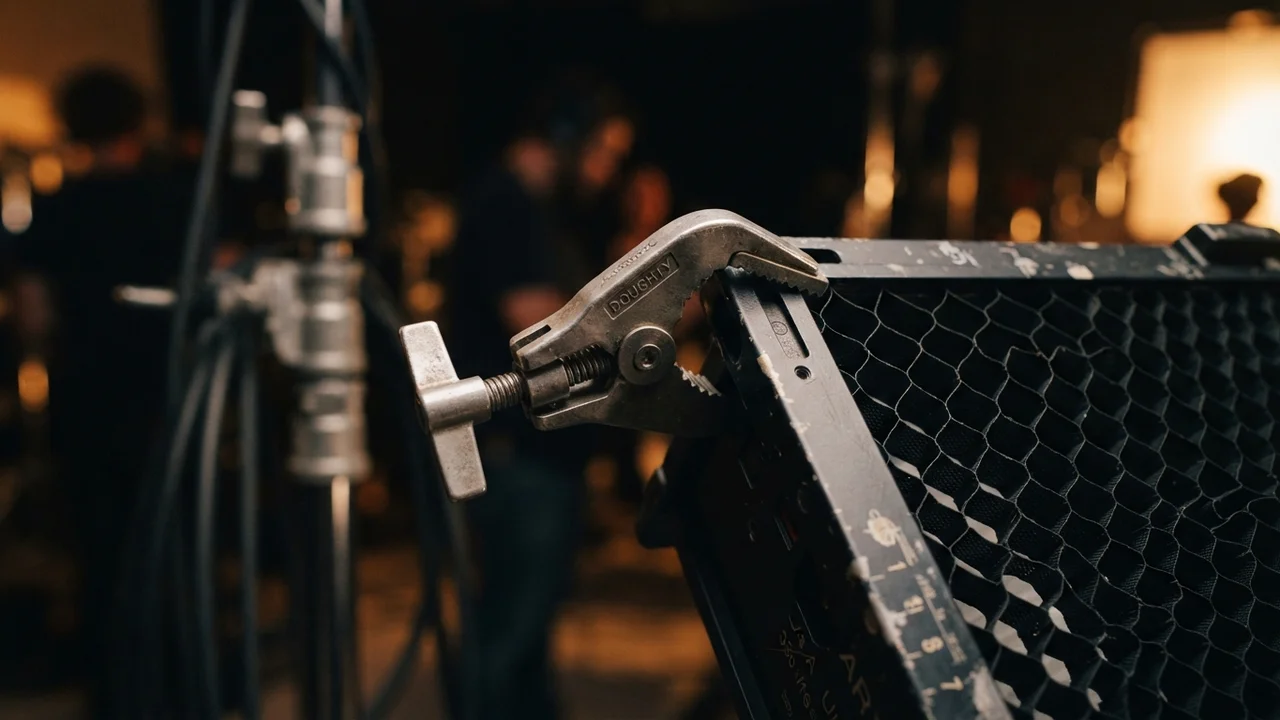
Clamp for mounting lighting fixtures to pipes and trusses; 30–100 kg load capacity, standard 5/8" stud, often with quick-release mechanism.

Technical Details

Standard grid clamps carry loads of 30-75 kg, depending on the model. The clamping range covers pipe diameters from 25mm (1 inch) to 50mm (2 inches). The jaws are made of hardened steel with a ribbed surface or rubber inserts for non-slip grip. The 5/8" spigot (16mm receiver) is the industry standard for fixture mounting. Variants include quick-release clamps with a snap closure, heavy-duty versions up to 100kg load capacity, and special angle clamps for angled mounting.

History & Development

Developed in 1923 by Century Lighting in New York for Broadway theaters, where spotlights had to be mounted on the characteristic iron grids above the stage. Mole-Richardson adapted the system in 1935 for film studios, as similar truss structures were emerging there. The breakthrough came in 1958 with the standardization of the 5/8" spigot by the USITT (United States Institute for Theatre Technology). Modern versions since the 1990s utilize lightweight metal alloys and ergonomic quick-release mechanisms.

Practical Use in Film

In "Blade Runner 2049" (2017), DoP Roger Deakins used grid clamps to mount LED panels on the truss systems of practical sets. Typical workflow: Rigging crew hangs trusses, electricians attach fixtures using grid clamps, final alignment is done via jaw rotation. Advantage: quick repositioning without tools with quick-release systems. Disadvantage: limited load capacity compared to welded mounts, susceptibility to vibration on mobile rigs.

Comparison & Alternatives

Distinction from the C-clamp: Grid clamps for round pipes, C-clamps for flat edges and boards. Safety chains are mandatory additions, not alternatives. Modern alternatives: Magnetic mounts for steel structures (up to 40kg), suction cup systems for smooth surfaces. Quick-rig systems with bayonet locks are increasingly replacing screw clamps in time-critical productions. Permanent installations use permanently screwed mounting plates instead of clamps.
From the crafts

Perspectives

Cinematographer

Ich nutze Gitterklemmen hauptsächlich für flexible Lichtpositionierung an unserem Grid-System – die Quick-Release-Varianten sparen mir wertvolle Zeit beim Umbauen zwischen Setups. Die 5/8"-Standardaufnahme macht jeden Scheinwerfer kompatibel, aber bei schweren HMI-Leuchten über 40kg bestehe ich auf doppelte Sicherung mit Safety-Chain.

Director

Für mich bedeuten Gitterklemmen narrative Flexibilität – wenn eine Szene mehr Drama braucht, kann mein Gaffer die Leuchten schnell umpositionieren ohne das gesamte Rigging neu zu planen. Bei Dialogen nutze ich die schnelle Anpassbarkeit für subtile Lichtverschiebungen zwischen den Einstellungen verschiedener Charaktere.

Producer

Gitterklemmen kosten 45-120 Euro pro Stück, aber sie amortisieren sich durch Zeitersparnis beim Setup – rechne 30% weniger Rigging-Zeit gegenüber fest verschraubten Systemen. Das Equipment ist standardisiert und bei jedem Verleih verfügbar, reduziert also Beschaffungsrisiken und Transportkosten bei internationalen Produktionen.

More in the lexikon

Related terms

Test your knowledge

Quiz

1. Was beschreibt „Gitterklemme" am besten?

2. Zu welchem Department gehört „Gitterklemme"?

3. Wie viele verschiedene Fachperspektiven bietet dieser Eintrag?

Report an error
From the Filmfarm ecosystem

Understand visual language, budget productions, connect crew.

The Lexikon is part of the Filmfarm ecosystem — alongside budgeting (FilmBalance), an industry magazine (FilmCircus) and crew networking (FilmCall, CrewMesh). One shared vocabulary for the whole production.

FilmFarm FilmRadarComing soonFilmPulseComing soonFilmNumbersComing soonFilmCapitalComing soonFilmLabComing soonFilmBalanceComing soonFilmCircusComing soon