Filmlexikon.
Support
Diffusion Filter
Camera · Equipment

Diffusion Filter

Murnau AI illustration
216 diffusion 250 diffusion 251 diffusion artificial silk china silk diffusion gel diffusion dracast silkray

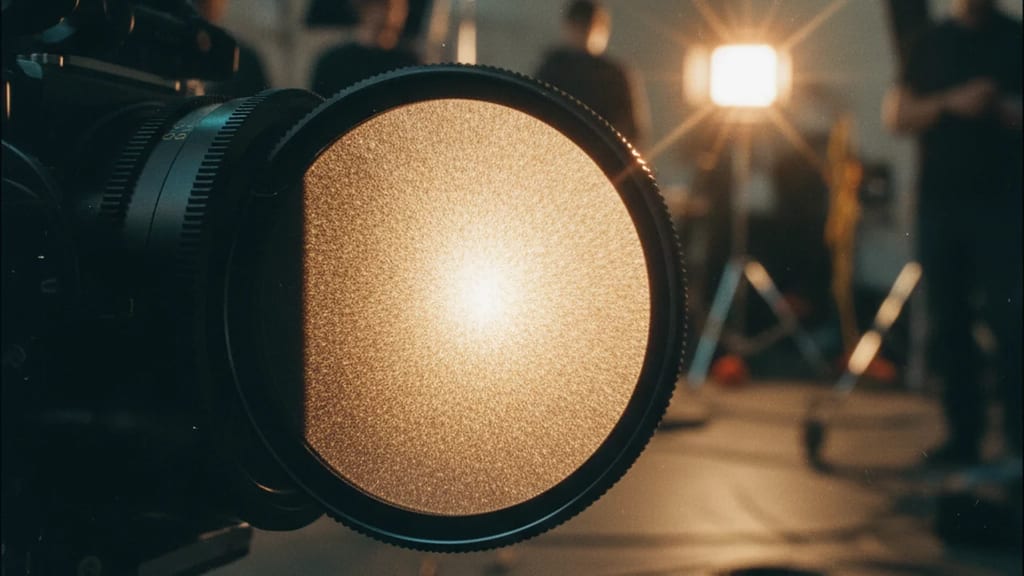
Optical filter that scatters light rays to soften hard edges, minimize skin blemishes, and create a dreamy, ethereal atmosphere.

Technical Details

Classic diffusion filters consist of optical glass with etched or vapor-deposited microscopic particles, modern silk or synthetic fiber fabrics, or special plastic films. Tiffen Pro-Mist filters are available in strengths of 1/8, 1/4, 1/2, 1, 2, and 5, with strength 1/4 reducing contrast by approximately 15%. Schneider Classic Soft filters use microscopic glass beads with diameters between 0.1 and 50 micrometers. Light scattering occurs through Mie scattering and typically causes a 0.3-1 stop light loss.

History & Development

1920s: First primitive diffusion effects using Vaseline or silk stockings in front of the lens in silent films. In 1935, Kodak developed the first professional soft focus filters for Hollywood productions. Tiffen introduced the Pro-Mist series in 1978, which became an industry standard. In the 1990s, Schneider Classic Soft and Formatt Black Pro-Mist were added. Since 2010, special Digital Diffusion Filters have complemented the range, optimized for sharper digital sensors.

Practical Application in Film

Cinematographer Conrad Hall extensively used Pro-Mist filters for the dreamlike sequences in "American Beauty" (1999). "The Godfather" (1972) utilized silk stockings and later Tiffen diffusion for the characteristic warm interior scenes. Modern productions like "1917" (2019) combined Schneider Classic Soft 1/2 with digital post-processing. Diffusion filters eliminate the "digital" look of 4K cameras and reduce post-production for skin retouching. Disadvantage: Reduced resolution in fine details, potential color shifts with strong filters.

Comparison & Alternatives

Distinction from pure soft focus filters: Diffusion filters maintain basic sharpness, while soft focus filters create a uniform blur. Pro-Mist produces halation effects around light sources, while Classic Soft appears more uniform. Modern alternatives: Digital diffusion in DaVinci Resolve or optical low-pass filters directly in the camera sensor. Glimmerglass filters offer stronger contrast reduction, Black Pro-Mist simultaneously reduces saturation. For skin shots: Diffusion filters; for landscapes: Soft focus filters are preferred.
From the crafts

Perspectives

Cinematographer

Ich setze Pro-Mist 1/4 standardmäßig bei digitalen Kameras ein, um den Film-Look zurückzuholen und gleichzeitig Nachbearbeitung bei Gesichtsaufnahmen zu sparen. Bei LED-Panels verstärkt sich der Halation-Effekt erheblich, weshalb ich die Filterstärke entsprechend anpasse. Schneider Classic Soft bevorzuge ich bei Tageslicht-Exterieurs, da er weniger Farbverschiebungen verursacht.

Director

Diffusionsfilter helfen mir dabei, Zeitebenen visuell zu trennen – starke Diffusion für Rückblenden, klares Bild für die Gegenwart. Bei Liebesszenen verwende ich bewusst Pro-Mist 1/2, um die emotionale Intimität zu verstärken und harte Realität zu mildern. Der Glow-Effekt bei Kerzenlicht oder Fenstern unterstützt die romantische Stimmung ohne kitschig zu wirken.

Producer

Ein kompletter Satz Diffusionsfilter kostet 800-2.500 Euro je Objektivdurchmesser, amortisiert sich aber durch reduzierte Postproduktionskosten bei Schönheitskorrekturen. Zeitersparnis in der Nachbearbeitung: 2-4 Stunden pro Drehtag weniger Retusche. Wichtig: Backup-Filter einplanen, da Beschädigungen am Set häufig auftreten und Ersatz 2-3 Tage Lieferzeit bedeutet.

More in the lexikon

Related terms

Test your knowledge

Quiz

1. Was beschreibt „Diffusionsfilter" am besten?

2. Zu welchem Department gehört „Diffusionsfilter"?

3. Wie viele verschiedene Fachperspektiven bietet dieser Eintrag?

Report an error
From the Filmfarm ecosystem

Understand visual language, budget productions, connect crew.

The Lexikon is part of the Filmfarm ecosystem — alongside budgeting (FilmBalance), an industry magazine (FilmCircus) and crew networking (FilmCall, CrewMesh). One shared vocabulary for the whole production.

FilmFarm FilmRadarComing soonFilmPulseComing soonFilmNumbersComing soonFilmCapitalComing soonFilmLabComing soonFilmBalanceComing soonFilmCircusComing soon