Cinematographer
Full Aperture nutzt jeden Quadratmillimeter des Negativs. Für Super 35 oder spätere Format-Flexibilität ist das die maximale Informations-Basis.
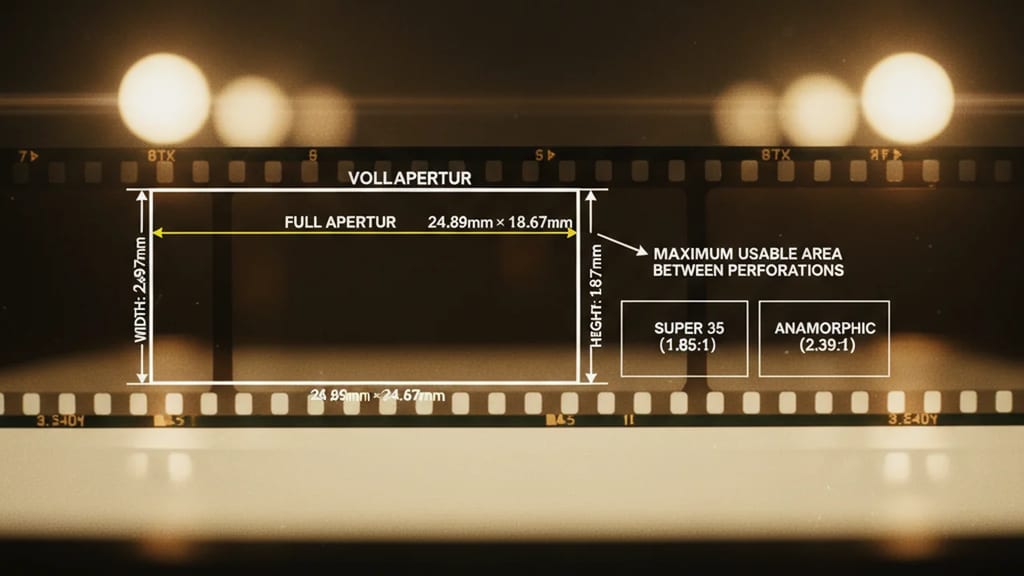
The maximum usable area of 35mm film frame (24.89mm × 18.67mm) utilizing the entire space between perforations – historically called 'silent aperture' as it predates sound tracks, used for Super 35, VistaVision extraction, and modern digital scanning for maximum resolution.
Full Aperture refers to the complete utilization of the 35mm film area between the perforation rows. This maximum recording area – 24.89mm × 18.67mm – offers the highest resolution and flexibility for various release formats.
| Aspect | Value |
|---|---|
| Width | 24.89mm |
| Height | 18.67mm |
| Ratio | ~1.33:1 |
| Area | ~465mm² |
| Era | Significance |
|---|---|
| Silent Film | Original Format |
| Sound Film | Space for soundtrack needed |
| Academy | Reduced area |
| Super 35 | Return to Full |
| Aspect | Description |
|---|---|
| Name | "Silent" = without soundtrack |
| Usage | Before Optical Sound |
| Size | Maximum area |
| Ratio | 1.33:1 |
| Format | Width (mm) | Height (mm) | Ratio |
|---|---|---|---|
| Full Aperture | 24.89 | 18.67 | 1.33:1 |
| Academy | 21.95 | 16.00 | 1.37:1 |
| Super 35 | 24.89 | Variable | Variable |
| Flat Extract | ~21 | ~11.3 | 1.85:1 |
| Aspect | Academy | Full Aperture |
|---|---|---|
| Soundtrack | Space reserved | No space |
| Width | Reduced | Maximum |
| Usage | Standard Sound | Silent/Super 35 |
| Resolution | Lower | Higher |
| Aspect | Description |
|---|---|
| Principle | Utilize Full Aperture |
| Soundtrack | Not on negative |
| Extraction | Various ratios |
| Flexibility | Maximum |
| Target Ratio | From Full Aperture |
|---|---|
| 1.85:1 Flat | Utilize horizontally |
| 2.39:1 Scope | Anamorphic or Crop |
| 1.78:1 (16:9) | TV Extraction |
| 4:3 | Completely |
| Area | Reason |
|---|---|
| Super 35 | Maximum area |
| VistaVision | 8-Perf horizontally |
| Scanning | Complete capture |
| Archival | All information |
| Aspect | Full Aperture Scan |
|---|---|
| Capture | Beyond the image |
| Perfs | Visible |
| Flexibility | Reframing possible |
| Resolution | Maximum |
| Camera | Description |
|---|---|
| ARRI Alexa | Full Sensor |
| RED | 8K Full Frame |
| Sony Venice | Full Frame Mode |
| Concept | Analogous to Full Aperture |
| Aspect | Description |
|---|---|
| Principle | 8-Perf horizontally |
| Size | Double the area |
| Usage | VFX Plates |
| Full Ap | Equivalent concept |
| Year | Development |
|---|---|
| 1889 | Edison Full Frame |
| 1927 | Sound film, Academy |
| 1950s | Widescreen era |
| 1980s | Super 35 Revival |
| Advantage | Description |
|---|---|
| Resolution | Maximum pixels |
| Reframing | Room for maneuver |
| Quality | Less enlargement |
| Options | Multiple Deliverables |
| Disadvantage | Description |
|---|---|
| Optical Sound | Not directly possible |
| Projection | Not standard |
| Workflow | Conversion necessary |
| Lenses | Full circle needed |
| Aspect | Description |
|---|---|
| Image Circle | Must cover Full Aperture |
| Vignetting | Avoid |
| Sharpness | To the corners |
| Coverage | Larger than Academy |
| Phase | Description |
|---|---|
| Shoot | Full Aperture |
| Scan | Overscan/Full Gate |
| Edit | Desired framing |
| Delivery | Extracted format |
| Application | Description |
|---|---|
| IMAX | Maximum Information |
| 4K Restoration | Full negative utilization |
| Multiple Releases | Various ratios |
| Future-Proofing | Higher resolutions |
| Concept | Description |
|---|---|
| Full Sensor | Entire sensor area |
| Open Gate | No crop modes |
| Maximum | Utilize all pixels |
| Flexibility | Post-crop possible |
| Practice | Reason |
|---|---|
| Framing for Extraction | Safe areas |
| Check lenses | Coverage |
| Document | Intended frame |
| Overscan | Safety |
Full Aperture remains relevant – whether as the basis for Super 35 in film productions or as a scanning standard for archives. The principle of utilizing the maximum available area directly translates to digital "Open Gate" workflows, where maximum sensor utilization offers similar flexibility.
Full Aperture nutzt jeden Quadratmillimeter des Negativs. Für Super 35 oder spätere Format-Flexibilität ist das die maximale Informations-Basis.
Full Aperture gibt mir Optionen in Post – Reframing, verschiedene Aspect Ratios. Die volle Negativ-Fläche bedeutet maximale Flexibilität.
Full Aperture-Aufnahmen kosten zunächst nicht mehr, bieten aber Flexibilität für verschiedene Auswertungen – Kino, TV, IMAX-Versionen aus einem Dreh.
1. Was beschreibt „Vollapertur / Vollformat / Stummes Format" am besten?
2. Zu welchem Department gehört „Vollapertur / Vollformat / Stummes Format"?
3. Wie viele verschiedene Fachperspektiven bietet dieser Eintrag?
The Lexikon is part of the Filmfarm ecosystem — alongside budgeting (FilmBalance), an industry magazine (FilmCircus) and crew networking (FilmCall, CrewMesh). One shared vocabulary for the whole production.