Technical Details
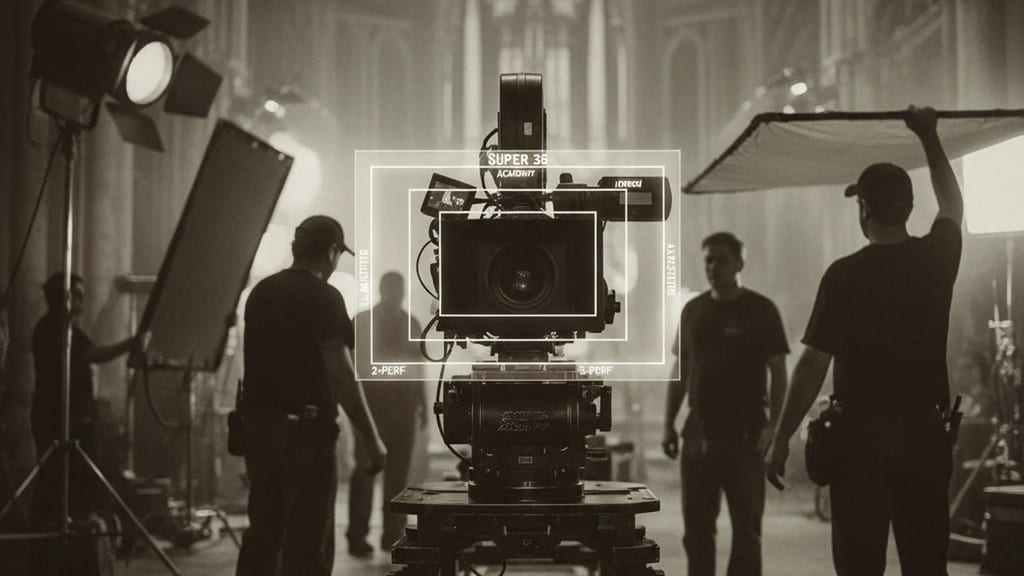
The Super 35 negative measures exactly 24.89 × 18.67 mm compared to the Academy format's 22.05 × 16.54 mm. The camera omits the recording of an optical soundtrack, making 15% more image area available. The format operates with 3-perf or 4-perf pull-down, with 3-perf saving 25% of film material. Scanning is typically done at 2K or 4K resolution to extract various aspect ratios such as 2.39:1, 1.85:1, or 16:9 through cropping or anamorphic squeezing.
History & Development
Panavision developed Super 35 in 1982 in response to the limitations of the Academy format and the cost of anamorphic systems. The first feature film in Super 35 was "Greystoke: The Legend of Tarzan" (1984). In the 1990s, the format became established through films like "Terminator 2" (1991) and "Jurassic Park" (1993). With the advent of the Digital Intermediate (DI) from 2000 onwards, Super 35 became the standard for digital post-production workflows.
Practical Use in Film
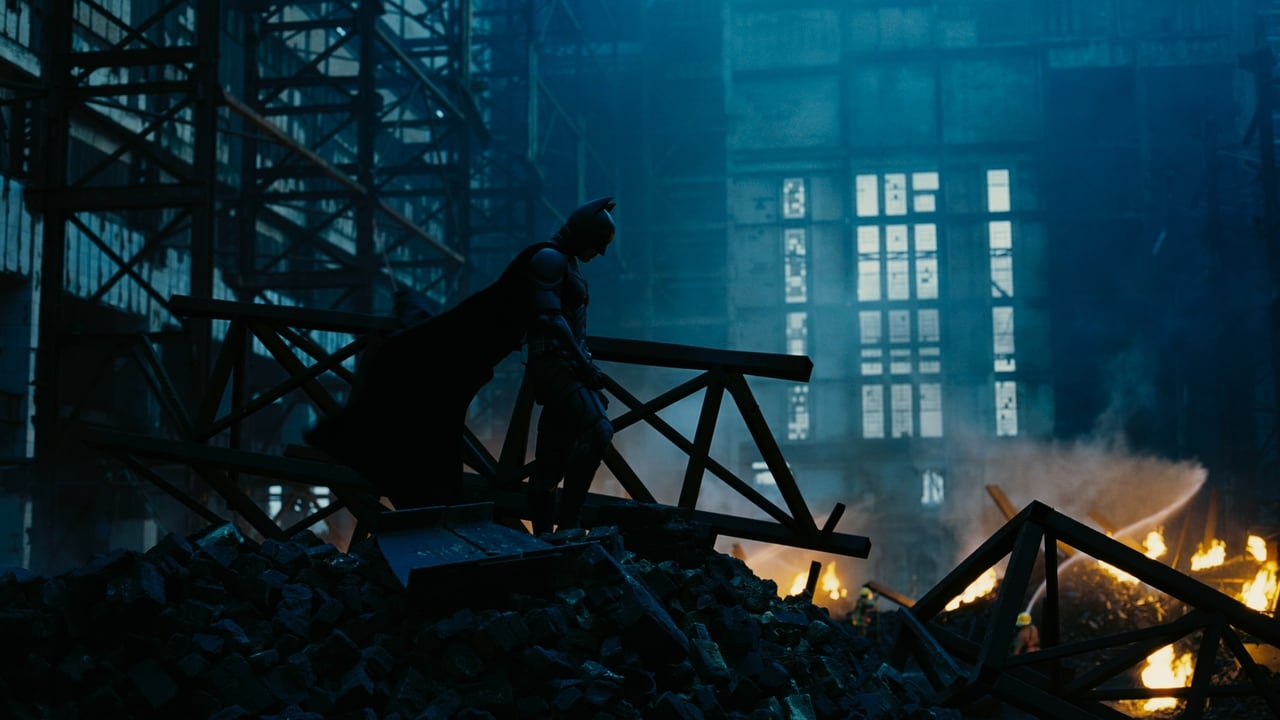
Christopher Nolan shot the "Dark Knight" trilogy in Super 35, utilizing its flexibility for IMAX blow-ups. The typical workflow involves scanning the negative, digital grading, and outputting in various formats. Advantages: more affordable spherical lenses, greater depth of field, post-production flexibility. Disadvantages: grain structure at extreme magnifications, additional DI effort for theatrical releases with optical sound.
Comparison & Alternatives
Super 35 differs from anamorphic 35mm through the use of spherical lenses and digital format adaptation instead of optical compression. The similar Super 16 utilizes the same principle with 16mm film. Modern alternatives include digital cameras with Super 35 sensors (ARRI Alexa, RED) measuring 23.76 × 13.37 mm for 16:9. Anamorphic 35mm remains relevant for its characteristic look with lens flares and bokeh, while Super 35 offers maximum post-production flexibility.
News
Canon is expanding its Cinema EOS portfolio with the C810, a 6K Super 35mm camera featuring a DIGIC X9 processor. The model offers 4K recording at 120fps in RAW quality and boasts an improved Dual Pixel autofocus system that operates down to -7EV. With an RF mount and a price of approximately $12,000, the C810 is aimed at professional productions with mixed camera fleets.