Cinematographer
Academy Aperture ist die historische Grundlage aller 35mm-Formate. Als Kameramann muss ich diese Geschichte kennen, um moderne Formatentscheidungen zu verstehen.
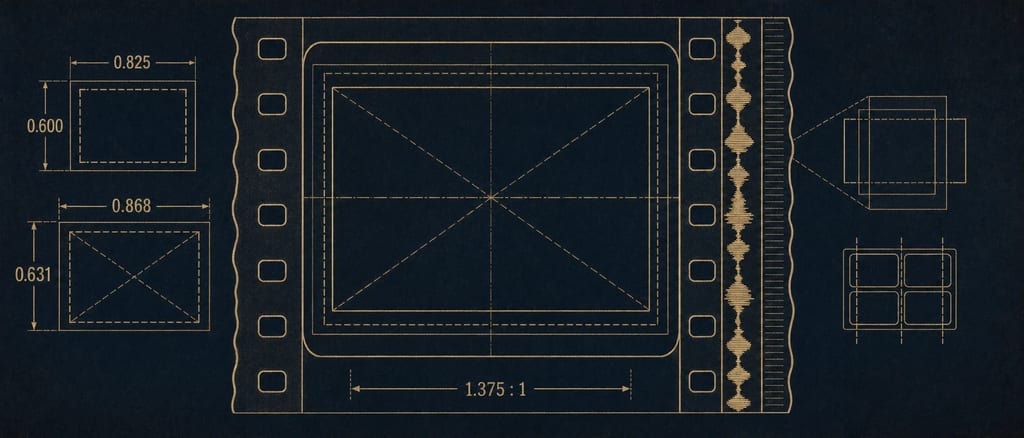
Standard 35mm film frame size established by AMPAS in 1932 – the 1.375:1 aspect ratio became the industry standard after sound-on-film reduced image area.
Academy Aperture is the standardized 35mm film format with an aspect ratio of 1.375:1 (often rounded to 1.37:1). It was introduced in 1932 by the Academy of Motion Picture Arts and Sciences (AMPAS) and remained the dominant standard until the 1950s.
| Year | Event |
|---|---|
| 1889 | Edison establishes 35mm film width |
| 1909 | Silent film format approx. 1.33:1 |
| 1927 | "The Jazz Singer" – first sound film |
| 1929 | Problem: Soundtrack reduces image area |
| 1932 | AMPAS standardizes Academy Aperture |
| Parameter | Value |
|---|---|
| Aspect Ratio | 1.375:1 |
| Image Width (Camera) | 22.0mm |
| Image Height (Camera) | 16.0mm |
| Image Width (Projector) | 20.96mm |
| Image Height (Projector) | 15.29mm |
| Image Area | ~320 mm² |
| Perforations | 4 per frame |
| Problem | Solution |
|---|---|
| Soundtrack | Optical track needed space |
| Image Loss | Left side of image cropped |
| Incompatibility | Different studios, different solutions |
| Projection | Cinemas needed uniform masks |
| Standard | AMPAS defined a binding format |
| Format | Aspect Ratio | Image Area |
|---|---|---|
| Silent Film | 1.33:1 | 356 mm² |
| Academy | 1.375:1 | 320 mm² |
| Super 35 | 1.33:1 | 356 mm² |
| Academy Flat | 1.85:1 | 280 mm² |
| Scope | 2.35–2.40:1 | Variable |
| Aspect | Description |
|---|---|
| Nearly Square | More vertical space than modern formats |
| Close-ups | Very effective for faces |
| Symmetry | Classic composition |
| Headroom | More space above heads |
| Year | Event |
|---|---|
| 1952 | Cinerama (2.89:1) launches |
| 1953 | CinemaScope (2.55:1) |
| 1954 | VistaVision (1.85:1) |
| 1950s | Widescreen replaces Academy |
| Usage | Description |
|---|---|
| Restoration | Historical films |
| Style Choice | Deliberate retro aesthetic |
| Independent | Sometimes for an intimate look |
| TV Origin | 4:3 is based on Academy |
| Aspect | Significance |
|---|---|
| Reference | Basis for understanding formats |
| Safe Area | Academy markings in viewfinder |
| History | Foundation of all 35mm standards |
| Composition | Teaches vertical image utilization |
Academy Aperture is historical – but its influence remains. The classic aesthetic of Hollywood's "Golden Age" continues to shape our understanding of cinematic composition to this day.
Academy Aperture ist die historische Grundlage aller 35mm-Formate. Als Kameramann muss ich diese Geschichte kennen, um moderne Formatentscheidungen zu verstehen.
Das Academy-Format prägte Jahrzehnte des Kinos. Die fast quadratische Form zwang zu präziser Komposition – eine Disziplin, von der ich heute noch lerne.
Academy Aperture war der erste echte Industriestandard. Diese Standardisierung ermöglichte erst den globalen Filmverleih – Kinos weltweit konnten dieselben Prints zeigen.
1. Was beschreibt „Academy-Apertur" am besten?
2. Zu welchem Department gehört „Academy-Apertur"?
3. Wie viele verschiedene Fachperspektiven bietet dieser Eintrag?
The Lexikon is part of the Filmfarm ecosystem — alongside budgeting (FilmBalance), an industry magazine (FilmCircus) and crew networking (FilmCall, CrewMesh). One shared vocabulary for the whole production.