Technical Details
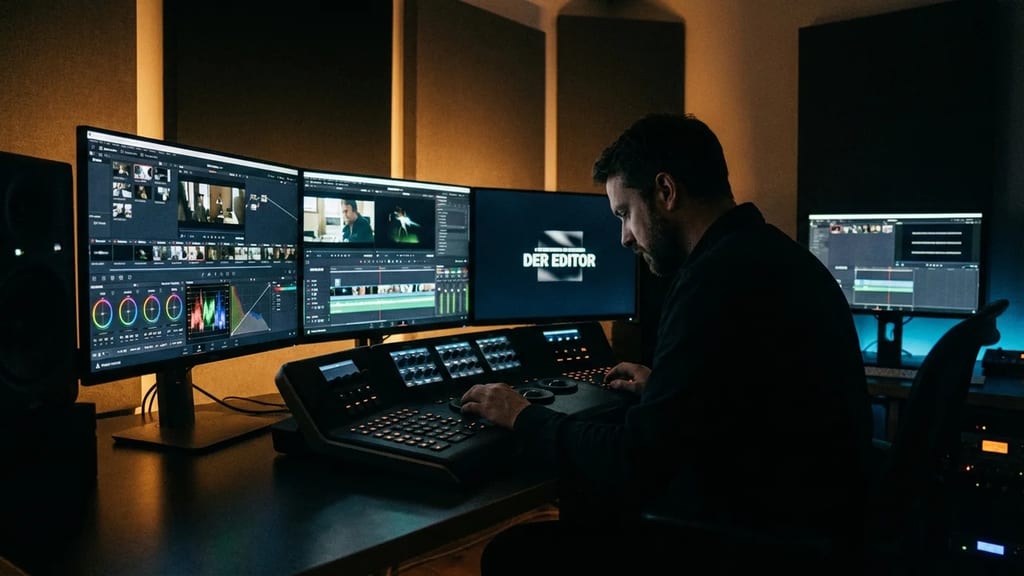
Modern film editors primarily work with Non-Linear Editing Systems (NLE) such as Avid Media Composer, Adobe Premiere Pro, or DaVinci Resolve. Typical workstations feature 64-128 GB RAM, multiple 4K monitors, and storage capacities of 50-500 TB for raw footage. The editing suite includes specialized hardware like jog-shuttle controllers, audio monitoring via Genelec or Focal speakers, and calibrated reference monitors for color grading. Distinctions are made between the Assembly Editor (rough cut), Picture Editor (fine cut), and Supervising Editor (overall responsibility).
History & Development
In 1895, Georges Méliès first edited film sequences manually with scissors and glue. In 1915, D.W. Griffith established fundamental editing principles with "Birth of a Nation." In 1924, Sergei Eisenstein further developed montage theory. The transition to electronic systems began in 1971 with the CMX 600, and the first digital NLE system, Lightworks, followed in 1989. Avid revolutionized digital editing for feature films in 1989, first employed on "Let's Kill All the Lawyers" (1992).
Practical Application in Film
Thelma Schoonmaker edited Scorsese's "Goodfellas" (1990) over 14 months, reducing 40 hours of footage to 146 minutes. The average editing rhythm is 2.5 seconds per shot in action films, and 4-6 seconds in dramas. For "Dunkirk" (2017), Lee Smith used three different timelines with varying editing frequencies: Land (one week), Sea (one day), Air (one hour). A rough cut typically takes 8-12 weeks, with a fine cut requiring an additional 4-8 weeks.
Comparison & Alternatives
The film editor differs from the cutter in narrative responsibility – while cutters perform mechanical cuts, editors shape the dramaturgy. Assistant Editors organize footage and create sync rushes but do not make creative decisions. Online Editors perform the technical finishing, while Offline Editors are responsible for the creative montage. Modern AI tools like Adobe Sensei or Blackmagic Neural Engine automate synchronization and footage selection but do not replace the narrative shaping performed by the film editor.