Technical Details
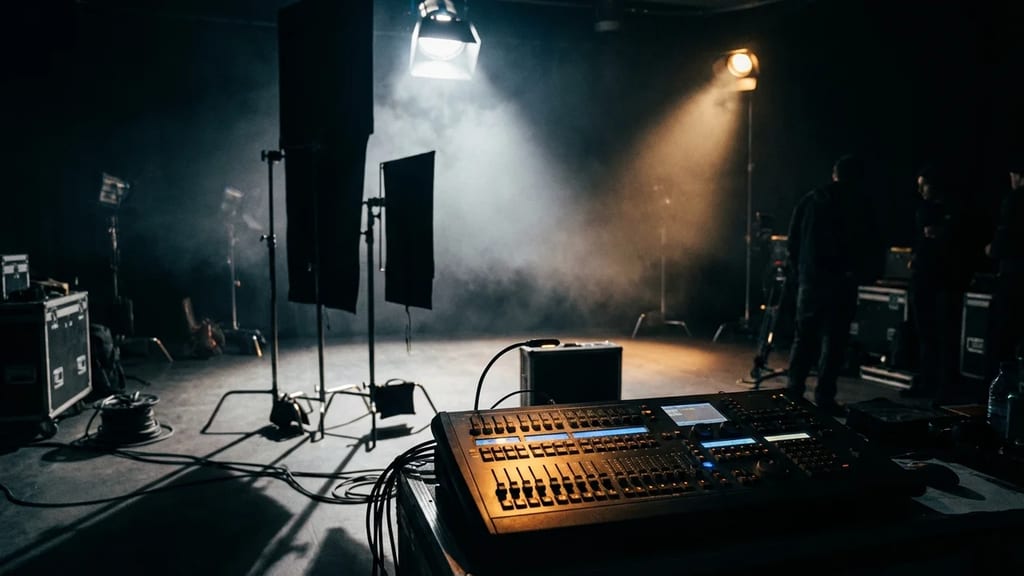
DMX controllers operate with 8-bit resolution per channel (0-255 values) and continuously send data packets at a refresh rate of 44 Hz. Professional film consoles like the MA Lighting grandMA3 or ETC Ion Xe offer 2,048 to 16,384 parameters and support multiple DMX universes simultaneously. The devices operate with a supply voltage of 100-240V AC and provide Ethernet, USB, and MIDI interfaces for network integration and timecode synchronization.
History & Development
The DMX512 protocol originated in 1986 as a replacement for analog 0-10V control systems in the theater sector. In 1990, DMX512-A was ratified as ANSI standard E1.11. The first film production with fully DMX-controlled lighting was "Interview with the Vampire" in 1994, where over 200 moving lights were coordinated. From 2000 onwards, extended protocols like Art-Net and sACN for Ethernet-based transmission became established, enabling up to 32,768 universes per network today.
Practical Application in Film
For "Blade Runner 2049," a grandMA2 system controlled over 800 LED panels for the futuristic city scenes, synchronized with camera moves via Mo-Sys tracking. For "The Revenant," DMX control allowed for precise adjustment of LED mats to natural daylight during "Golden Hour" shots. The controller enables real-time adjustments of color temperature (2,700-6,500K) and intensity without interrupting filming. Modern systems store up to 999 cues and allow for seamless crossfades between lighting moods.
Comparison & Alternatives
DMX differs from analog dimmer consoles through digital precision and bidirectional communication (RDM - Remote Device Management). While simple lighting consoles only control brightness, DMX controllers manage complex parameters like pan/tilt movements, gobo changes, and color mixing. Modern alternatives like the sACN protocol (ANSI E1.31) transmit DMX data over standard Ethernet networks, eliminating the need for special DMX cables. For smaller productions, USB-DMX interfaces with software controllers like Chamsys MagicQ offer cost-effective solutions.