Filmlexikon.
Support
DMX512
Lighting · Terms

DMX512

Murnau AI illustration
color temperature flow roll take

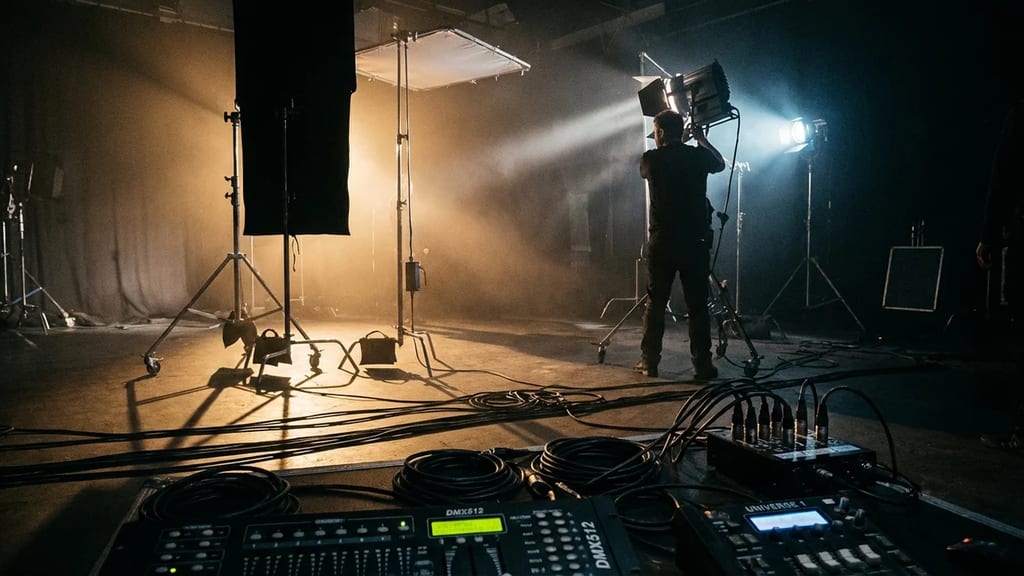
DMX512 transmits lighting control data via XLR cables at 250,000 baud to up to 512 channels per universe.

Technical Details

DMX512 operates at a voltage of 5 volts and transmits data unidirectionally from the controller to the devices via 3-pin or 5-pin XLR cables. The data rate is exactly 250,000 bits per second with a frame rate of 44 Hz. Each DMX packet contains a start code, followed by 512 8-bit data words. The maximum cable length is 500 meters without an amplifier, with a line impedance of 120 ohms. Modern variants like sACN (Streaming ACN) and Art-Net enable transmission via Ethernet networks.

History & Development

The USITT (United States Institute for Theatre Technology) developed DMX512 in 1986 as a successor to analog 0-10V control systems. The first version, DMX512/1986, was replaced in 1990 by DMX512/1990, which forms the basis still valid today. In 2004, it was standardized as ANSI E1.11-2004, and in 2008, it was revised to ANSI E1.11-2008. With increasing digitalization, Ethernet-based protocols emerged from 2005 onwards, transporting multiple DMX universes over IP networks.

Practical Application in Film

In "Blade Runner 2049" (2017), DMX512 controlled over 200 LED panels to create the futuristic city lighting, synchronized with camera movements. The lighting programming was done in advance, allowing DoP Roger Deakins to ensure identical lighting situations for multiple takes. Moving lights typically receive 16-32 DMX channels for pan, tilt, dimmer, color, and gobo control. Disadvantage: The 8-bit resolution creates visible jumps during slow fades, which is why high-end consoles use 16-bit modes via two channels.

Comparison & Alternatives

RDM (Remote Device Management) extends DMX512 with bidirectional communication for device configuration and status feedback. sACN and Art-Net transport DMX data over standard Ethernet infrastructure and theoretically enable 32,768 and 32,512 universes, respectively. Wireless DMX systems like CRMX transmit the signal wirelessly at 2.4 GHz with a latency under 5 ms. For complex installations, ETC Net3 or MA-Net replaces classic DMX with native network protocols offering higher resolution and expanded functionalities.
From the crafts

Perspectives

Cinematographer

Ich programmiere die Grundbeleuchtung vorab per DMX und kann während des Drehs präzise Korrekturen fahren, ohne dass Elektriker Scheinwerfer anfassen müssen. Bei Steadicam-Fahrten durch mehrere Räume triggere ich die Beleuchtungsszenarien über Timecode, wodurch jeder Take identisch belichtet ist. Die 256 Dimmer-Stufen reichen für die meisten Situationen, nur bei extremen Slow-Motion-Aufnahmen sehe ich manchmal Sprünge in den Fades.

Director

DMX ermöglicht mir, Lichtchoreografien wie Musikstücke zu komponieren – ich kann Stimmungswechsel auf die Sekunde genau timen und komplexe Farbverläufe programmieren, die die emotionale Reise der Charaktere unterstreichen. In Dialogszenen wechsle ich per Knopfdruck zwischen verschiedenen Beleuchtungskonzepten, je nachdem ob ich Intimität oder Spannung erzeugen will. Das spart enorm viel Zeit gegenüber manuellen Lichtanpassungen.

Producer

DMX-Konsolen kosten 15.000-80.000 Euro, amortisieren sich aber durch eingesparte Arbeitszeit der Elektriker und präzisere Beleuchtungsabläufe. Ein erfahrener Lichtoperator kann 50-100 Scheinwerfer gleichzeitig steuern, wofür ich sonst ein ganzes Team bräuchte. Bei Nachtdrehs oder komplexen Studioaufbauten reduziert sich die Setup-Zeit um 30-40%, da Szenarien vorab programmiert und gespeichert werden können.

More in the lexikon

Related terms

Test your knowledge

Quiz

1. Zu welchem Department gehört „DMX512"?

2. Wie viele verschiedene Fachperspektiven bietet dieser Eintrag?

Report an error
From the Filmfarm ecosystem

Understand visual language, budget productions, connect crew.

The Lexikon is part of the Filmfarm ecosystem — alongside budgeting (FilmBalance), an industry magazine (FilmCircus) and crew networking (FilmCall, CrewMesh). One shared vocabulary for the whole production.

FilmFarm FilmRadarComing soonFilmPulseComing soonFilmNumbersComing soonFilmCapitalComing soonFilmLabComing soonFilmBalanceComing soonFilmCircusComing soon