Technical Details
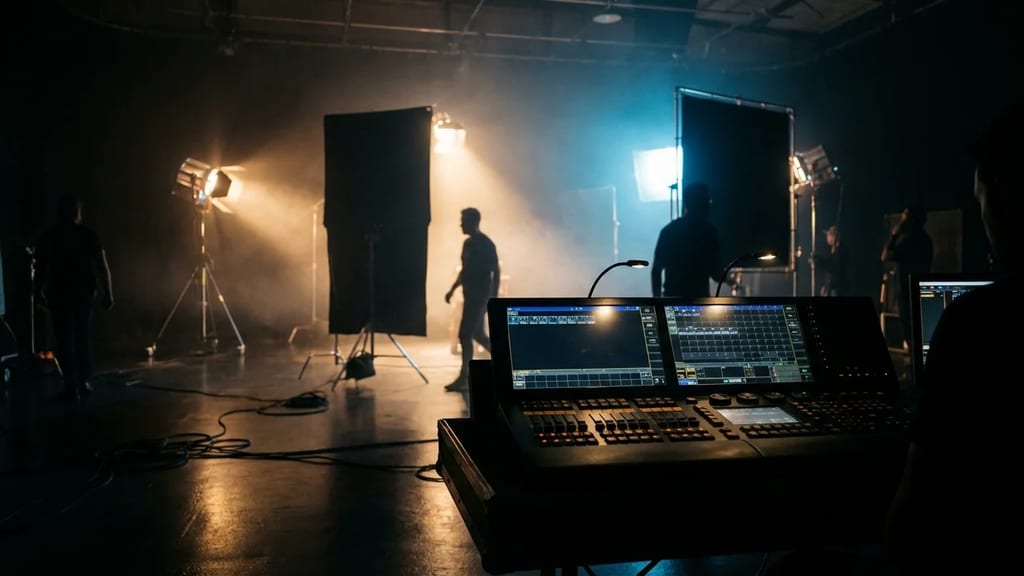
Professional film lighting consoles feature 12-48 motorized faders with 16-bit resolution (65,536 dimming levels per channel). Standard connections include 5-pin XLR for DMX-out, Ethernet for Art-Net/sACN protocols, and USB for show files. Processor power in modern devices ranges from 1-4 GB RAM with Linux or Windows-based operating systems. Two main types dominate: compact Wing Consoles with 1024 parameters and full-fledged consoles with up to 32,768 controllable attributes.
History & Development
In 1976, Strand Lighting developed the first computer-controlled lighting console, the "Light Palette," with 8-bit resolution. The breakthrough came in 1986 with the DMX512 standard, which enabled unified device communication for the first time. Wholehog introduced moving light control in 1992, while ETC established touchscreen operation with the Eos series in 1995. Since 2010, network-based systems with tablet integration and cloud synchronization have dominated.
Practical Use in Film
On "Blade Runner 2049," Gaffer Giles Nuttgens used an MA Lighting GrandMA2 to control the complex LED wall choreography in the replicant scenes. Typical film workflows utilize cue lists with 0.5-2 second crossfade times between lighting states. The console stores presets for standard setups like "Day Interior" or "Magic Hour," which the gaffer recalls with the press of a button. Disadvantage: Complex operation requires specialized operators; advantage: Millisecond-precise repeatability of lighting states for retakes.
Comparison & Alternatives
Distinction from simple dimmer packs: Lighting consoles control intelligent fixtures (moving lights, LED panels), while dimmers only regulate conventional tungsten lamps. Software solutions like Chamsys MagicQ PC are increasingly replacing hardware consoles but offer less tactile control. Tablet apps like Luminair are suitable for smaller productions with under 100 DMX channels but do not achieve the precision and speed of physical faders in complex setups.