Filmlexikon.
Support
DJI Ronin
Camera · Equipment

DJI Ronin

Murnau AI illustration
gimbal steadicam m 1 steadicam m 2 steadicam operator steadicam volt steadicam tiffen steadicam dji ronin 2

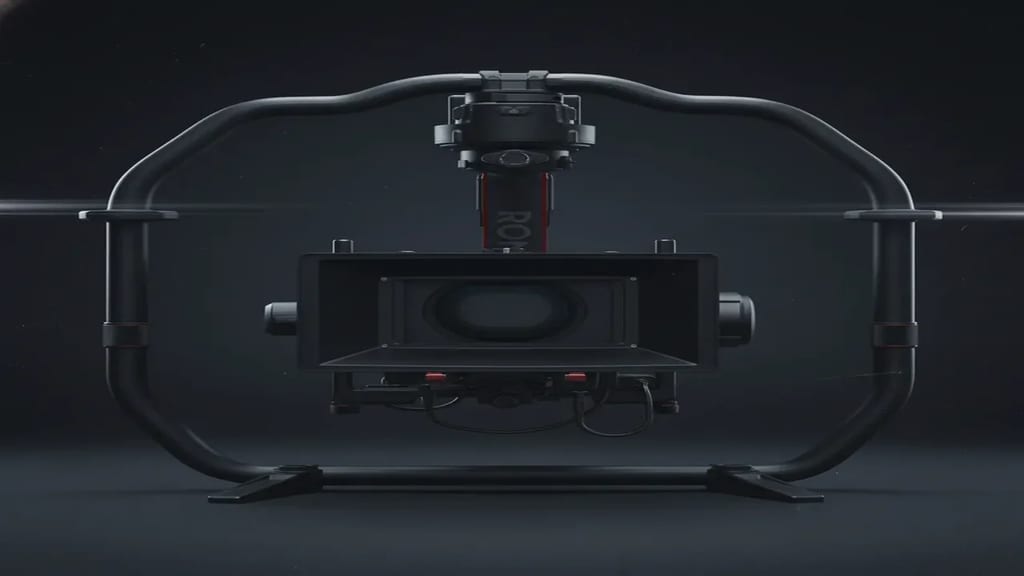
DJI gimbal system with 3-axis stabilization for cameras up to 13.6 kg, often replacing Steadicam with brushless motors and 4096-step resolution per axis.

Technical Details

The original Ronin features a maximum tilt speed of 90°/s and utilizes 32-bit ARM processors for its stabilization algorithms. The carbon fiber chassis weighs 3.3 kg and can support cameras ranging from RED Epic to Canon 5D Mark III. Three brushless motors control the roll, pitch, and pan axes with a resolution of 4096 steps per revolution. Power is supplied by interchangeable TB47S batteries with a 4500 mAh capacity. Subsequent models like the Ronin 2 support payloads up to 13.6 kg and offer GPS tracking as well as 360° continuous rotation on all axes.

History & Development

DJI introduced the first Ronin at NAB in 2014, thereby conquering the handheld gimbal market previously dominated by MōVI Systems. The Chinese company adapted its drone stabilization technology for larger cameras and offered the system for $2,999 – significantly cheaper than the $15,000 competition. In 2015, the more compact Ronin-M followed, the Ronin 2 with improved payload in 2017, and the Ronin-S for DSLR cameras in 2019. The current RS series (2020) integrates ActiveTrack technology and smartphone integration.

Practical Use in Film

Cinematographer Emmanuel Lubezki used the Ronin in "The Revenant" (2015) for its famous tracking shots through difficult terrain, where conventional Steadicam systems would have failed. For "1917" (2019), Roger Deakins combined multiple Ronin systems for seamless transitions between different set areas. The gimbal enables low-mode shots 30 cm above the ground as well as overhead shots without a crane. Typical workflows include balancing before shooting begins, calibrating the IMU sensors, and programming repeatable moves using the DJI Assistant software.

Comparison & Alternatives

The Ronin primarily competes with Freefly Systems MōVI Pro, Zhiyun Crane series, and RED DSMC2 Stabilizer. While MōVI offers a higher payload (32 kg), the Ronin excels in user-friendliness and value for money. For smaller productions, the Ronin often replaces Steadicam rigs; for large productions, it complements traditional dolly and crane setups. Technocranes and Libra Heads remain standard for heavy cinema cameras over 20 kg, while the Ronin bridges the gap between handheld and mechanical stabilization systems.
From the crafts

Perspectives

Cinematographer

Als DoP schätze ich am Ronin besonders die präzise Horizontkontrolle bei extremen Kamerabewegungen, die mir völlig neue Einstellungsgrößen ermöglicht – von Macro-Details bis zu weiten Landschaftsfahrten in einem einzigen Take. Die direkte Haptik des Controllers gibt mir die gleiche intuitive Bildkontrolle wie beim freihändigen Arbeiten, nur eben stabilisiert. Einziger Kritikpunkt: Bei Wind über 15 km/h kämpft das System merklich gegen die Naturkräfte.

Director

Der Ronin hat meine Inszenierungssprache revolutioniert, weil ich endlich Subjective-Camera-Shots über längere Sequenzen fahren kann, ohne dass das Publikum seekrank wird. Besonders bei Thriller-Projekten nutze ich die nahtlosen 360°-Schwenks für Paranoia-Momente, wo die Kamera den Protagonisten umkreist. Die Wiederholbarkeit programmierter Fahrten spart mir unzählige Takes beim Schnitt zwischen verschiedenen Einstellungsgrößen.

Producer

Ein Ronin-Setup kostet mich täglich 180 Euro Miete plus 400 Euro für einen qualifizierten Operator – deutlich günstiger als ein Steadicam-Team mit 800 Euro Tagessatz. Die Zeitersparnis ist noch wichtiger: Statt 20 Minuten Dolly-Aufbau schaffe ich komplexe Fahrten in 5 Minuten Setup-Zeit. Allerdings plane ich immer 30% Puffer für Akku-Wechsel und Re-Balancing ein, besonders bei Objektiv-Changes.

More in the lexikon

Related terms

Test your knowledge

Quiz

1. Was beschreibt „DJI Ronin" am besten?

2. Zu welchem Department gehört „DJI Ronin"?

3. Wie viele verschiedene Fachperspektiven bietet dieser Eintrag?

Report an error
From the Filmfarm ecosystem

Understand visual language, budget productions, connect crew.

The Lexikon is part of the Filmfarm ecosystem — alongside budgeting (FilmBalance), an industry magazine (FilmCircus) and crew networking (FilmCall, CrewMesh). One shared vocabulary for the whole production.

FilmFarm FilmRadarComing soonFilmPulseComing soonFilmNumbersComing soonFilmCapitalComing soonFilmLabComing soonFilmBalanceComing soonFilmCircusComing soon