Filmlexikon.
Support
Steadicam Operator
Camera · Terms

Steadicam Operator

Murnau AI illustration
gimbal steadicam m 1 steadicam m 2 steadicam volt steadicam tiffen steadicam dji ronin 2 dji ronin 4d

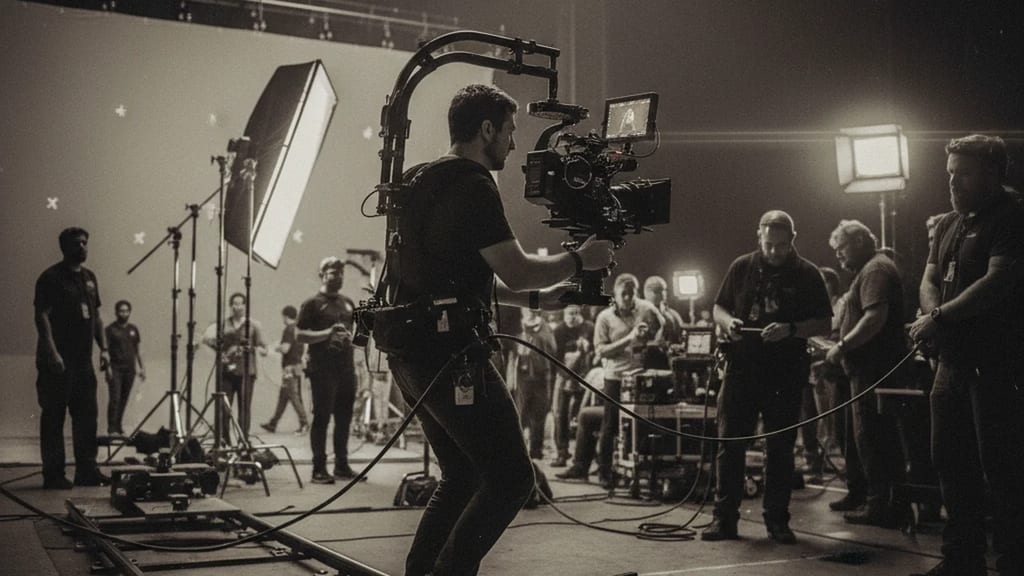
Camera operator specialized in Steadicam systems, using gyroscopic stabilization and counterweighted arms to achieve smooth, fluid camera movements through complex environments without traditional tracks or cranes.

Technical Details

The Steadicam system operates with a two-axis gimbal that decouples the camera from the operator's movements. The spring arm compensates for vertical movements with a spring tension of 20-80 pounds. The counterweight at the bottom of the system typically weighs 8-15 kg and ensures a low center of gravity. Modern systems like the Steadicam Ultra2 can carry cameras up to 45 kg with an operating time of 8-12 hours. The system requires precise balancing in three planes: static, dynamic, and inertial.

History & Development

Garrett Brown developed the first Steadicam system in 1973-1975 and first demonstrated it with his famous run up the "Rocky Steps." The first commercial use was in 1976 in "Bound for Glory," followed by Stanley Kubrick's "The Shining" (1980) with its iconic hotel corridor sequences. In 1978, Brown received an Academy Technical Achievement Award. In the 1990s, more compact systems like the Steadicam JR emerged for lighter cameras. Since 2010, digital gimbal systems have dominated the market for smaller productions, while Steadicam remains the standard for high-end productions.

Practical Use in Film

Steadicam enables complex shots like Paul Thomas Anderson's 2:37-minute opening sequence in "Boogie Nights" or the chase through the kitchen and restaurant in "Goodfellas." The operator can climb stairs, navigate through tight spaces, or film from moving vehicles. Typical applications include walkings, crane-up/down movements without a crane, and 360-degree circling shots. Preparation requires 30-45 minutes of balancing time per camera change. Disadvantages include the physical strain on the operator and limitations with rapid pans exceeding 90 degrees.

Comparison & Alternatives

Modern 3-axis gimbals like DJI Ronin or MoVI offer similar stabilization with less weight but do not achieve the smoothness of a professional Steadicam system. Camera drones replace Steadicam for exterior shots with large differences in elevation. Spidercam systems are used for complex sports broadcasts. For a handheld look without perfect stabilization, cinematographers consciously opt for free-hand camera work. Steadicam remains the first choice for long takes in controlled environments and when maximum image stability with simultaneous flexibility is required.
From the crafts

Perspectives

Cinematographer

Für mich ist der Steadicam-Operator ein zusätzliches Kreativwerkzeug, das mir ermöglicht, komplexe Kamerabewegungen zu realisieren, die mit Dolly oder Handheld unmöglich wären. Ich kann fließende Übergänge zwischen verschiedenen Brennweiten schaffen und gleichzeitig die absolute Kontrolle über Schärfeverlauf und Bildkomposition behalten, da die Kamera trotz Bewegung präzise positionierbar bleibt.

Director

Der Steadicam-Operator erweitert meine narrative Palette um die Möglichkeit, Charaktere durch Räume zu begleiten und dabei die emotionale Intensität durch ungebrochene Realzeit zu steigern. Ich kann Zuschauer direkt in die Handlung hineinziehen, besonders bei Verfolgungsszenen oder intimen Dialogen, wo traditionelle Schnitte die Spannung unterbrechen würden.

Producer

Ein erfahrener Steadicam-Operator kostet 800-1200 Euro pro Drehtag plus Equipment, spart aber oft teure Dolly-Aufbauten und reduziert Drehzeit durch weniger Setups. Bei komplexen Sequenzen amortisiert sich die Investition durch eingesparte Drehtage, allerdings muss ich zusätzliche Vorbereitungszeit und einen physisch anspruchsvollen 10-12-Stunden-Tag einkalkulieren.

More in the lexikon

Related terms

Test your knowledge

Quiz

1. Was beschreibt „Steadicam-Operator" am besten?

2. Zu welchem Department gehört „Steadicam-Operator"?

3. Wie viele verschiedene Fachperspektiven bietet dieser Eintrag?

Report an error
From the Filmfarm ecosystem

Understand visual language, budget productions, connect crew.

The Lexikon is part of the Filmfarm ecosystem — alongside budgeting (FilmBalance), an industry magazine (FilmCircus) and crew networking (FilmCall, CrewMesh). One shared vocabulary for the whole production.

FilmFarm FilmRadarComing soonFilmPulseComing soonFilmNumbersComing soonFilmCapitalComing soonFilmLabComing soonFilmBalanceComing soonFilmCircusComing soon