Filmlexikon.
Support
Steadicam M-1
Camera · Terms

Steadicam M-1

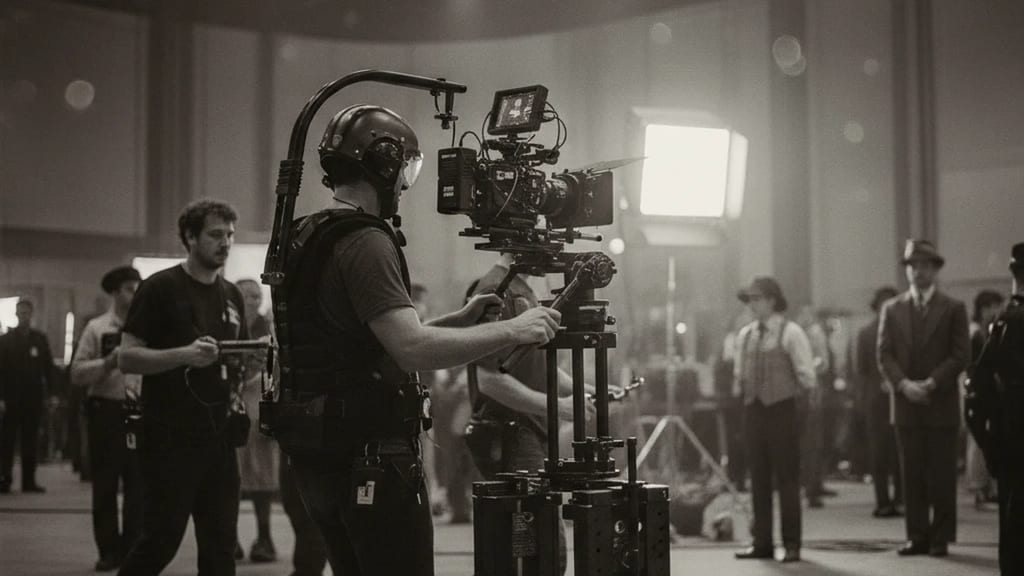
Murnau AI illustration
gimbal steadicam m 2 steadicam operator steadicam volt steadicam tiffen steadicam dji ronin 2 dji ronin 4d

Garrett Brown's mechanical camera stabilization rig (1976), weighing 25–35 kg; enables smooth tracking shots without rails via spring-loaded parallelogram arms and gimbal suspension.

Technical Details

The fully equipped M-1 system weighs between 25-35 kg, with the camera sled alone reaching 8-12 kg. The isoelastic arm brace uses sprung parallelograms made of aluminum with a weight capacity of 3-17 kg for the camera. The gimbal operates with precision-bearing gimbal rings made of anodized aluminum. The battery packs supply 12V/24V DC power via Anton/Bauer connectors. The system allows for tilts of ±30° and unlimited pan movements. The basic configuration supported 16mm cameras like the Arriflex 16SR, and later 35mm models.

History & Development

Garrett Brown invented the Steadicam in 1973 and founded Cinema Products Corporation in 1975 for its marketing. The M-1 debuted in 1976 in "Bound for Glory" under Haskell Wexler. Its commercial breakthrough came with the famous Rocky staircase sequence in the same year. In 1978, Stanley Kubrick revolutionized Steadicam storytelling with the Overlook Hotel tracking shots in "The Shining." Cinema Products was acquired by Tiffen in 1987, who continuously developed the system. The M-1 remained the industry standard until the 1990s.

Practical Use in Film

The M-1 enabled fluid camera movements through tight spaces, stairs, and difficult terrain for the first time, without tracks or cranes. In "Goodfellas" (1990), Michael Ballhaus realized the legendary Copacabana shot through the kitchen and cellar in one take. The system requires specially trained Steadicam operators, as its use demands considerable physical condition and technical understanding. Typical shooting days with the M-1 were limited to 6-8 hours due to the physical strain.

Comparison & Alternatives

The M-1 differs from modern electronic gimbals through its purely mechanical operating principle and the characteristic "Steadicam movement" with slight pendulum motions. Successors like the Steadicam Ultra, Master Series, or modern alternatives like MōVI systems offer electronic stabilization and lower weight. For classic Steadicam aesthetics with organic movements, the mechanical principle of the M-1 remains irreplaceable, while electronic systems provide more precise image stabilization with less characteristic motion language.
From the crafts

Perspectives

Cinematographer

Das M-1 zwingt mich zu bewusster, fließender Bildkomposition, da abrupte Bewegungen durch die Trägheit des Systems gedämpft werden. Die mechanische Stabilisierung erzeugt eine organische Bewegungsqualität, die elektronische Gimbals nicht replizieren können - diese leichten Pendelungen werden zum visuellen Signature meiner Kameraarbeit.

Director

Mit dem Steadicam M-1 kann ich dem Zuschauer das Gefühl geben, unsichtbar durch meine Szenen zu schweben und Charaktere zu verfolgen, ohne dass Schnitte die Immersion unterbrechen. Die Möglichkeit, kontinuierlich von Low-Angle zu High-Angle zu wechseln oder durch Menschenmengen zu gleiten, eröffnet völlig neue narrative Dimensionen für Sequenzpläne.

Producer

Das M-1 bedeutet zusätzliche 800-1200 Euro Tagesmiete plus spezialisierte Operator-Honorare ab 600 Euro täglich, reduziert aber Aufbauzeiten für komplexe Kamerafahrten erheblich. Statt drei Stunden Schienenaufbau kann der Steadicam-Operator sofort drehen, was bei engen Drehplänen entscheidend wird - allerdings limitiert die körperliche Belastung die Anzahl der Takes pro Tag.

More in the lexikon

Related terms

Test your knowledge

Quiz

1. Was beschreibt „Steadicam M-1" am besten?

2. Zu welchem Department gehört „Steadicam M-1"?

3. Wie viele verschiedene Fachperspektiven bietet dieser Eintrag?

Report an error
From the Filmfarm ecosystem

Understand visual language, budget productions, connect crew.

The Lexikon is part of the Filmfarm ecosystem — alongside budgeting (FilmBalance), an industry magazine (FilmCircus) and crew networking (FilmCall, CrewMesh). One shared vocabulary for the whole production.

FilmFarm FilmRadarComing soonFilmPulseComing soonFilmNumbersComing soonFilmCapitalComing soonFilmLabComing soonFilmBalanceComing soonFilmCircusComing soon