Filmlexikon.
Support
Tiffen Steadicam
Camera · Terms

Tiffen Steadicam

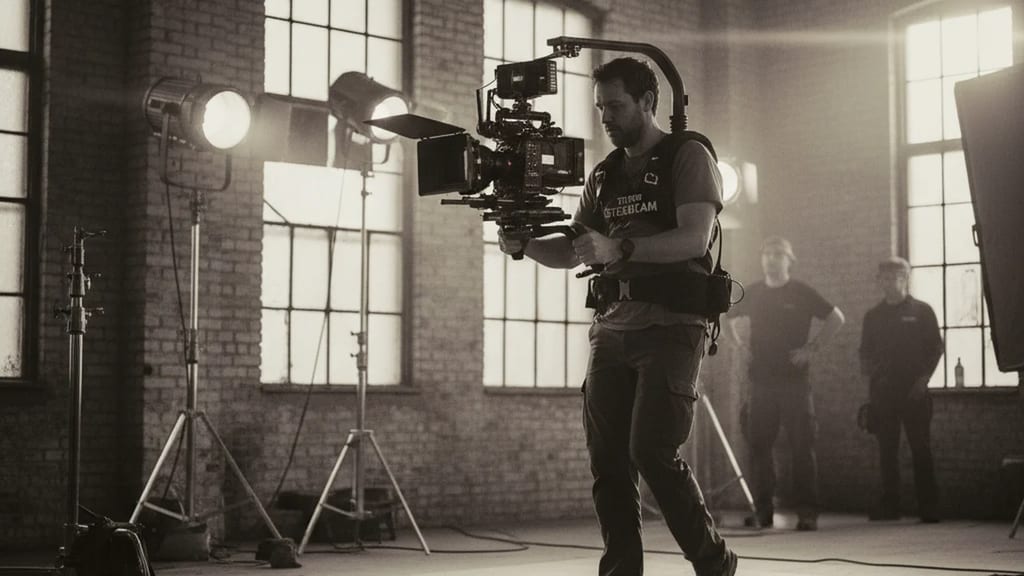
Murnau AI illustration
gimbal steadicam m 1 steadicam m 2 steadicam operator steadicam volt steadicam dji ronin 2 dji ronin 4d

Tiffen Steadicam: camera stabilization rig with spring-loaded arm and gimbal, supporting 1–30 kg payloads and reducing vibration by up to 90%.

Technical Details

Modern Tiffen Steadicam systems can carry camera weights between 1-30 kg, with the overall system typically weighing 1.5-2 times the camera's weight. The Iso-Elastic Arm utilizes pneumatic dampers and reduces vertical movement by up to 90%. The gimbal employs precision-bearing gimbals with adjustable friction for pan, tilt, and roll axes. Professional models like the Steadicam Ultra2 feature a 18-inch vertical operating range and allow tilt angles from +90° to -90°. Battery power ranges from 12-24V with runtimes of 2-4 hours depending on configuration.

History & Development

Garrett Brown invented the Steadicam system in 1975 and first demonstrated it in "Bound for Glory" (1976). The breakthrough came with Stanley Kubrick's "The Shining" (1980), where the iconic hotel corridor shots were created. Tiffen acquired the Steadicam division from Cinema Products Corporation in 2000. Significant development leaps occurred in 1981 with the Model III, 1994 with the Master Series, and 2010 with digital monitoring systems. The current Ultra2 series (since 2015) integrates wireless video transmission and GPS tracking.

Practical Use in Film

Steadicam enables complex, fluid camera movements without tracks or cranes. Martin Scorsese's "Goodfellas" (1990) utilized a 3-minute Steadicam sequence through the Copacabana restaurant. "Rocky" (1976) established the famous stair runs, while "Boogie Nights" (1997) employed 360° pans in clubs. The operator wears a 15-25 kg vest system and requires special Steadicam certification. Typical shooting days require 2-3 operators in rotation due to the physical strain.

Comparison & Alternatives

Steadicam differs from handheld stabilizers (DJI Ronin, MōVI) through its body mounting and greater inertial mass. While electronic gimbals offer more precise stabilization, Steadicam creates the characteristic "floating" movement with a slight float effect. Modern alternatives include crane systems (Technocrane), dolly shots, or drone footage. Steadicam remains indispensable for tight spaces, staircases, or crowds where other systems fail.
From the crafts

Perspectives

Cinematographer

Ich setze Steadicam gezielt für organische Bewegungen ein, die den Zuschauer emotional in die Handlung ziehen - der leichte Float verleiht Sequenzen eine traumhafte Qualität, die mit statischen Setups unmöglich ist. Das System erfordert jedoch intensive Vorbereitung beim Ausbalancieren und präzise Kommunikation mit meinem Operator, da Brennweiten-Änderungen das gesamte Gleichgewicht beeinflussen.

Director

Steadicam ist mein Werkzeug für subjektive Erzählperspektiven - ich kann den Zuschauer buchstäblich durch die Augen meiner Protagonisten sehen lassen und komplexe Räume in einer einzigen, fließenden Bewegung erschließen. Die Technik erzeugt eine intime Nähe zu den Charakteren, gleichzeitig verleiht sie Actionszenen eine kinetische Energie, die statische Kameras nicht erreichen.

Producer

Steadicam-Drehtage kosten 800-1.500 Euro zusätzlich für Equipment und Operator, sparen aber oft teure Dolly-Aufbauten und reduzieren die Drehzeit durch weniger Schnitte pro Sequenz. Ich plane grundsätzlich Pufferzeiten ein, da komplexe Steadicam-Shots mehrere Takes benötigen und die körperliche Belastung des Operators Pausenzeiten erfordert.

More in the lexikon

Related terms

Test your knowledge

Quiz

1. Was beschreibt „Tiffen Steadicam" am besten?

2. Zu welchem Department gehört „Tiffen Steadicam"?

3. Wie viele verschiedene Fachperspektiven bietet dieser Eintrag?

Report an error
From the Filmfarm ecosystem

Understand visual language, budget productions, connect crew.

The Lexikon is part of the Filmfarm ecosystem — alongside budgeting (FilmBalance), an industry magazine (FilmCircus) and crew networking (FilmCall, CrewMesh). One shared vocabulary for the whole production.

FilmFarm FilmRadarComing soonFilmPulseComing soonFilmNumbersComing soonFilmCapitalComing soonFilmLabComing soonFilmBalanceComing soonFilmCircusComing soon