Filmlexikon.
Support
Digital Matte Painting
VFX · Terms

Digital Matte Painting

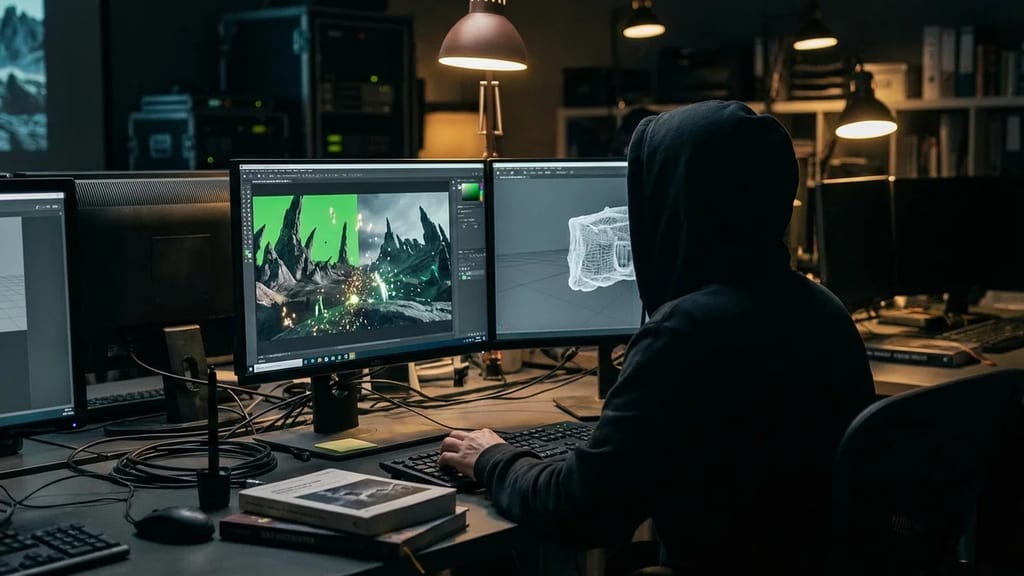
Murnau AI illustration
compositing keying green screen blue screen chroma key roto rotoscoping clip on matte box

Digital artwork creating or extending environments that would be impractical to build or film.

Technical Details

Digital Matte Paintings are typically created in resolutions ranging from 4096×2160 to 7680×4320 pixels to allow for camera movement and reframing. Standard software includes Photoshop for 2D work, Nuke for compositing, and increasingly 3D programs like Maya or Blender for 2.5D projections. Typical workflow steps: Camera Tracking, 3D Layout creation, Matte Painting in layers (foreground, midground, background), parallax simulation through projection onto 3D geometry. Color depth is by default 16-bit per channel, and 32-bit float for HDR workflows.

History & Development

The first digital matte painting was created in 1985 for "Young Sherlock Holmes" at Industrial Light & Magic. In 1993, "Jurassic Park" revolutionized the technique with fully computer-generated environments. In 2000, "Gladiator" introduced 2.5D projections, enabling camera movement within painted environments. From 2005 onwards, "Sin City" established full digital backlot production. Today, matte paintings are increasingly merging with environment modeling and are supplemented by AI tools like Stable Diffusion for concept phases.

Practical Application in Film

"Lord of the Rings" utilized over 200 digital matte paintings for Middle-earth landscapes, often based on New Zealand photography. "Blade Runner 2049" combined practical miniature sets with digital extensions for futuristic cityscapes. Typical workflow: On-set, clean plates and HDRI spheres are captured for lighting reference, followed by 3D tracking of the camera. Advantages: Cost savings compared to set construction or location shoots. Disadvantages: Time-consuming post-production and limited interaction of actors with the environment.

Comparison & Alternatives

Distinction from Environment Modeling: Matte paintings are based on painted/photographic elements, while 3D environments are based on geometric models. Virtual Production with LED walls (Volume technology) is increasingly displacing matte paintings as it allows for real-time rendering and natural lighting moods on set. Concept art remains purely illustrative for planning purposes, whereas matte paintings deliver final rendered film images. Set extensions only augment existing practical sets, while complete matte paintings replace entire environments.
From the crafts

Perspectives

Cinematographer

Ich muss bereits beim Dreh die späteren Matte Painting-Extensions mitdenken und entsprechende Clean Plates ohne Schauspieler aufnehmen. Die Beleuchtung des praktischen Sets muss zur geplanten digitalen Umgebung passen, weshalb ich eng mit dem Matte Painting-Supervisor zusammenarbeite, um HDRI-Referenzen und Farbtemperaturen abzustimmen. Camera Tracking-Marker am Set erleichtern mir später die Integration.

Director

Digitale Matte Paintings geben mir völlige kreative Freiheit bei der Gestaltung von Schauplätzen, die praktisch unmöglich oder unbezahlbar wären – von außerirdischen Landschaften bis zu historischen Rekonstruktionen. Ich kann in der Postproduktion noch Stimmungen und Bildkompositionen anpassen, muss aber bereits am Set die Schauspielerführung für unsichtbare Umgebungen präzise planen. Die Gefahr liegt darin, dass zu viele nachträgliche Änderungen den Zeitplan sprengen.

Producer

Ein qualitativ hochwertiges Matte Painting kostet zwischen 15.000-50.000 Euro und benötigt 3-8 Wochen Produktionszeit, verglichen mit mehreren 100.000 Euro für entsprechende Set-Bauten oder Location-Kosten. Ich kalkuliere 20% Buffer für Revision-Zyklen ein, da Regisseure oft nachträgliche Änderungen wünschen. Die Vorlaufzeit in der Preproduktion ist entscheidend – Concept Art muss früh stehen, damit die Matte Painting-Teams parallel zum Dreh arbeiten können.

More in the lexikon

Related terms

Test your knowledge

Quiz

1. Was beschreibt „Digitales Matte Painting" am besten?

2. Zu welchem Department gehört „Digitales Matte Painting"?

3. Wie viele verschiedene Fachperspektiven bietet dieser Eintrag?

Report an error
From the Filmfarm ecosystem

Understand visual language, budget productions, connect crew.

The Lexikon is part of the Filmfarm ecosystem — alongside budgeting (FilmBalance), an industry magazine (FilmCircus) and crew networking (FilmCall, CrewMesh). One shared vocabulary for the whole production.

FilmFarm FilmRadarComing soonFilmPulseComing soonFilmNumbersComing soonFilmCapitalComing soonFilmLabComing soonFilmBalanceComing soonFilmCircusComing soon