Filmlexikon.
Support
Contax Planar 50
Camera · Terms

Contax Planar 50

Murnau AI illustration
flow para roll take

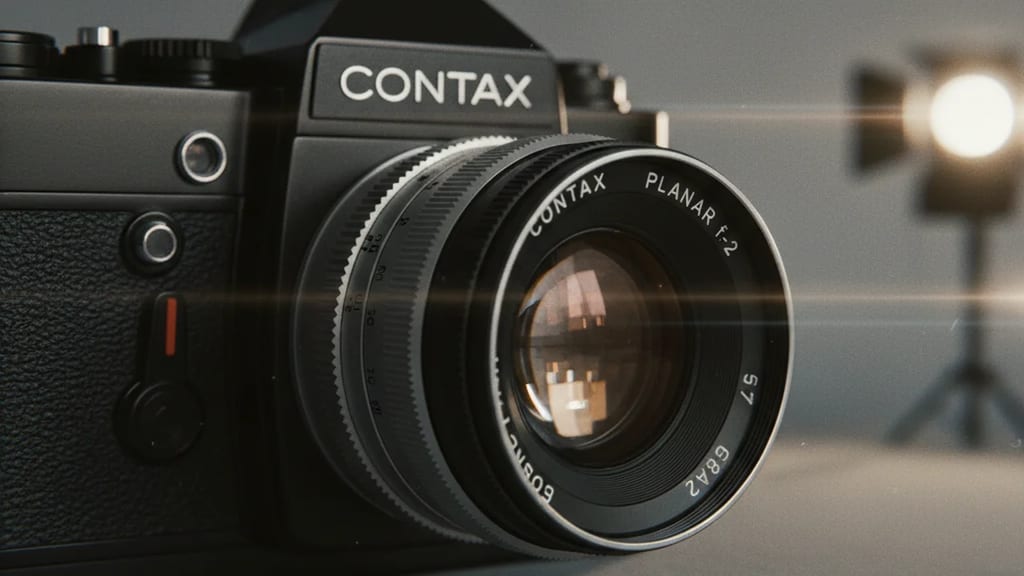
Zeiss 50mm f/1.4 prime lens renowned for natural perspective, distinctive bokeh rendering, and even focus transition in portrait cinematography.

Technical Details

The lens features 6 elements in 4 groups with a minimum focusing distance of 35 cm. The filter thread is 55mm, and the weight is 265g. The aperture from f/1.4 to f/16 is controlled by 6 aperture blades. The Zeiss T* coating significantly reduces stray light and reflections. Versions were available for the Contax/Yashica mount (C/Y) as well as the later Zeiss ZE/ZF series for Canon EF and Nikon F-mount.

History & Development

Carl Zeiss developed the original Planar design in 1896; the Contax Planar 50mm f/1.4 first appeared in 1975 for the Contax RTS. After Kyocera acquired Contax in 2005, Zeiss continued the lens line as the independent ZE/ZF series. In 2018, Zeiss ceased manual lens production for SLRs, focusing on autofocus lenses for mirrorless systems.

Practical Use in Film

The Contax Planar 50 was frequently used for portrait shots and more intimate scenes due to its natural perspective and characteristic bokeh. The shallow depth of field at its widest aperture of f/1.4 allows for precise focus pulling and atmospheric subject isolation. Cinematographers appreciate its even sharpness distribution across the entire image field and its neutral color rendition without warm or cool tints. In available light situations, the lens's high speed allows for shots without additional lighting.

Comparison & Alternatives

Compared to the Canon 50mm f/1.4 USM, the Contax Planar offers higher micro-contrast and less chromatic aberration. The Leica Summilux-R 50mm f/1.4 surpasses it in resolution but costs three times as much. Modern alternatives like the Sigma 50mm f/1.4 DG HSM Art offer autofocus and better edge sharpness but do not achieve the characteristic rendering quality of the Zeiss design. For digital productions, mirrorless systems with native 50mm lenses have largely replaced the manual Contax Planar.

From the crafts

Perspectives

Cinematographer

Ich setze das Contax Planar 50 gezielt für organische Hautdarstellung ein, da es Poren und Strukturen weicher rendert als moderne scharfzeichnende Objektive. Die gleichmäßige Vignettierung bei Offenblende hilft mir, Gesichter natürlich zu modellieren, ohne dass ich mit Flaggen arbeiten muss.

Director

Das charakteristische Bokeh des Planar 50 unterstützt meine Erzählung durch sanfte Übergänge zwischen Schärfe und Unschärfe - besonders in emotionalen Nahaufnahmen isoliere ich Charaktere subtil vom Hintergrund. Die neutrale Farbgebung lässt mir mehr Spielraum in der Postproduktion für gezieltes Color Grading.

Producer

Ein gebrauchtes Contax Planar 50 kostet etwa 400-600 Euro und amortisiert sich schnell gegenüber Mietobjektiven bei längeren Drehs. Da keine Lizenzgebühren für Autofokus-Patente anfallen und die Reparatur durch Zeiss-Service günstig ist, rechnet sich die Anschaffung für Produktionen mit wiederkehrenden Portraitaufnahmen.

More in the lexikon

Related terms

Test your knowledge

Quiz

1. Zu welchem Department gehört „Contax Planar 50"?

2. Wie viele verschiedene Fachperspektiven bietet dieser Eintrag?

Report an error
From the Filmfarm ecosystem

Understand visual language, budget productions, connect crew.

The Lexikon is part of the Filmfarm ecosystem — alongside budgeting (FilmBalance), an industry magazine (FilmCircus) and crew networking (FilmCall, CrewMesh). One shared vocabulary for the whole production.

FilmFarm FilmRadarComing soonFilmPulseComing soonFilmNumbersComing soonFilmCapitalComing soonFilmLabComing soonFilmBalanceComing soonFilmCircusComing soon