Technical Details
The lens uses a 6-element in 4-group construction with a Planar design, minimizing spherical and chromatic aberrations. The minimum focus distance is 85cm, and the filter thread diameter is 72mm. With a weight of 570g and a length of 82mm, it is among the more compact fast telephoto lenses. The aperture operates in half-stop increments from f/1.4 to f/16, and the lens hood reduces lens flares by approximately 90% compared to unprotected shots. Various versions exist for the Contax/Yashica mount, and later also for Canon EF and other systems.
History & Development
Carl Zeiss introduced the first Planar 85mm f/1.4 in 1975 for the Contax RTS system, based on calculations by Erhard Glatzel. The optic quickly established itself as a benchmark for portrait lenses and was produced virtually unchanged until 2005. After the discontinuation of Contax cameras in 2005, Zeiss licensed the design to various manufacturers. Today, Zeiss produces the design as "Planar T* 85mm f/1.4" for Canon and Nikon mounts, with the optical formula remaining nearly identical.
Practical Use in Film
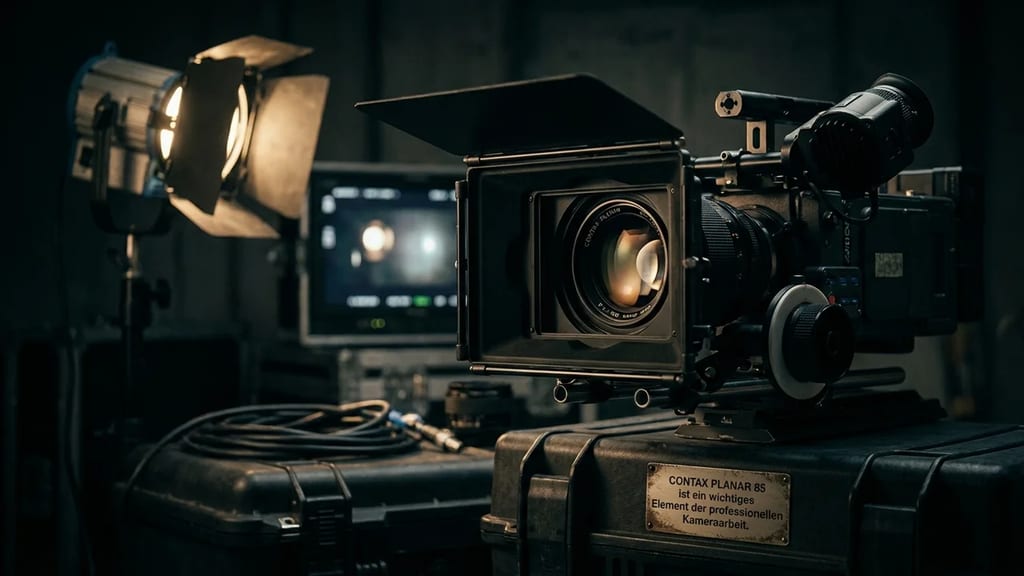
Cinematographers appreciate the Contax Planar 85 for close-ups and portraits, as it produces a characteristic bokeh with smooth transitions at wide apertures. Its high resolution of over 60 line pairs per millimeter makes it ideal for 35mm film productions. Roger Deakins used adapted Zeiss optics for several productions, and Gordon Willis employed similar focal lengths for the characteristic close-ups in "The Godfather." The lens is particularly suitable for available light situations, as it still delivers usable image quality at f/1.4, while most competing products only reach their optimal sharpness from f/2.0 onwards.
Comparison & Alternatives
Compared to modern designs like the Canon 85mm f/1.2L or Sony FE 85mm f/1.4 GM, the Contax Planar exhibits less contrast but a more organic color rendition. The Zeiss Otus 85mm f/1.4 is based on a completely new design and achieves higher resolution, but costs three times as much. For film productions, it competes with the Cooke S4 85mm T2.0, which is specifically optimized for cinematography but is less fast. Vintage examples of the Contax version command collector prices today, while the modern ZE/ZF versions offer the same optical performance at a third of the price.