Technical Details
Film color palettes are mostly defined in the HSB (Hue-Saturation-Brightness) color space, with complementary color schemes having a color distance of 180°. Monochromatic palettes vary saturation and brightness with constant hue, while triadic schemes use three evenly distributed colors (120° distances). In digital post-production, implementation is done via LUTs (Look-Up Tables) with 33³ or 65³ data points. Analog-complementary palettes use color distances of 150-210°, split-complementary schemes use a main hue plus two adjacent complementary colors.
History & Development
Conscious color design began in 1935 with "Becky Sharp," the first three-strip Technicolor film. Natalie Kalmus, as a Technicolor consultant, established the first systematic color guidelines. In the 1970s, cinematographers like Gordon Willis ("The Godfather") developed characteristic color signatures. Since the 1990s, digital tools like DaVinci Resolve have enabled precise color manipulation. The "Orange-Teal Look" dominated blockbuster productions from 2000 onwards, while modern colorists like Stefan Sonnenfeld develop individual color languages for franchises.
Practical Application in Film
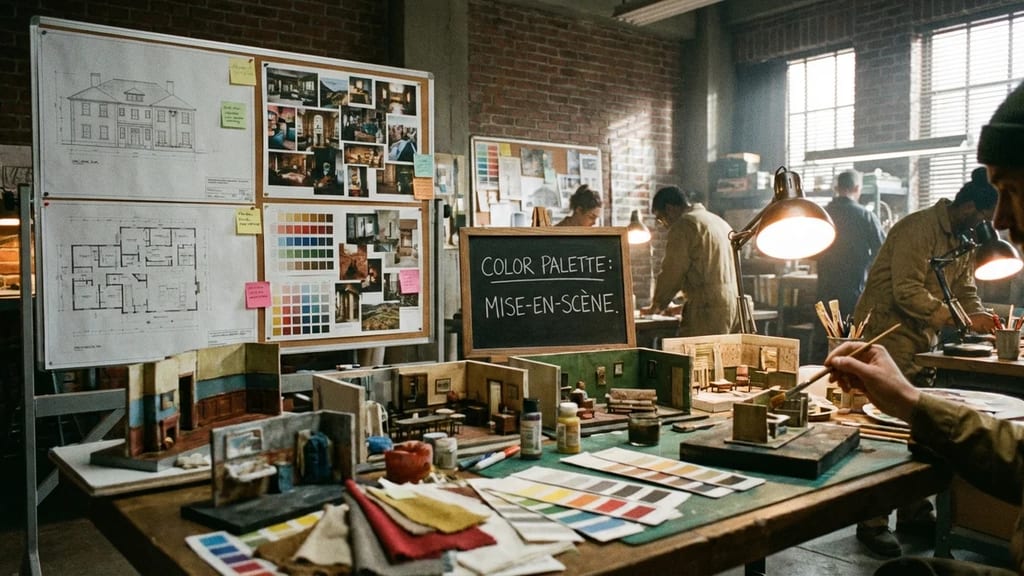
Wes Anderson uses symmetrical color palettes with precisely defined Pantone colors per scene. "Mad Max: Fury Road" (2015) employs a four-color palette: Orange (desert), Blue (night/water), Silver (vehicles), Red (blood/danger). "Her" (2013) works with warm red tones (2700K-3200K color temperature) for intimacy. The color palette is determined during production design, enhanced through set lighting, and finalized in post-production via color grading. Costume designers and set designers receive color samples according to RAL or Pantone standards.
Comparison & Alternatives
Color palettes differ from color grading, which alters existing footage in post-production, whereas palettes are implemented during production. Color temperature only describes the warm-cool characteristic of light (2000K-10000K), while palettes encompass the entire color spectrum. LUTs are technical implementation tools, not creative concepts. Modern HDR productions (Rec. 2020) expand available color spaces by 75% compared to Rec. 709, but enable more complex palette management across multiple output formats.