Filmlexikon.
Support
Cool Colors
Art Department · Terms

Cool Colors

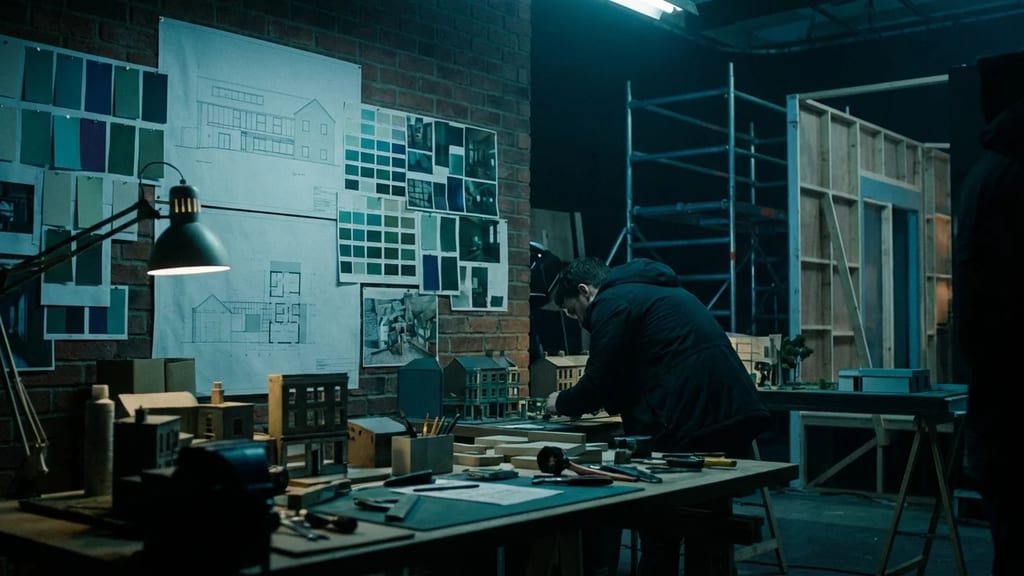
Murnau AI illustration
warm colors cool color contrast triadic colors color scheme analogous colors

Cool Colors: hues in the blue-cyan-green spectrum (450–490nm) achieved through 4000–5600K lighting or color correction with boosted blue channels.

Technical Details

Digital cinema cameras capture cool colors through sensors with increased blue sensitivity at 450-490nm. In color correction, cool looks are generated by shifting the white balance to 3200-4500 Kelvin, while shadow-midtone-highlight correction specifically enhances the blue and cyan channels. LUTs (Look-Up Tables) for cool grading typically use lift values from +0.02 to +0.08 in the blue channel. LED panels for cool light operate with CRI values above 95 at color temperatures between 5600-6500 Kelvin.

History & Development

The deliberate use of cool colors in film began in 1935 with the first three-strip Technicolor process in "Becky Sharp." Director Rouben Mamoulian was the first to systematically use blue hues for emotional sequences. In 1982, "Blade Runner" under Ridley Scott introduced the "Bleach Bypass" process, which enhanced cool silver tones. With digital color correction from 2000 onwards, the "Teal and Orange Look" became established, contrasting cool blue-green tones with warm skin tones.

Practical Application in Film

Denis Villeneuve consistently uses 4000 Kelvin lighting with an additional cyan shift of +15 points in DaVinci Resolve in "Blade Runner 2049" (2017). Christopher Nolan employs cool 5600K HMI lights without CTB filters in "Dunkirk" to emphasize the coldness of the water. The workflow requires precise Kelvin settings on set, as subsequent corrections exceeding 500 Kelvin can amplify image noise. Cool colors reduce perceived image depth by 15-20%, which Steadicam operators must compensate for during camera movements.

Comparison & Alternatives

Cool colors differ from neutral grays by having a saturation above 10% on the vectorscope. Warm colors (3200K and below) produce opposite psychological effects and are preferred for intimate scenes. Modern HDR workflows with the Rec.2020 color space expand cool colors by 35% compared to Rec.709, but full representation is only possible on OLED displays. Desaturated cool colors ("Bleached Look") are increasingly replacing the classic blue-cyan look, as they are more consistently reproducible across different output formats.

From the crafts

Perspectives

Cinematographer

Ich setze kühle Farben gezielt über die Kelvin-Einstellung meiner Leuchten ein – 5600K HMIs ohne Korrekturfilter geben mir die Grundlage, die ich dann über LUTs am Monitor kontrolliere. Bei Nachtaufnahmen verwende ich bewusst LED-Panels mit 6000K statt der üblichen 3200K, um Straßenszenen eine unheimliche Atmosphäre zu verleihen. Das Schwierige ist, dass kühle Farben weniger Hautton-Information tragen, weshalb ich die Actors oft mit warmem Führungslicht separiere.

Director

Kühle Farben sind mein Werkzeug für emotionale Distanz und Bedrohung – wenn meine Protagonisten sich entfremden, lasse ich die Farbtemperatur systematisch von 3200K auf 5600K ansteigen. In Thrillern nutze ich den Kontrast zwischen kühlen Außenräumen und warmen Innenräumen, um Safe Spaces zu definieren. Besonders effektiv ist der Wechsel innerhalb einer Szene: Beginne ich warm und werde zunehmend kühler, verstärkt das die narrative Spannung ohne zusätzlichen Dialog.

Producer

Kühle Farbkonzepte bedeuten für mich höhere Stromkosten, da HMI-Scheinwerfer mit 5600K deutlich mehr Energie verbrauchen als Tungsten-Licht. Die Postproduktion wird um 15-20% teurer, weil kühle Looks mehr Rendering-Zeit für komplexe Farbkorrekturen benötigen. Dafür spare ich bei Gels und Farbfiltern, da ich das natürliche Tageslicht direkt nutzen kann – das reduziert meine Grip-Kosten um etwa 800 Euro pro Drehtag.

More in the lexikon

Related terms

Test your knowledge

Quiz

1. Was beschreibt „Kühle Farben" am besten?

2. Zu welchem Department gehört „Kühle Farben"?

3. Wie viele verschiedene Fachperspektiven bietet dieser Eintrag?

Report an error
From the Filmfarm ecosystem

Understand visual language, budget productions, connect crew.

The Lexikon is part of the Filmfarm ecosystem — alongside budgeting (FilmBalance), an industry magazine (FilmCircus) and crew networking (FilmCall, CrewMesh). One shared vocabulary for the whole production.

FilmFarm FilmRadarComing soonFilmPulseComing soonFilmNumbersComing soonFilmCapitalComing soonFilmLabComing soonFilmBalanceComing soonFilmCircusComing soon