Filmlexikon.
Support
Chroma-Q Space Force
Lighting · Terms

Chroma-Q Space Force

Murnau AI illustration
chroma q color temperature flow roll take

Chroma-Q LED panel series with RGBW LEDs, CRI 95+, color temperature 2,700–6,500K, battery-powered for location shooting and tight spaces.

Technical Details

The Space Force series comprises three main models: ST (Standard), XT (Extended), and LT (Light). The flagship XT model measures 140 × 140 × 85 mm with a weight of 1.2 kg and offers a color temperature range from 2,700K to 6,500K. The integrated Osram RGBW LEDs achieve a CRI of 95+ and a TLCI of 98. The units can be controlled via DMX-512, RDM, or the proprietary app via Bluetooth. The beam angle is 25° as standard, but can be adjusted to 10°, 40°, or 60° using interchangeable optics.

History & Development

Chroma-Q introduced the first Space Force at NAB in Las Vegas in 2018 as a response to the growing demand for compact, battery-powered LED lights. Development was led by Chroma-Q's R&D team in the UK, with a focus on maximum portability and professional color rendering. The XT variant, with improved light output, followed in 2020, and the power-efficient LT version for extended location shoots was released in 2022.

Practical Use in Film

Space Force lights are particularly suitable for run-and-gun productions, interviews, and as accent lighting in confined spaces. In the Netflix series "The Crown," Space Force XT arrays were used as hidden motivated lights in historical interiors where traditional tungsten lights would have generated too much heat. The rapid color temperature adjustment allows for seamless transitions between daylight and artificial light without filter changes. Battery life of up to 90 minutes at full power makes them ideal for outdoor shoots without a power connection.

Comparison & Alternatives

In the segment of compact LED panels, the Space Force primarily competes with the Aputure MC series and the Astera AX-Tubes. Compared to the Aputure MC, it offers higher light output but is less compact. Its modular design distinguishes it from tube lights like Astera products and allows for more precise light shaping. For larger productions with fixed setups, classic LED panels like the Arri SkyPanel series remain superior, while the Space Force excels in its mobility.
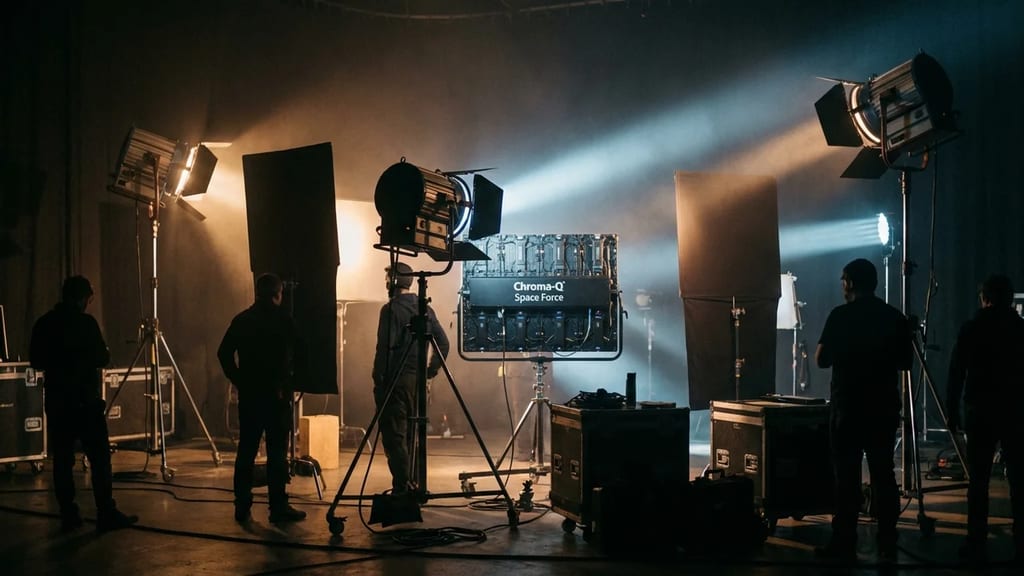
From the crafts

Perspectives

Cinematographer

Als DoP schätze ich die Space Force für ihre konstante Farbtemperatur auch bei Dimmung – ein Problem vieler günstiger LED-Panels. Die kompakte Bauform ermöglicht es mir, sie in Sets zu verstecken, wo größere Leuchten sichtbar wären, und die App-Steuerung spart Zeit beim Anpassen der Lichtfarbe zwischen Takes.

Director

Ich nutze Space Force-Arrays gerne für subtile Farbakzente, die Stimmungen unterstützen – warmere Töne für intime Szenen, kältere für Spannung. Die schnelle Farbwechsel-Funktion ermöglicht es mir, verschiedene emotionale Nuancen einer Szene zu testen, ohne dass das Licht-Team ständig Filter wechseln muss.

Producer

Mit 800 Euro pro Einheit sind Space Force-Leuchten günstiger als Arri-Equipment, aber teurer als No-Name-LEDs. Der Vorteil liegt in der Zeitersparnis: Keine Generatoren für kleine Setups, schneller Aufbau durch Magnethalterung, und die Langlebigkeit rechtfertigt die Investition gegenüber billigen Alternativen, die oft nach wenigen Produktionen ausfallen.

More in the lexikon

Related terms

Test your knowledge

Quiz

1. Was beschreibt „Chroma-Q Space Force" am besten?

2. Zu welchem Department gehört „Chroma-Q Space Force"?

3. Wie viele verschiedene Fachperspektiven bietet dieser Eintrag?

Report an error
From the Filmfarm ecosystem

Understand visual language, budget productions, connect crew.

The Lexikon is part of the Filmfarm ecosystem — alongside budgeting (FilmBalance), an industry magazine (FilmCircus) and crew networking (FilmCall, CrewMesh). One shared vocabulary for the whole production.

FilmFarm FilmRadarComing soonFilmPulseComing soonFilmNumbersComing soonFilmCapitalComing soonFilmLabComing soonFilmBalanceComing soonFilmCircusComing soon