Filmlexikon.
Support
Choreography
Art Department · Terms

Choreography

Murnau AI illustration
schauspielfuehrung dance film props multiples

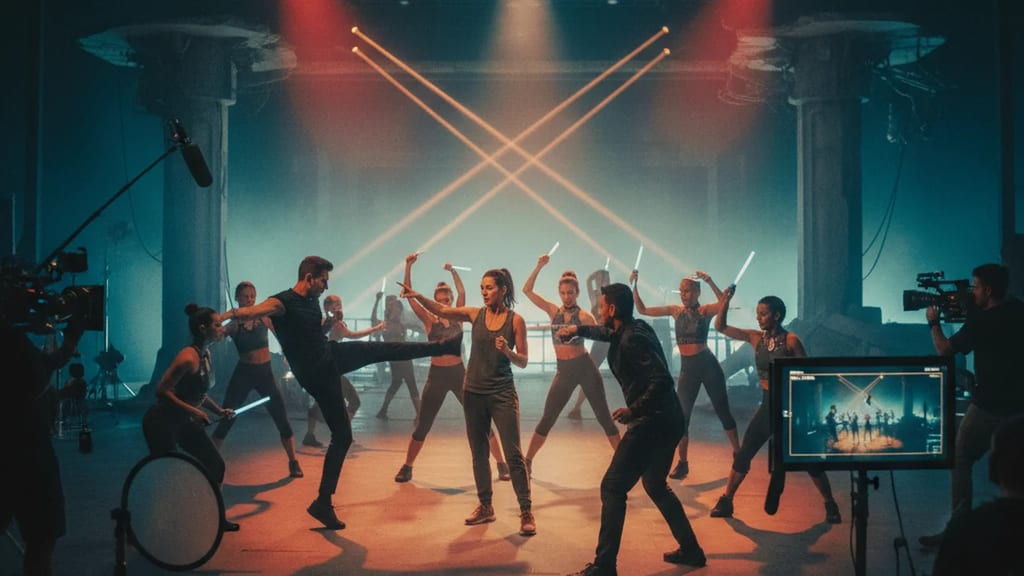
Planned blocking of talent and camera movement using ground plans (1:50 scale), tape marks for positioning, and rhythmic 8-count structure in dance sequences.

Technical Details

Choreographic notation is done using Ground Plans with grid measurements (usually 1:50 scale), in which movement lines, stop points, and gaze directions are indicated. For fight scenes, the standard safety distance between actors is at least 15 cm for simulated blows. Dance choreographies are organized into 8-count structures (32 beats per phrase), while action sequences are often rhythmized in 4/4 time. Paths are fixed using markings (Tape Marks) on the floor, with T-shaped markings for stop positions and arrows for movement directions.

History & Development

The first documented film choreography originated in 1895 in Lumière's footage, where workers were deliberately positioned for the camera. Busby Berkeley revolutionized camera choreography in 1933 with "42nd Street" through geometric formations of up to 200 dancers. Stanley Kubrick established precise notation of camera movements in relation to actor movements in 1975 with "Barry Lyndon," using scene times of up to 3 minutes without cuts. Digitalization since the 1990s has enabled pre-visualization software like Maya or FrameForge for three-dimensional movement planning.

Practical Application in Film

In "Goodfellas" (1990), Scorsese choreographed the famous Copacabana shot over 184 seconds with 47 different actor positions. Action films like "John Wick" (2014) use Fight Choreography with an average of 15 movements per 10-second sequence. In musical film adaptations, playback speeds of 23.976 fps are precisely matched to the choreography rhythm. The workflow includes: Blocking rehearsals (2-3 days), Marking runs (1 day), Full-intensity rehearsals before shooting begins.

Comparison & Alternatives

Choreography differs from Blocking through its rhythmic component and precise timing structure. While Blocking establishes basic positions, Choreography defines the exact movement dynamics. Stunt Coordination focuses on safety aspects for high-risk movements. Since the 2000s, Motion Capture has replaced traditional choreography notation in VFX-intensive productions, but still requires basic choreographic planning for the reference performance of the actors.
From the crafts

Perspectives

Cinematographer

Ich plane meine Dolly-Geschwindigkeiten und Fokus-Pulls exakt nach den choreografierten Schauspielerbewegungen - bei einer 180°-Kameraschwenkung über 8 Sekunden muss der Schauspieler seine Position millimetergenau nach 4,2 Sekunden erreichen. Die Choreografie bestimmt meine Objektivwahl: Bei komplexen Gruppenbewegungen verwende ich 35mm für Tiefenschärfe, bei intimen Tanzszenen 85mm für selektiven Fokus.

Director

Choreografie ist mein Werkzeug zur visuellen Erzählung - die Gehgeschwindigkeit eines Charakters transportiert seinen emotionalen Zustand, die räumliche Anordnung von Figuren zeigt Machtverhältnisse. In Dialogszenen choreografiere ich bewusst asymmetrische Bewegungsmuster, um Spannungen zu visualisieren. Ich arbeite mit mathematischen Verhältnissen: Dominante Charaktere bewegen sich in geraden Linien, unsichere in kurvigen Bahnen.

Producer

Choreografie kostet mich durchschnittlich 8.000€ zusätzlich pro Drehtag durch Choreograf-Honorar (800€/Tag) und verlängerte Probenzeit, spart aber 15-20% der Drehzeit durch präzise Vorbereitung. Komplexe Tanzsequenzen erfordern 5-7 Probentage vor Drehbeginn - das sind 15.000€ Mehrkosten, aber ohne diese Vorbereitung würde der Dreh das Doppelte kosten. Versicherungstechnisch reduziert professionelle Choreografie bei Actionszenen meine Prämien um 12%.

More in the lexikon

Related terms

Test your knowledge

Quiz

1. Zu welchem Department gehört „Choreografie"?

2. Wie viele verschiedene Fachperspektiven bietet dieser Eintrag?

Report an error
From the Filmfarm ecosystem

Understand visual language, budget productions, connect crew.

The Lexikon is part of the Filmfarm ecosystem — alongside budgeting (FilmBalance), an industry magazine (FilmCircus) and crew networking (FilmCall, CrewMesh). One shared vocabulary for the whole production.

FilmFarm FilmRadarComing soonFilmPulseComing soonFilmNumbersComing soonFilmCapitalComing soonFilmLabComing soonFilmBalanceComing soonFilmCircusComing soon