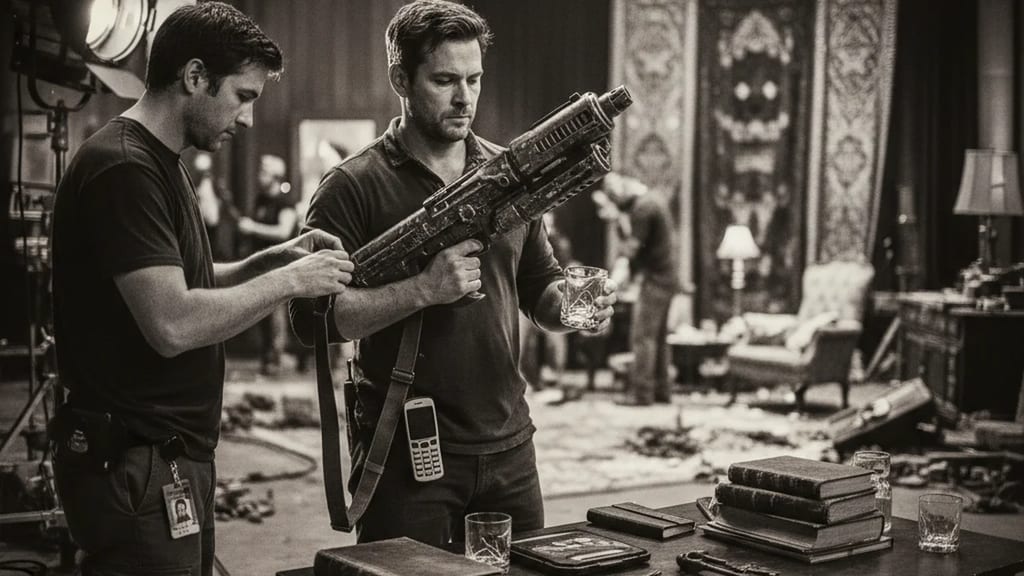
Handheld object actors interact with — gun, glass, phone. Part of set dressing but actor-dependent, distinct from static décor.
On set, you quickly distinguish between what is permanently installed and what the actor handles. The prop—or Accessoire in German jargon—is your movable object within the frame. A weapon that is drawn. A glass that is emptied. A telephone that has rung. The fundamental difference from other set dressing lies in the action: a prop is used, not just placed decoratively.
The practice strictly differentiates here. The Production Designer handles set dressing—furniture, murals, everything that defines the environment. The Props Master or the props department manages props because they have to function. A revolver must sit correctly in the hand, a wine glass must not clink when the actor sets it down. You'll quickly notice: an incorrect weight in the hand, too loud a noise when setting it down—and the take is ruined. The actor loses focus, the scene becomes artificial. That's why the props crew tests every prop beforehand at shooting distance.
Typical props include weapons (pistols, knives), household items (cutlery, dishes, bottles), personal items (wallets, watches, jewelry), electronic devices (telephones, remote controls), and tools. Some are needed multiple times—because the scene is shot from different angles or because the prop is damaged during a take. Therefore, every props department keeps doubles and triples on hand. A bloody knife? You need at least three versions: a clean one for close-ups before the action, a bloody one for the action itself, and a clean one again if it's shown afterward.
At the editing table, you are primarily interested in the prop as a visual and narrative anchor. A cigarette being lit marks a passage of time. A ring being pulled off a finger carries emotional weight. Continuity is critical here—if the actor holds the glass in their right hand in a wide shot, it must also be in their right hand in the close-up. That's why the Script Supervisor photographs every setup with a Polaroid or digitally: prop position, clothing, everything. Without these images, post-production becomes a nightmare.
Related terms
Quiz
1. Was beschreibt „Accessoire" am besten?
2. Zu welchem Department gehört „Accessoire"?