Definition
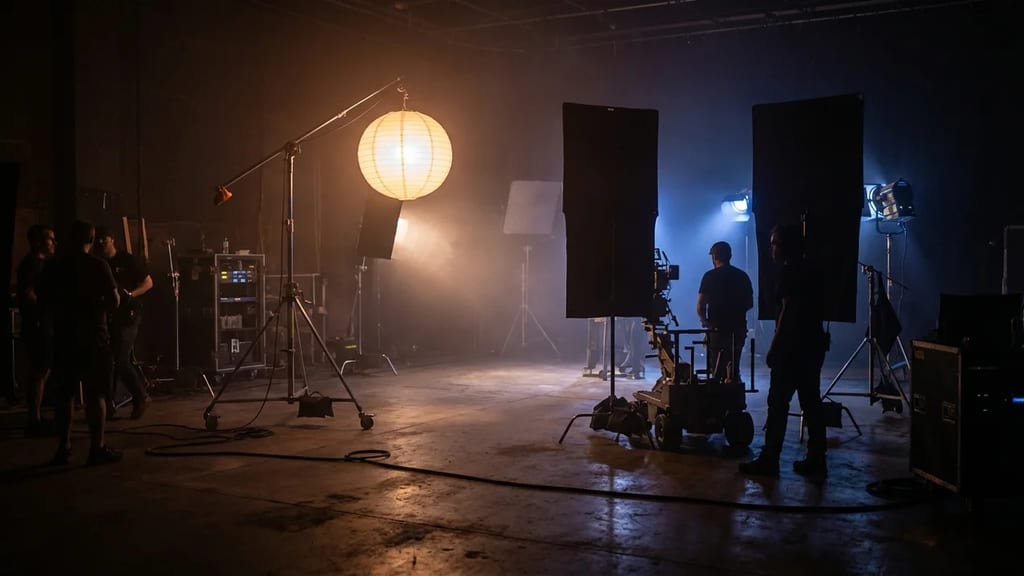
The China Ball is a spherical lighting unit consisting of a 360° light source at the center of a translucent white nylon shell with diameters ranging from 60 to 150 cm. This construction produces completely omnidirectional, soft light without any discernible directional characteristics. The name derives from the nylon shells produced in China, which have been used since the 1980s as a cost-effective alternative to more expensive softboxes.
##Technical Details
Standard China Balls use 200W to 2000W tungsten-halogen lamps or modern LED panels as the light source. The nylon shell reduces light intensity by an average of 1.5 stops with a color temperature shift of approximately 100-200K towards warm white. Typical diameters are 60, 90, 120, and 150 cm, with larger variants producing correspondingly softer light with less shadow definition. Suspension is achieved via integrated loops or Velcro fasteners at the equator of the sphere.
History & Development
In 1979, American gaffer George Spiro Dibie developed the first commercial China Balls for Wim Wenders' "Hammett." The original idea was inspired by Chinese paper lanterns but was implemented with fire-resistant nylon materials. In the 1990s, China Balls became established as a standard for available light situations, especially after their prominent use in "The Godfather" (1972) for the famous restaurant scenes. Modern LED versions since 2010 have significantly reduced fire hazards and heat generation.
Practical Use in Film
Roger Deakins systematically employed China Balls in "1917" (2019) to evenly illuminate the continuous camera movements through trenches. In interiors, they simulate natural window light or supplement practicals without harsh shadows. China Balls are particularly suitable for 360° camera movements, as they provide identical light from any angle. Disadvantages include limited light direction control and the impossibility of precise shadow placement.
Comparison & Alternatives
Unlike softboxes or Fresnels, China Balls offer no light shaping through barndoors or diffusion filters. Space Lights with rectangular diffusers achieve similar omnidirectionality with better light output. LED panels with spherical attachments (e.g., Aputure Lantern) combine modern technology with the China Ball principle and offer color temperature control. Balloon Lights use inflatable constructions for larger diameters but are more susceptible to wind during exterior shoots.