Technical Details
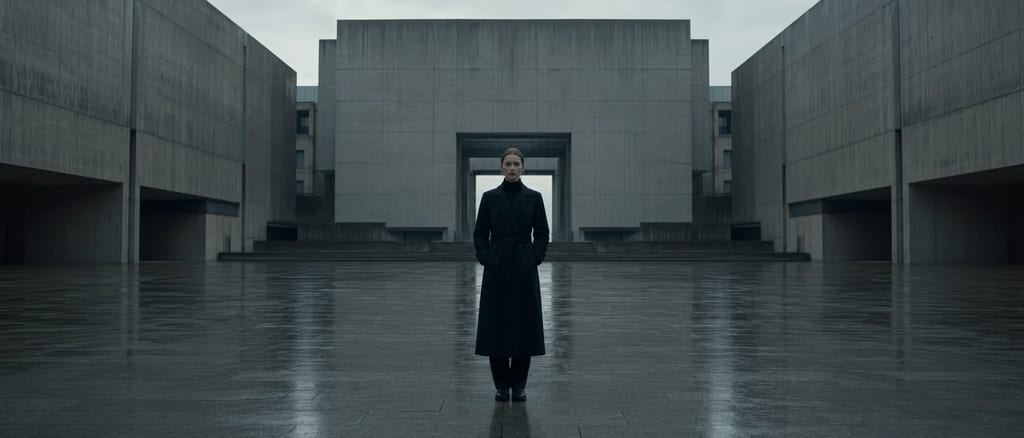
In standard cinema formats (2.35:1 Cinemascope, 1.85:1 Widescreen), the central focal point is mathematically precise at 50% of the image width and 50% of the image height. Modern camera systems like ARRI Alexa or RED offer overlayable grid lines (Center Cross) in the viewfinder for precise alignment. Center framing works in three variants: point-central (single subject), linear-central (horizontal or vertical centering), and symmetrical-central (mirrored subject arrangement). In digital post-production, editing systems like Avid or Premiere Pro enable pixel-accurate centering through mathematical image center calculation.
History & Development
Sergei Eisenstein first systematically used center framing in 1925 in "Battleship Potemkin" for monumental visual impact. Stanley Kubrick perfected the technique from the 1960s onwards with mathematically precise symmetries, especially in "2001: A Space Odyssey" (1968). Wes Anderson has established center framing as a trademark of his visual style since "Rushmore" (1998). Digital technology enabled pixel-accurate centering in post-production from 2000 onwards, while modern autofocus systems simplified precise subject placement during shooting.
Practical Application in Film
Kubrick's "The Shining" (1980) uses center framing for psychological unease in the hotel corridors. Anderson systematically centers dialogues and plot progressions in "The Grand Budapest Hotel" (2014) for a fairytale aesthetic. Horror and thriller productions employ center framing for jump scares, as viewers instinctively fixate on the center of the frame. The technique requires precise camera movements and exact subject guidance, as even minimal deviations can destroy the intended symmetry. Static shots work optimally, while handheld camera work makes center framing practically impossible.
Comparison & Alternatives
Center framing directly contrasts with the rule of thirds, which deliberately positions subjects outside the image center. While the rule of thirds creates dynamic, natural-looking compositions, center framing creates formal, often artificial visual effects. Asymmetrical framing emphasizes unease and movement, while center framing conveys stability and control. Modern cinematic trends favor hybrid approaches: combining central main subjects with asymmetrical secondary elements blends classic elegance with contemporary dynamism.