Filmlexikon.
Support
Framing
Camera · Terms

Framing

Murnau AI illustration
picture frame long side framing center framing short side framing

Composition of the on-screen image through sensor size, lens focal length, and camera distance, controlled via HD monitors with framelines and safe-area markings.

Technical Details

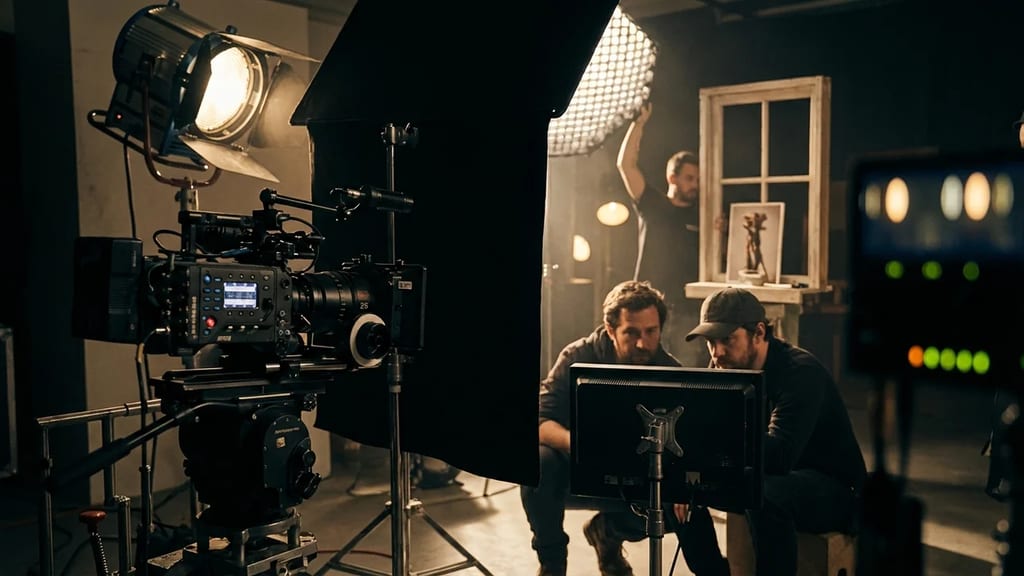
Framing is determined by the camera's sensor size (e.g., Super 35mm with 24.89 × 18.66 mm), the lens's focal length, and the camera-to-subject distance. In digital cameras, framing is controlled via LCD monitors or electronic viewfinders with resolutions between 1920×1080 and 3840×2160 pixels. Modern cameras offer framelines for various aspect ratios, safe area markers (90% of the image area), and center markers for precise image composition. A distinction is made between static framing (Fixed Frame) and dynamic framing through camera movements (Reframing).

History & Development

Conscious framing developed from 1895 onwards with the first film recordings by the Lumière brothers, who adopted photography's 4:3 aspect ratio. D.W. Griffith revolutionized framing from 1908 onwards through the systematic use of different shot sizes. In 1953, "The Robe" introduced the Cinemascope format (2.55:1, later 2.39:1) to compete with television. The Nouvelle Vague from 1958 onwards experimented with unconventional framing and jump cuts. Digital technology has enabled flexible reframing options in post-production since the 2000s.

Practical Application in Film

Stanley Kubrick used extremely wide frames with natural lighting in "Barry Lyndon" (1975) for historical authenticity. Sergio Leone perfected extreme close-ups in his Westerns in a 2.35:1 frame for maximum emotional intensity. Wes Anderson works with symmetrical, centered framing and static camera positions. Framing is now mostly done via HD monitors with false color display and zebra function. Common workflows include shooting in higher resolutions (4K/6K) with subsequent reframing to 2K/HD deliverables.

Comparison & Alternatives

Framing differs from image composition by the technical aspect of determining the frame, while composition describes the aesthetic arrangement of content. Unlike photographic cropping, cinematic framing primarily occurs during recording. Modern alternatives include multi-camera setups with different focal lengths, 360° cameras with subsequent frame extraction, and Variable Aspect Ratio (VAR) for format-dependent delivery. Open Gate Recording allows for maximum flexibility in post-production.
From the crafts

Perspectives

Cinematographer

Ich nutze die Kadrierung als primäres Gestaltungsmittel für die visuelle Erzählung und kontrolliere sie permanent über meinen 7-Zoll-Monitor mit Framelines. Die Wahl zwischen 35mm- und 85mm-Brennweite verändert nicht nur den Bildausschnitt, sondern auch die räumliche Tiefenwirkung und Subjektperspektive. Bei Handkamera-Arbeiten verwende ich bewusst dynamisches Reframing, um die emotionale Intensität der Szene zu verstärken.

Director

Ich setze Kadrierung gezielt ein, um die Aufmerksamkeit des Zuschauers zu lenken und narrative Informationen zu dosieren – enge Kader für intime Momente, weite für epische Sequenzen. Durch Off-Screen-Space schaffe ich Spannung, indem ich wichtige Handlungselemente außerhalb des Rahmens positioniere. Die Kadrierung bestimmt auch die emotionale Distanz zwischen Zuschauer und Figur.

Producer

Ich kalkuliere bei aufwendigen Kadrierungen mit 15-20% längeren Dreh- und Setup-Zeiten, da präzise Bildausschnitte mehrere Takes erfordern. Multi-Format-Deliverables für Kino und Streaming bedeuten zusätzliche Postproduktionskosten von etwa 8.000-12.000 Euro pro Stunde fertigen Films. Bei internationalen Koproduktionen plane ich verschiedene Aspect Ratios für unterschiedliche Vertriebskanäle bereits in der Vorproduktion ein.

More in the lexikon

Related terms

Test your knowledge

Quiz

1. Zu welchem Department gehört „Kadrierung"?

2. Wie viele verschiedene Fachperspektiven bietet dieser Eintrag?

Report an error
From the Filmfarm ecosystem

Understand visual language, budget productions, connect crew.

The Lexikon is part of the Filmfarm ecosystem — alongside budgeting (FilmBalance), an industry magazine (FilmCircus) and crew networking (FilmCall, CrewMesh). One shared vocabulary for the whole production.

FilmFarm FilmRadarComing soonFilmPulseComing soonFilmNumbersComing soonFilmCapitalComing soonFilmLabComing soonFilmBalanceComing soonFilmCircusComing soon