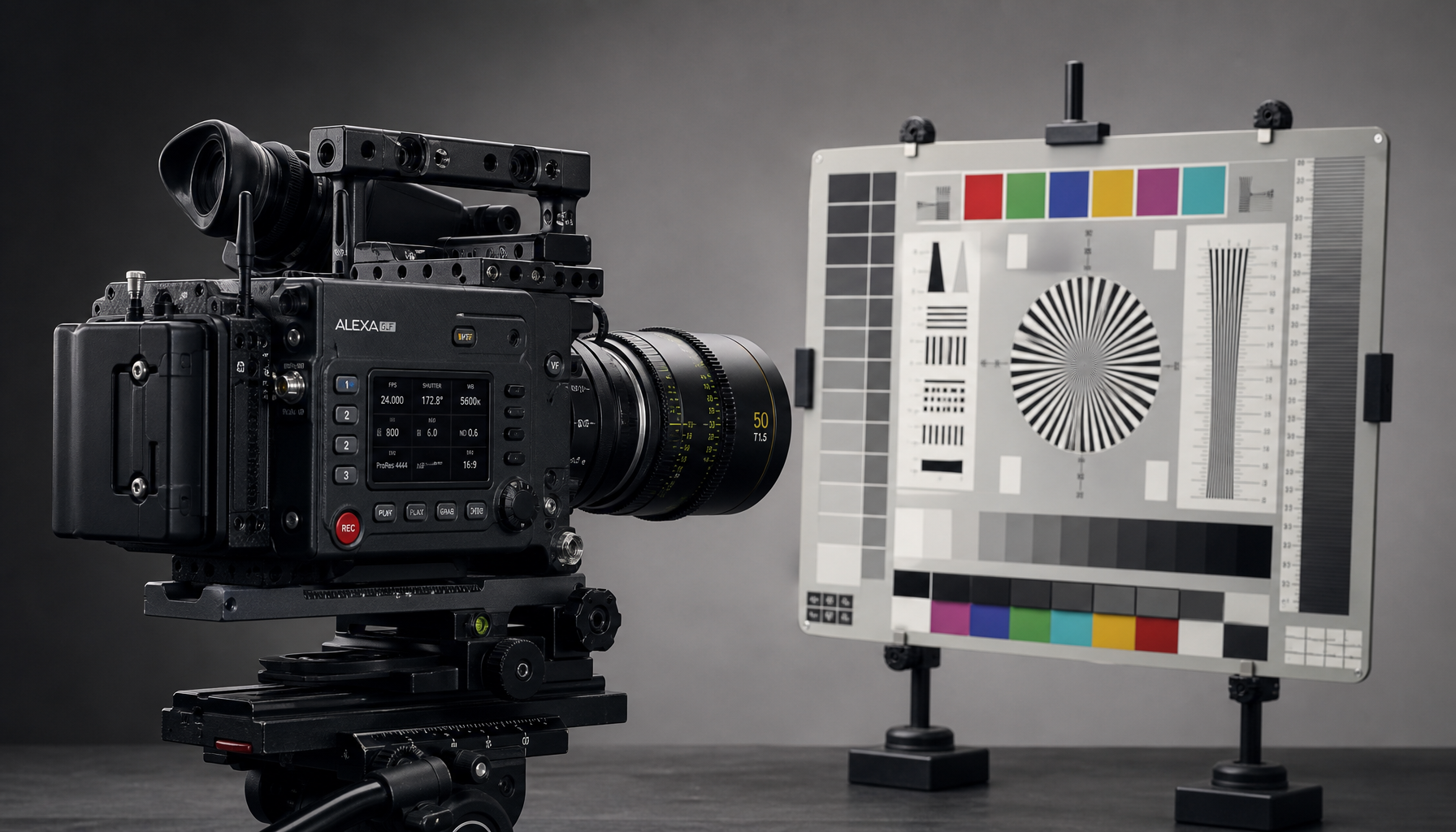
Measuring a camera's intrinsics — focal length, lens distortion, sensor size — as the foundation for matchmoving and tracking. Without clean calibration, no CG element sits solidly in the shot.
Before a tracking program can reconstruct a virtual camera from a shot, it needs to know what it was shot with. This is precisely what camera calibration provides: the so-called intrinsics — focal length, lens distortion, sensor dimensions, position of the optical center. These values describe how the lens maps the three-dimensional world onto the sensor, including all deviations from the ideal pinhole camera model.
How Calibration is Performed
The classic method is the grid chart: a checkerboard or dot pattern filmed from multiple angles. Because the geometry of the pattern is known, the software can calculate focal length and distortion profile from it. Lens data sheets and metadata from the camera are used as supplements — modern cinema lenses sometimes provide their values directly via data interfaces. On set, filming the chart is part of the VFX routine: per lens, per focal length, ideally at the aperture used for the shot.
Why Inaccuracy Ruins Everything
Tracking software solves a system of equations where the intrinsics should be fixed values. If they are incorrect, the solver distributes the error across the camera movement — the track may look usable at first glance, but CG elements will float, slide along edges, or tilt away during pans. Uncorrected distortion is particularly treacherous: at the image edge, a wide-angle lens can quickly deviate by several pixels from the ideal image, and it's precisely there that any composite seam will reveal itself. Therefore, for compositing, work is done with undistorted footage, and the distortion is only reapplied at the end.
- Refilm charts after every lens change — even the same focal length behaves differently from lens to lens.
- Zoom shots require special treatment: focal length and distortion change over the zoom range, and the chart alone is then insufficient.
- Lens and camera data in the camera report: sensor crop mode and the actual utilized sensor area are the most frequently forgotten.
Related terms
Quiz
1. Was beschreibt „Kamerakalibrierung" am besten?
2. Zu welchem Department gehört „Kamerakalibrierung"?