Technical Details
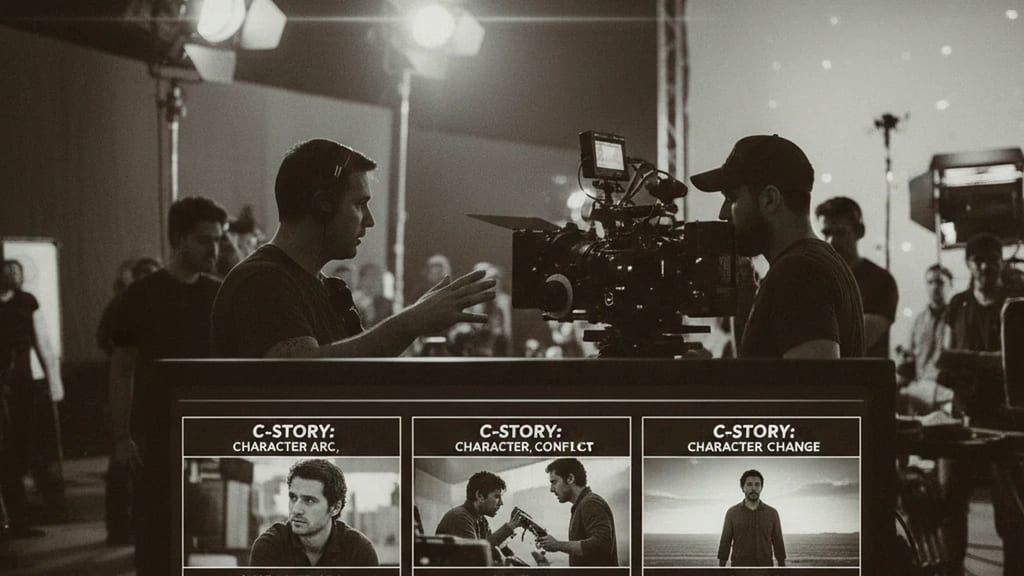
The C-Story follows a compressed three-act structure with setup (pages 10-20), development (pages 45-85), and resolution (pages 95-110) in a 120-page screenplay. Its plot points are timed 10-15 pages apart from the A-Story to avoid overlapping emotional climaxes. A characteristic feature is the limited cast of a maximum of 2-3 characters and the thematic mirroring of the main plot through contrast or parallel development.
History & Development
The concept of the C-Story developed in Hollywood screenwriting workshops in the early 1980s, first systematized by Syd Field in "Screenplay: The Foundations of Screenwriting" in 1983. The television series "Hill Street Blues" (1981-1987) established the model for episodic storytelling with up to five parallel plotlines. Since the 1990s, the C-Story has been a standard feature of ensemble films and series formats, with streaming platforms increasingly focusing on more complex multi-strand narratives since 2010.
Practical Application in Film
In "Pulp Fiction" (1994), the Butch-Coolidge storyline forms the C-Story to Vincent-Jules (A-Story) and Marsellus-Wallace-Mia (B-Story). "The Departed" (2006) uses the C-Story around Madolyn as an emotional bridge between the protagonists' undercover identities. During editing, C-Story scenes are strategically placed as breathing room between intense A-Story moments or used for tension building through cross-cutting. The average scene redundancy is 15%, as C-Stories are often shortened more than primary plotlines.
Comparison & Alternatives
The C-Story differs from the B-Story by having less protagonist involvement and weaker causal links to the main plot. While B-Stories are usually subplot-dependent, C-Stories often function as standalone vignettes. In European auteur films, the concept is applied less frequently; instead, episodic equality of all plotlines dominates. Modern series expand the system to D- and E-Stories, with the C-Story retaining its function as a thematic resonance chamber to the A-Story.