Filmlexikon.
Support
Beat
Editing · Terms

Beat

Murnau AI illustration
weave cutting rhythm metric montage tempo harter schnitt hard cut

Smallest narrative unit in editing that marks dramatic turns or emotional transitions. Action films typically use 3–8 seconds per beat, dramas 12–24 seconds.

Technical Details

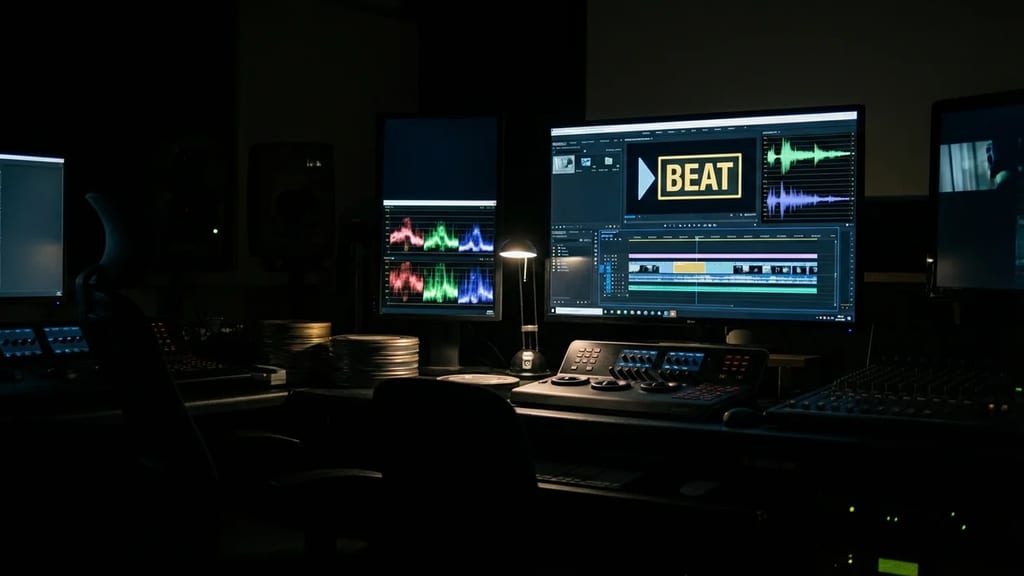
Beats manifest in editing through specific cut patterns: hard cuts for dramatic turns, jump cuts for psychological breaks, or match cuts for emotional transitions. The average beat length varies by genre: action films work with 3-8 seconds per beat, dramas with 12-24 seconds. Modern editing software like Avid Media Composer or Premiere Pro allows for beat markers every 4, 8, or 16 frames for precise timing. Color coding distinguishes emotional (red), narrative (blue), and rhythmic beats (green).

History & Development

Sergei Eisenstein developed the beat concept in 1925 as a "montage cell" for "Battleship Potemkin." Walter Murch systematized digital beat analysis in 1979 with "Apocalypse Now" through numerical frame counting. Pixar Studios established the "22-beat structure" for animated films starting in 1995, which is now an industry-wide standard. Since 2010, AI-assisted beat detection has enabled automatic rhythm recognition with 94% accuracy.

Practical Application in Film

Edgar Wright uses musical beats as an editing tempo in "Baby Driver" (2017) with exact 120 BPM synchronization. Christopher Nolan structures "Dunkirk" (2017) across three beat levels: land (1 week), sea (1 day), air (1 hour). Quentin Tarantino works with "Mexican Standoff" beats: 3-7 seconds of stillness before outbursts of violence. The Safdie Brothers use overlapping beats with a 0.5-second shift in "Uncut Gems" (2019) for stress induction.

Comparison & Alternatives

Beats differ from scenes (300-600 seconds) and sequences (5-15 minutes) through their micro-structure. While tempo changes influence the overall rhythm, beats modulate local tension arcs. Shot rhythm refers to camera timing, beat rhythm to narrative turns. Alternative concepts: "Moments" (Terrence Malick), "Pulses" (Denis Villeneuve), or "Cells" (Gaspar Noé) work with similar principles, but without fixed time specifications.
From the crafts

Perspectives

Cinematographer

Ich plane meine Shot-Listen nach Beat-Struktur, weil jeder Beat eine spezifische Kamera-Energie braucht – statische Einstellungen für kontemplative Beats, Handheld für aggressive Wendungen. Beat-Timing bestimmt meine Belichtungswechsel und Fokus-Pulls, besonders bei emotionalen Charakterbögen innerhalb langer Takes.

Director

Ich strukturiere jede Szene in 3-7 Beats vor dem Dreh, weil Schauspieler konkrete Wendepunkte brauchen, um authentische Reaktionen zu entwickeln. Beat-Mapping hilft mir, Dialoge zu straffen und überflüssige Exposition zu eliminieren – jeder Beat muss Story oder Charakter vorantreiben, sonst fliegt er raus.

Producer

Beat-basierte Drehpläne reduzieren meine Drehtage um durchschnittlich 15%, weil Regisseure gezielter inszenieren statt endlos zu probieren. Ich kalkuliere 45 Minuten Setup-Zeit pro Beat-Wechsel und spare Budget durch präzise Shot-Listen – weniger Coverage bedeutet weniger Filmmaterial und Post-Production-Stunden.

More in the lexikon

Related terms

Test your knowledge

Quiz

1. Was beschreibt „Beat" am besten?

2. Zu welchem Department gehört „Beat"?

3. Wie viele verschiedene Fachperspektiven bietet dieser Eintrag?

Report an error
From the Filmfarm ecosystem

Understand visual language, budget productions, connect crew.

The Lexikon is part of the Filmfarm ecosystem — alongside budgeting (FilmBalance), an industry magazine (FilmCircus) and crew networking (FilmCall, CrewMesh). One shared vocabulary for the whole production.

FilmFarm FilmRadarComing soonFilmPulseComing soonFilmNumbersComing soonFilmCapitalComing soonFilmLabComing soonFilmBalanceComing soonFilmCircusComing soon