Technical Details
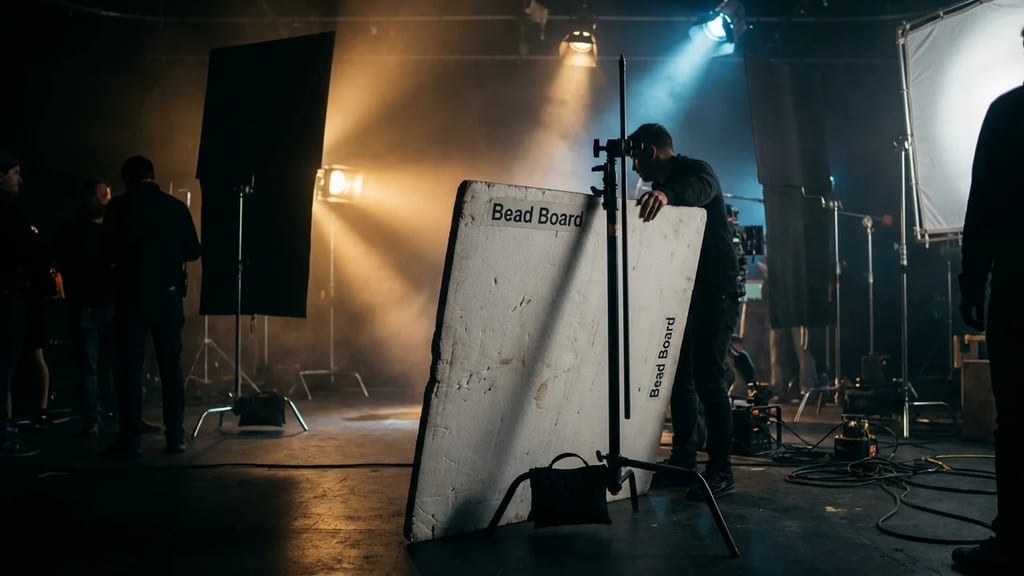
Bead boards reflect approximately 85-90% of incident light with a diffusion factor of nearly 180°. Their density ranges from 15-25 kg/m³, enabling extremely lightweight handling. The matte surface texture prevents hotspots and creates even, low-shadow illumination. Professional film boards are treated for UV resistance and impregnated for fire retardancy according to B1 standards. Variants include black boards for negative fill and gray versions for reduced reflection.
History & Development
The systematic use of bead boards as film reflectors began in Hollywood in the 1960s as a cost-effective alternative to expensive fabric reflectors. Gaffers like Conrad Hall popularized the technique in films such as "Butch Cassidy and the Sundance Kid" (1969). By the 1980s, the method had become standard through DoPs like Vilmos Zsigmond. Modern developments include recyclable bio-polystyrene variants and dimensionally stable composite boards.
Practical Application in Film
Roger Deakins extensively used bead boards for natural-looking facial illumination in "1917" (2019) to eliminate harsh shadows. Typical workflow: positioning at a 45° angle to the main light source, 1-3 meters from the subject. For exterior shots, they serve as sunlight bouncers; in studios, they act as key light fill. Advantages: low weight, cost-effective, readily available. Disadvantages: susceptibility to wind, limited durability, not waterproof.
Comparison & Alternatives
Bead boards differ from molton boards in their higher reflectivity and lower weight, and from silver reflectors in their softer light quality. LED panels are increasingly replacing bead boards as they offer more controllable, color-temperature-variable light. Ultrabounce fabric provides similar reflection properties with better weather resistance. Bead boards remain the first choice for spontaneous setups, budget productions, and when maximum portability is required.