Cinematographer
Aus DoP-Perspektive ist dieses Element essentiell für die visuelle Gestaltung. Es ermöglicht mir die gewünschte Farbstimmung und das ästhetische Bild konsistent umzusetzen.
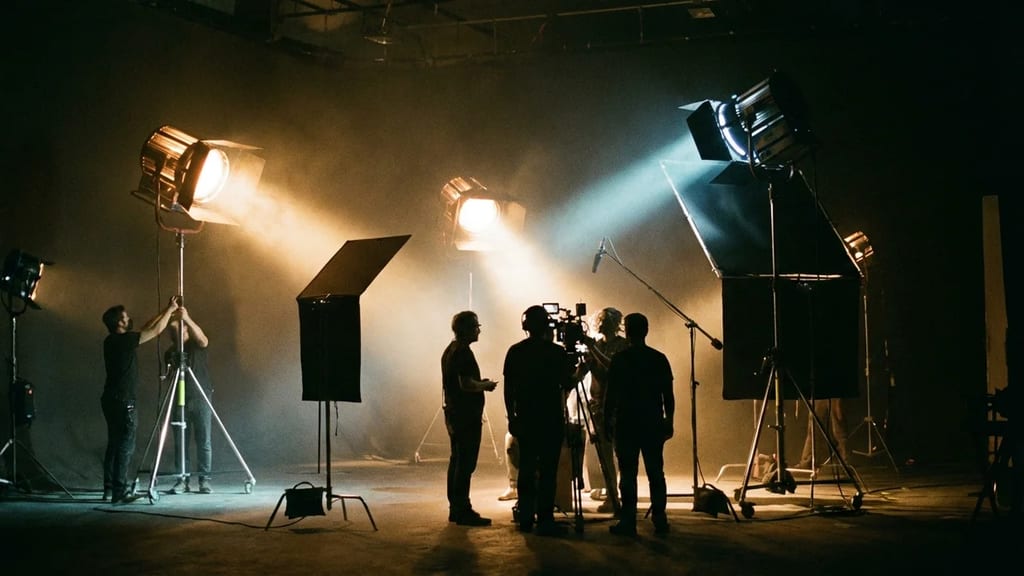
Beam angle of a lighting fixture, measured at 50% light intensity drop from peak. Determines lit area size from narrow (5–15°) to wide (40–80°).
The Beam Angle (German: Abstrahlwinkel, often also referred to as Half-Value Angle) is a photometric characteristic of a spotlight and describes the width of the emitted light cone in degrees (°). It is defined as the angle between the two directions in which the luminous intensity has dropped to 50% of its maximum value. This definition corresponds to the Full Width at Half Maximum (FWHM).
The beam angle determines whether light appears as a narrow spot or a wide flood: a small angle concentrates the light into a focused, hard cone, while a large angle distributes it broadly. It is a property of the optics or the spotlight and its lenses/reflectors, not a standalone device.
In photometry, the Beam Angle is distinguished from the Field Angle. Both measure the light cone, but at different thresholds:
| Term | Threshold | Description |
|---|---|---|
| Beam Angle (Abstrahlwinkel) | 50% of maximum luminous intensity | The brightly perceived, usable core of the light cone (FWHM) |
| Field Angle (Feldwinkel) | 10% of maximum luminous intensity | The wider cone including the edge light that falls off outwards |
The Field Angle is therefore always larger than the Beam Angle. The exact reference point for the 50% threshold is important, as it can vary depending on the standard: The Illuminating Engineering Society (IES, including ANSI/IES LS-1) relates the 50% to the maximum luminous intensity. CIE (CIE S 017) and NEMA, on the other hand, relate the 50% to the luminous intensity in the center of the cone (Center Beam Intensity). For a symmetrical distribution where the maximum is in the center of the cone, both definitions are identical. For uneven or asymmetrical distributions (e.g., "Batwing" characteristics where the maximum is not in the center of the cone), the two definitions differ. The beam angle is measured using a goniophotometer based on the luminous intensity distribution.
On many spotlights, the beam angle can be varied. Fresnel spotlights are adjusted between "spot" (narrow, intense) and "flood" (wide, softer) by moving the lamp and reflector. Profile spotlights (ERS) are available with fixed lens tubes for different angles, or as zoom profiles with an adjustable range. Reflectors, optics, and accessories (e.g., light shapers, snoots, spot lenses) also change the effective beam angle.
For lighting design, the beam angle is crucial along with the distance: the diameter of the light cone on the subject can be estimated from the angle and distance. For LED lights, the beam angle is specified by the manufacturer; the associated photometric data are based on measurement and performance standards such as IES LM-79 or IEC 62722-2-1 (Luminaire performance) and are documented in standardized lighting files (IES or CIE/EULUMDAT files). (Note: The EN 60598 standard, on the other hand, exclusively regulates the safety of luminaires and does not define a beam angle.)
Aus DoP-Perspektive ist dieses Element essentiell für die visuelle Gestaltung. Es ermöglicht mir die gewünschte Farbstimmung und das ästhetische Bild konsistent umzusetzen.
Diese professionelle Lösung erhöht die Produktionseffizienz und reduziert Post-Production-Anforderungen. Sie ermöglicht flexible, schnelle Anpassungen während des Drehs.
Als Gaffer ist dies ein unverzichtbares Werkzeug meines täglichen Handwerkszeugs. Es ermöglicht mir professionelle Lichtkontrolle und schnelle Anpassungen auf Set, was Zeit spart und Qualität sichert.
1. Zu welchem Department gehört „Abstrahlwinkel"?
2. Wie viele verschiedene Fachperspektiven bietet dieser Eintrag?
The Lexikon is part of the Filmfarm ecosystem — alongside budgeting (FilmBalance), an industry magazine (FilmCircus) and crew networking (FilmCall, CrewMesh). One shared vocabulary for the whole production.