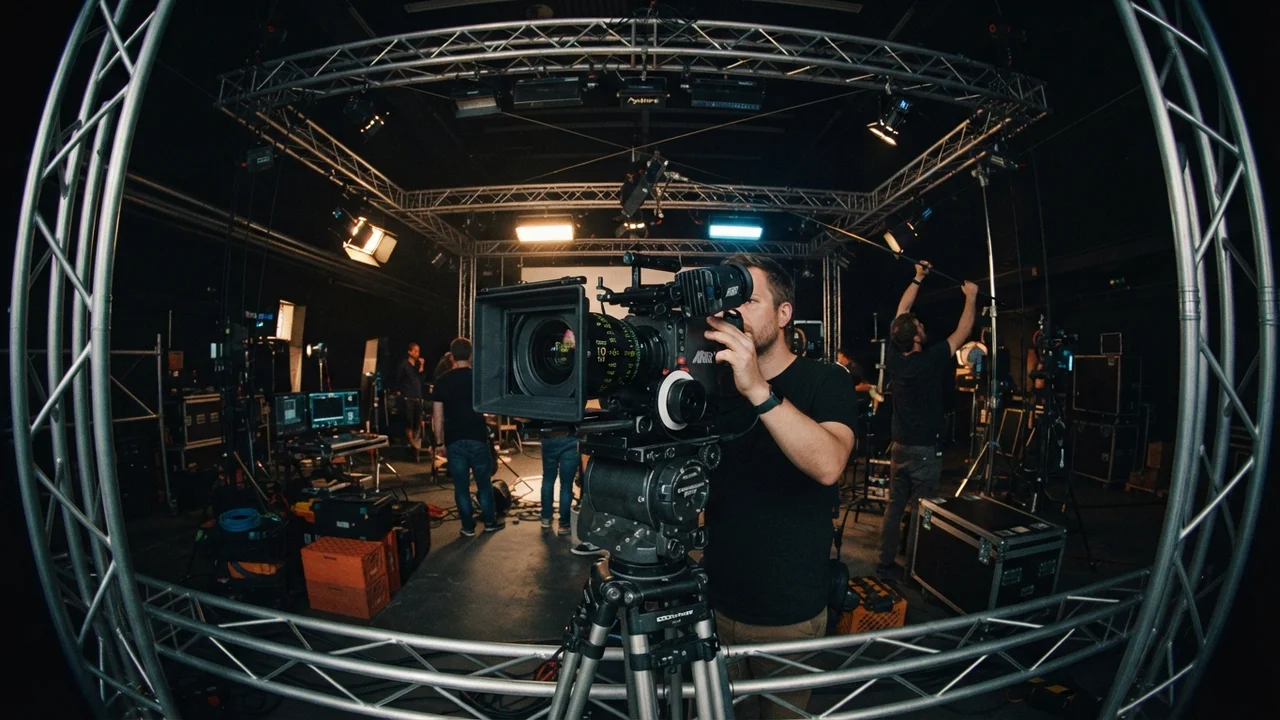
Definition
Barrel distortion refers to the optical distortion in wide-angle lenses, where straight lines at the edge of the image appear to bulge outwards, giving the image a barrel-like shape. The distortion arises from the complex lens construction of wide-angle lenses and increases with decreasing focal length. In extreme fisheye lenses, barrel distortion can reach values of over 15%, while it is typically 2-5% for standard wide-angle lenses between 24-35mm.
Technical Details
The distortion follows the mathematical formula r' = r × (1 + k₁r² + k₂r⁴), where k₁ is the coefficient for barrel distortion. At focal lengths below 20mm, radial distortion increases exponentially. Modern full-frame wide-angle lenses like the Canon EF 16-35mm f/2.8L exhibit approximately 3.2% barrel distortion at 16mm, while fisheyes like the Sigma 8mm f/3.5 reach values of up to 18%. The distortion is centered in the image and increases quadratically towards the edges.
History & Development
The systematic description of barrel distortion was first made in 1905 by the German optician Ernst Abbe. Early film cameras of the 1920s used simple wide-angle constructions with extreme barrel distortion of up to 8%. With the introduction of the retrofocus design by Pierre Angénieux in 1950, distortions were significantly reduced. Digital correction methods became established from 2003 with the RED One, which recorded lens distortion metadata for the first time.
Practical Use in Film
Stanley Kubrick deliberately used the barrel distortion of the Zeiss 18mm Super-Speed in "Barry Lyndon" (1975) for psychological spatial effects. Christopher Nolan systematically corrects all lens distortions in post-production, while Danny Boyle consciously used the barrel distortion of the Canon XL1 as a stylistic device in "28 Days Later" (2002). Modern VFX pipelines integrate automatic distortion maps that are applied during dailies processing. Software like Nuke or DaVinci Resolve uses lens grid shots for precise correction.
Comparison & Alternatives
In contrast to pincushion distortion in telephoto lenses, lines bulge outwards in barrel distortion. Anamorphic lenses additionally exhibit asymmetrical distortions due to their cylindrical elements. Modern computational photography approaches, as seen in the Alexa 35, correct distortions sensor-based. Tilt-shift lenses largely avoid barrel and pincushion distortion due to their symmetrical construction.