Filmlexikon.
Support
Pincushion Distortion
Camera · Terms

Pincushion Distortion

Murnau AI illustration
flow para roll take

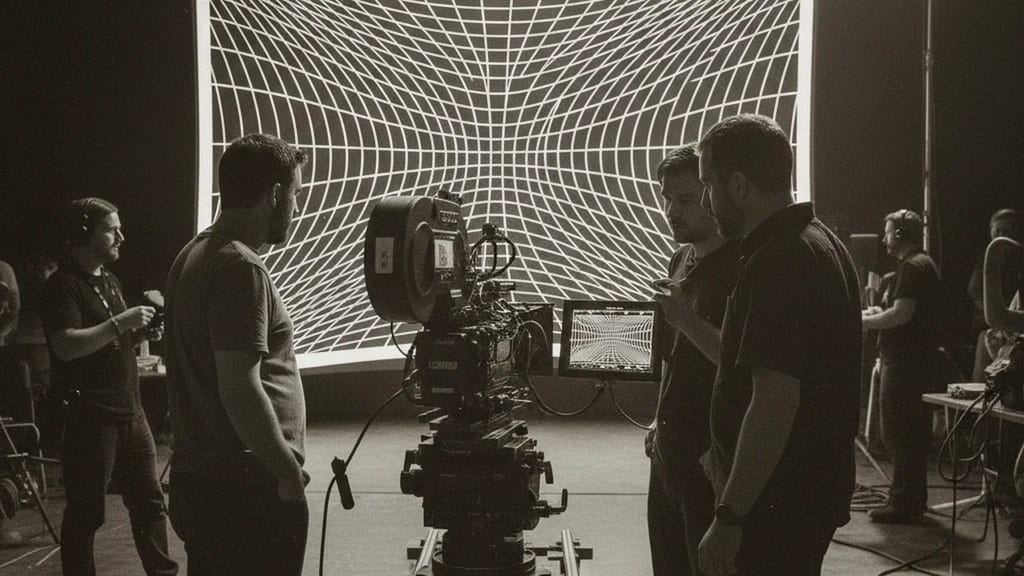
Optical distortion in telephoto lenses above 85mm where straight lines curve concavely toward the image edges. Can reach up to 8% distortion in extreme telephotos.

Technical Details

Pincushion distortion becomes more pronounced at focal lengths above 85mm, reaching distortion levels of up to 8% in extreme telephoto lenses (300-800mm). The distortion follows the mathematical formula rd = r × (1 + k × r²), where k is the negative distortion coefficient. Modern cine lenses exhibit distortion values below 0.5% due to aspherical lens elements and ED glass. Zoom lenses show the strongest pincushion distortion at the long end of the focal length range, while prime lenses achieve significantly lower values through optimized lens designs.

History & Development

The systematic study of pincushion distortion began in 1905 with Heinrich Erfle's optical studies at Carl Zeiss. In the 1920s, Leitz and Schneider developed the first corrected telephoto lenses for cinematography. The breakthrough came in 1961 with Canon's fluorite lenses, which for the first time enabled distortion below 1% at a 200mm focal length. Since the 1990s, digital correction systems like RED IPP or ARRI's lens correction automatically compensate for known distortion patterns of stored lenses.

Practical Application in Film

Ridley Scott consciously used the pincushion distortion of Panavision telephoto lenses in "Gladiator" (2000) to give portraits a subtle focus on the center of the face. Christopher Nolan, on the other hand, systematically corrects any distortion above 0.3% in post-production to ensure geometric precision. For greenscreen shots, strong pincushion distortion requires complex 3D tracking corrections, as the curved image edges make match moving more difficult. Digital Intermediate (DI) today allows for selective corrections of individual image regions.

Comparison & Alternatives

Pincushion distortion is the opposite of barrel distortion, where lines are curved convexly outwards. While wide-angle lenses below 35mm typically exhibit barrel distortion, telephoto lenses produce pincushion distortion. Fisheye lenses show extreme barrel distortion, and anamorphic lenses exhibit asymmetrical distortions. Software like DaVinci Resolve or Nuke automatically corrects known lens profiles, while unknown optics require manual calibration using test charts.
From the crafts

Perspectives

Cinematographer

Ich messe die Verzeichnung neuer Objektive grundsätzlich mit einem Testchart und erstelle LUTs für die Korrekte in Echtzeit am Monitor. Bei Teleobjektiven über 200mm plane ich 15% zusätzlichen Bildbereich für die Entzerrung ein, da sonst die Bildränder nach der Korrektur beschnitten werden. Besonders bei Architekturfotografie oder VFX-Shots ist präzise Geometrie entscheidend für das Compositing.

Director

Ich nutze die subtile Kissenverzerrung von Teleobjektiven gezielt für Porträts, da sie das Gesichtszentrum betont und die Aufmerksamkeit fokussiert. In Thrillern verstärke ich bewusst die Verzeichnung in der Postproduktion, um Unbehagen zu erzeugen. Bei Dialogen zwischen zwei Personen korrigiere ich die Verzeichnung komplett, um die natürliche Augenbewegung zwischen den Charakteren nicht zu stören.

Producer

Verzeichnungskorrektur in der Post kostet etwa 200€ pro VFX-Shot, da jede Einstellung individuell bearbeitet werden muss. Ich kalkuliere bei Teleobjektiv-lastigen Produktionen 5-8% zusätzliche Postproduktionskosten für Lens-Correction ein. Moderne Objektive mit geringer Verzeichnung amortisieren sich durch eingesparte Postproduktionszeit bereits nach 3-4 Drehtagen.

More in the lexikon

Related terms

Test your knowledge

Quiz

1. Zu welchem Department gehört „Kissenverzerrung"?

2. Wie viele verschiedene Fachperspektiven bietet dieser Eintrag?

Report an error
From the Filmfarm ecosystem

Understand visual language, budget productions, connect crew.

The Lexikon is part of the Filmfarm ecosystem — alongside budgeting (FilmBalance), an industry magazine (FilmCircus) and crew networking (FilmCall, CrewMesh). One shared vocabulary for the whole production.

FilmFarm FilmRadarComing soonFilmPulseComing soonFilmNumbersComing soonFilmCapitalComing soonFilmLabComing soonFilmBalanceComing soonFilmCircusComing soon