Filmlexikon.
Support
Astigmatism
Camera · Terms

Astigmatism

Murnau AI illustration
flow para roll take

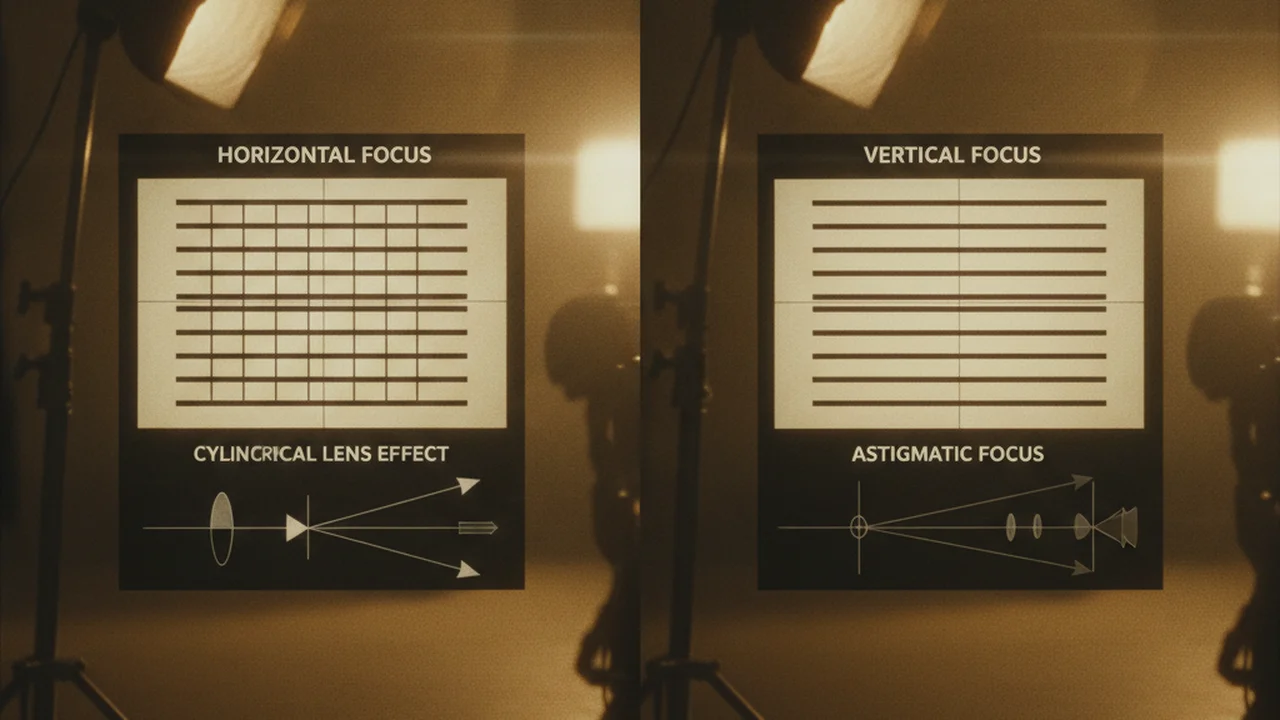
Optical aberration in lenses where points are rendered as lines due to unequal radii of curvature; measured in diopters.

Technical Details

Astigmatism is measured in diopters and arises from different radii of curvature of the lens surfaces in tangential and sagittal directions. In full-frame lenses, the aberration typically appears 15mm from the image center with values between 0.2 to 1.5 diopters. Modern aspheric lenses reduce the effect to below 0.3 diopters. A distinction is made between tangential astigmatism (focal line radial to the image center) and sagittal astigmatism (focal line concentric to the image center). The astigmatism coefficient A₃ mathematically describes the strength of the aberration.

History & Development

Astigmatism was first scientifically described in 1860 by the physicist Thomas Young. In photography, Ernst Abbe at Zeiss recognized its importance for lens design in 1881 and developed initial correction methods. The Cooke Triplet from 1893 was one of the first lenses with reduced astigmatism. Modern ED (Extra-low Dispersion) glasses since the 1970s and aspheric elements since the 1980s now enable correction to below 0.1 diopters in top-tier lenses.

Practical Use in Film

In wide-angle shots in "Blade Runner 2049," Roger Deakins deliberately used slightly astigmatic vintage lenses for more organic image edges. Documentarians often use more affordable lenses with higher astigmatism, creating characteristic "soft" corners. In studio photography, astigmatism charts with radial line patterns are used for quality control. The aberration intensifies at wide apertures and significantly weakens at f/5.6, which is why landscape shots are usually filmed at f/8-f/11.

Comparison & Alternatives

In contrast to spherical aberration, which occurs symmetrically, astigmatism is direction-dependent. Coma aberration creates comet-shaped blur, while astigmatism forms linear focal planes. Modern floating element designs dynamically correct astigmatism during focusing. Digital corrections in post-production can partially compensate for the effect, but only for static values, not for focus-dependent variations.
From the crafts

Perspectives

Cinematographer

Ich teste neue Objektive immer mit einem Stern-Chart in allen vier Bildecken bei verschiedenen Blenden, um den Astigmatismus zu bewerten. Bei kritischen Architekturaufnahmen vermeide ich die äußeren 20% des Bildkreises oder blende auf f/8 ab, um symmetrische Schärfe zu gewährleisten. Vintage-Objektive mit leichtem Astigmatismus setze ich gezielt für organischere Porträts ein, da die asymmetrische Unschärfe natürlicher wirkt als perfekt korrigierte moderne Linsen.

Director

Ich nutze den Astigmatismus als Stilmittel, um zwischen verschiedenen Realitätsebenen zu unterscheiden - perfekt korrigierte Objektive für "normale" Szenen, leicht astigmatische für Träume oder Erinnerungen. Die charakteristische Verzerrung in den Bildecken kann Unbehagen oder Desorientierung verstärken, besonders in Thriller- oder Horror-Sequenzen. Bei Dialogen achte ich darauf, dass Gesichter im schärfsten Bildbereich positioniert sind, während unwichtige Elemente bewusst in die astigmatischen Randbereiche gesetzt werden.

Producer

Hochwertige, astigmatismus-korrigierte Cine-Objektive kosten 15.000-40.000€ pro Brennweite, während ältere Objektive mit deutlichem Astigmatismus für 2.000-5.000€ zu haben sind und teilweise den gewünschten Look erzeugen. Ich kalkuliere zusätzliche Testzeit ein, wenn wir Vintage-Objektive verwenden, da jede Linse individuell charakterisiert werden muss. Bei internationalen Koproduktionen stelle ich sicher, dass alle Kamerateams identische Objektiv-Sets verwenden, um Kontinuitätsprobleme durch unterschiedlichen Astigmatismus zu vermeiden.

More in the lexikon

Related terms

Test your knowledge

Quiz

1. Zu welchem Department gehört „Astigmatismus"?

2. Wie viele verschiedene Fachperspektiven bietet dieser Eintrag?

Report an error
From the Filmfarm ecosystem

Understand visual language, budget productions, connect crew.

The Lexikon is part of the Filmfarm ecosystem — alongside budgeting (FilmBalance), an industry magazine (FilmCircus) and crew networking (FilmCall, CrewMesh). One shared vocabulary for the whole production.

FilmFarm FilmRadarComing soonFilmPulseComing soonFilmNumbersComing soonFilmCapitalComing soonFilmLabComing soonFilmBalanceComing soonFilmCircusComing soon