Filmlexikon.
Support
Mustache Distortion
Camera · Terms

Mustache Distortion

Murnau AI illustration
flow para roll take

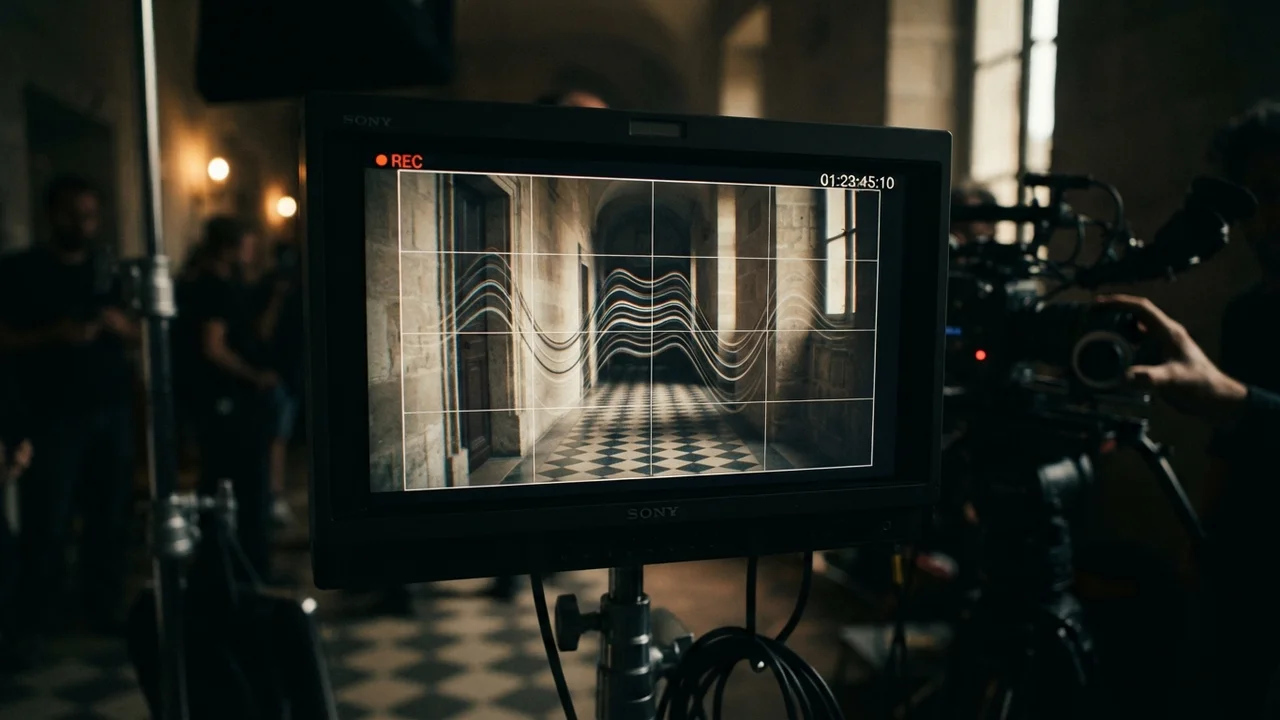
Complex distortion in extreme wide-angle lenses (8–16mm) producing mustache-like undulating patterns rather than uniform barrel curvature.

Technical Details

The distortion results from the combination of various lens aberrations: primary barrel distortion (-2.5% to -8% at extreme wide angles) overlaid by secondary higher-order aberrations. Fisheye lenses with focal lengths of 8-16mm exhibit the strongest manifestation, while retrofocus designs between 14-24mm produce moderate mustache effects. Mathematical correction requires polynomials of at least 6th order, as simple radial corrections cannot capture the complex curvature. Modern lenses use aspherical lens elements and special ED glass for minimization, but rarely achieve complete elimination at maximum wide-angle settings.

History & Development

The term became established in the 1960s with the introduction of extreme wide-angle lenses for 35mm film. Zeiss systematically documented the phenomenon for the first time in 1964 during the development of the Distagon 15mm f/3.5. The digital revolution exacerbated the problem due to smaller sensors and higher resolution, which made distortions more visible. Adobe integrated specific correction profiles into Lightroom in 2005 after photographers and filmmakers increasingly complained about "mustache artifacts." Modern computational photography since 2015 enables real-time correction directly in the camera.

Practical Use in Film

Ridley Scott deliberately used uncorrected mustache distortion in "Blade Runner 2049" for dystopian cityscapes to enhance spatial disorientation. Documentary filmmakers routinely correct the effect in post-production using DaVinci Resolve or AVID plugins. In action sequences with rapid camera movements, the distortion amplifies unwanted "rolling shutter" effects. Steadicam operators avoid lenses below 18mm for horizon-heavy subjects, as post-production correction crops up to 15% of the image content, thus negating compositional plans.

Comparison & Alternatives

Mustache distortion differs from simple barrel distortion by its characteristic wave-like pattern rather than uniform radial curvature. Pincushion distortion exhibits the opposite characteristic with outwardly curved edges. Tilt-shift lenses offer mechanical correction possibilities but cost three times as much as standard wide-angle optics. Modern drone cameras use digital gimbal stabilization combined with real-time de-distortion, but aggressive algorithms often eliminate desired organic image characteristics.

From the crafts

Perspectives

Cinematographer

Ich plane bei Objektiven unter 20mm grundsätzlich 10-15% Sicherheitsbereich für die Entzerrung ein und vermeide horizontale Referenzlinien in den Randbereichen. Bei Steadicam-Fahrten durch Innenräume mit vielen geraden Kanten wechsele ich lieber auf 24mm und gehe näher ran, als später mit aggressiver Nachbearbeitung Bildqualität zu verlieren.

Director

Ich setze bewusste Schnurrbart-Verzerrung für subjektive Kameraführung ein – die Deformation verstärkt Unwohlsein oder Rausch-Zustände der Charaktere. Bei normalen Dialogszenen bestehe ich auf Korrektur, da die Verzerrung Zuschauer unbewusst ablenkt und die emotionale Verbindung zu den Schauspielern stört.

Producer

Unkontrollierte Schnurrbart-Verzerrung kostet mich 2-3 zusätzliche Arbeitstage in der Postproduktion und erhöht die Render-Zeiten um 40%. Ich investiere lieber in höherwertige Optiken mit minimaler Verzerrung, als später teure Spezialisten für komplexe Bildkorrekturen zu engagieren – das rechnet sich bereits ab 15 Drehtagen.

More in the lexikon

Related terms

Test your knowledge

Quiz

1. Zu welchem Department gehört „Schnurrbart-Verzerrung"?

2. Wie viele verschiedene Fachperspektiven bietet dieser Eintrag?

Report an error
From the Filmfarm ecosystem

Understand visual language, budget productions, connect crew.

The Lexikon is part of the Filmfarm ecosystem — alongside budgeting (FilmBalance), an industry magazine (FilmCircus) and crew networking (FilmCall, CrewMesh). One shared vocabulary for the whole production.

FilmFarm FilmRadarComing soonFilmPulseComing soonFilmNumbersComing soonFilmCapitalComing soonFilmLabComing soonFilmBalanceComing soonFilmCircusComing soon