Filmlexikon.
Support
Ballast
Lighting · Terms

Ballast

Murnau AI illustration
color temperature flow roll take dolly hmi hydrargyrum medium arc iodide

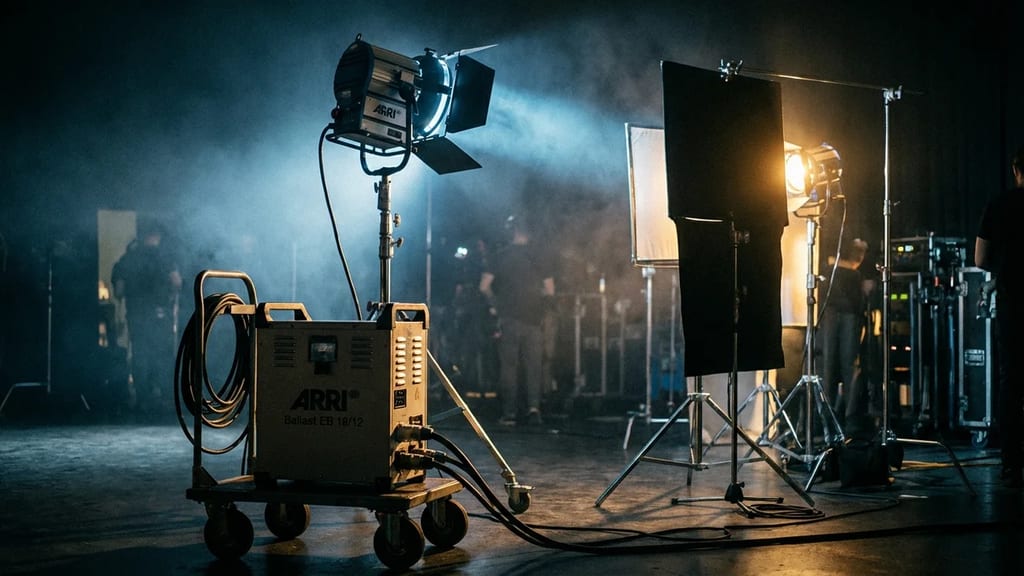
Electronic ballast for HMI lamps that generates ignition voltage up to 65,000 volts and uses 20–50 kHz high-frequency current to eliminate flicker.

Technical Details

Magnetic ballasts operate at 50/60 Hz mains frequency and produce a 100/120 Hz flicker, which leads to banding with cameras using electronic shutters. Electronic ballasts (EVG) operate lamps with high frequencies between 20-50 kHz and eliminate flicker almost completely. Modern flicker-free ballasts achieve frequencies of 1,000 Hz and allow shooting with shutter speeds up to 1/2000 second without visible artifacts. The ignition voltage for HMI lamps is 20,000-65,000 volts, after which the ballast regulates down to an operating voltage of 90-575 volts.

History & Development

OSRAM developed the first film-compatible HMI ballasts in 1969 together with the German company Geyer. Arri launched the first series-production flicker-free ballasts for 2.5/4 kW HMI lights in 1975. Electronic Theatre Controls (ETC) introduced digital ballasts with DMX control in 1991. From 2005 onwards, switch-mode power supplies became established, reducing weight by up to 60% and increasing efficiency to over 95%.

Practical Use in Film

For "Blade Runner 2049" (2017), DoP Roger Deakins exclusively used flicker-free ballasts to achieve extreme slow-motion sequences without banding. In "The Revenant" (2015), portable 1.2 kW Arri Electronic Ballasts enabled lighting in remote Canadian forests without generators. Standard workflows use 2.5/4 kW ballasts for daylight simulation and 6/12 kW units for large area lights. The disadvantage: ballasts generate their own noise of 35-45 dB, which can be disruptive during sound recording.

Comparison & Alternatives

In contrast to transformers for tungsten lamps, ballasts work with complex electronics for arc stabilization. LED lights require drivers instead of ballasts, consuming 80% less power for the same light output. Plasma lights like the Hive Plasma use 2.4 GHz microwave technology and require specialized high-frequency generators. Modern remote phosphor LED systems (Creamsource, Litepanels) are increasingly replacing HMI setups under 4 kW.
From the crafts

Perspectives

Cinematographer

Ich wähle grundsätzlich Flicker-Free-Ballasts ab 1.000 Hz, um bei High-Speed-Aufnahmen oder elektronischen Shuttern keine Streifenbildung zu riskieren. Die 6 kW Arri M-Series Ballasts platziere ich mindestens 15 Meter vom Set entfernt, da ihr Lüftergeräusch selbst bei "Silent Mode" noch 38 dB erreicht und in Dialog-Szenen hörbar wird.

Director

Mir ist wichtig, dass die Ballasts schnelle Dimmvorgänge ermöglichen - für Sonnenuntergangs-Szenen dimme ich HMI-Leuchten über DMX-gesteuerte Vorschaltgeräte kontinuierlich von 100% auf 35% herunter. Bei Nachtszenen nutze ich die Möglichkeit, Ballasts während der Aufnahme komplett stumm zu schalten, auch wenn das die Lampenlebensdauer verkürzt.

Producer

Electronic Ballasts kosten zwar 40% mehr als magnetische, sparen aber täglich 200-300 Euro Generatorkosten durch 15% höhere Effizienz bei 12 kW Setups. Ich kalkuliere immer Backup-Ballasts ein, da ein Defekt eine komplette Unit für 4-6 Stunden lahmlegt - bei Tageslicht-Exteriors ein produktionskritisches Risiko.

More in the lexikon

Related terms

Test your knowledge

Quiz

1. Was beschreibt „Vorschaltgerät" am besten?

2. Zu welchem Department gehört „Vorschaltgerät"?

3. Wie viele verschiedene Fachperspektiven bietet dieser Eintrag?

Report an error
From the Filmfarm ecosystem

Understand visual language, budget productions, connect crew.

The Lexikon is part of the Filmfarm ecosystem — alongside budgeting (FilmBalance), an industry magazine (FilmCircus) and crew networking (FilmCall, CrewMesh). One shared vocabulary for the whole production.

FilmFarm FilmRadarComing soonFilmPulseComing soonFilmNumbersComing soonFilmCapitalComing soonFilmLabComing soonFilmBalanceComing soonFilmCircusComing soon