Cinematographer
Aus DoP-Perspektive ist dieses Element essentiell für die visuelle Gestaltung. Es ermöglicht mir die gewünschte Farbstimmung und das ästhetische Bild konsistent umzusetzen.
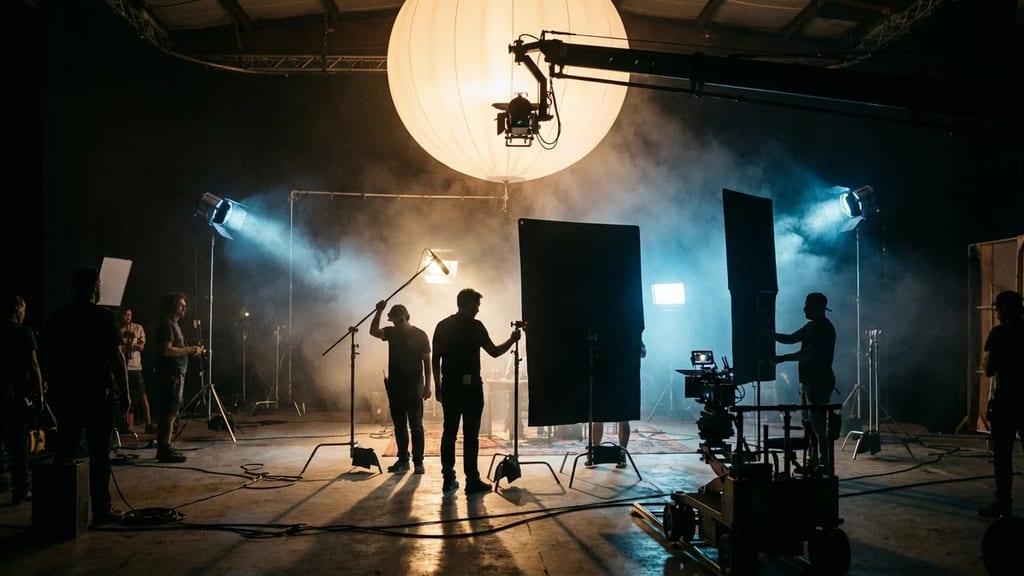
Light fixture with a bulb encased in a translucent fabric dome that diffuses light evenly in all directions for soft, shadowless illumination.
A Balloon Light (also known as a light balloon or illumination balloon) is a luminary in which one or more high-power lamps are housed within a translucent fabric envelope in the shape of a balloon. The envelope acts as an all-around diffuser, scattering and softening the light to create a large, evenly illuminated source with very soft shadows. Some models feature a reflective inner coating in the upper section to direct the light downwards (half-silvered).
A characteristic feature is the filling technique: the balloon can be filled with Helium, allowing it to float freely above the set and be positioned by tether lines, or with regular Air, when it is hung or mounted on rigging, a crane, or a stand. This allows for a large, high-positioned light source without the need for bulky trussing or crane equipment.
According to Wikipedia, an illumination balloon was patented in Germany as early as 1924. The modern, helium-filled version for professional use was developed in 1994 by Pierre Chabert and Benoît Beylier of the French company Airstar (Grenoble); Airstar is considered the inventor and leading manufacturer of this type of fixture. Early prominent film uses include Mission: Impossible (1996) and Titanic (1997); later, Avatar and the Pirates of the Caribbean series, among others, followed. In addition to Airstar, other manufacturers offer comparable light balloons.
Light balloons come in various shapes, each producing different lighting characteristics:
Depending on the model, light sources used include Tungsten (warm white), HMI (daylight), metal halide, mercury, or sodium vapor lamps, and increasingly LED. Tungsten typically provides warm light around 3200 K, while HMI provides daylight-white light around 5600 K; the specific color temperature depends on the installed light source. Modern LED balloons (e.g., Airstar's NEO series) are significantly lighter and some are dimmable or have controllable color temperature.
Balloon Lights are primarily used where a large, soft, and high-hanging ambient light is needed, but where it is difficult to set up trussing or cranes. This includes night exteriors, expansive sets, hard-to-light rooms, heritage locations, and studio and stage setups. The diffuse, all-around light creates a moonlight-like or broad-area light (Ambient/Fill) over a large area.
Helium-filled balloons must be secured against wind with multiple tether lines and require a supply of helium; providers like Airstar offer turnkey services with logistics, helium, and trained personnel. Air-filled versions are instead mounted on rigging, stands, or booms.
Aus DoP-Perspektive ist dieses Element essentiell für die visuelle Gestaltung. Es ermöglicht mir die gewünschte Farbstimmung und das ästhetische Bild konsistent umzusetzen.
Diese professionelle Lösung erhöht die Produktionseffizienz und reduziert Post-Production-Anforderungen. Sie ermöglicht flexible, schnelle Anpassungen während des Drehs.
Als Gaffer ist dies ein unverzichtbares Werkzeug meines täglichen Handwerkszeugs. Es ermöglicht mir professionelle Lichtkontrolle und schnelle Anpassungen auf Set, was Zeit spart und Qualität sichert.
1. Zu welchem Department gehört „Ballonlicht"?
2. Wie viele verschiedene Fachperspektiven bietet dieser Eintrag?
The Lexikon is part of the Filmfarm ecosystem — alongside budgeting (FilmBalance), an industry magazine (FilmCircus) and crew networking (FilmCall, CrewMesh). One shared vocabulary for the whole production.