Filmlexikon.
Support
Baby Pin
Lighting · Equipment

Baby Pin

Murnau AI illustration
baby color temperature flow roll take

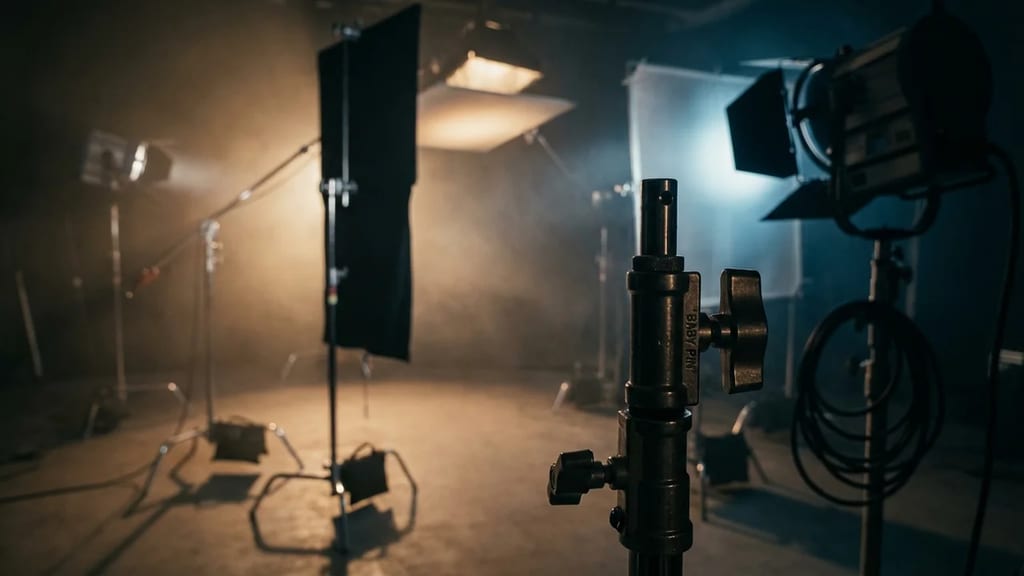
15.875mm (5/8") steel pin with 11° taper for lights up to 650W; 1934 Mole-Richardson standard for studio mounting.

Technical Details

The Baby Pin measures exactly 15.875mm (5/8") in diameter with a typical length of 50-75mm. The end is tapered with an 11° angle for self-centering mounting. Most Baby Pins feature a circumferential groove (Safety Groove) 25mm from the base, serving as a safeguard against accidental detachment. The material standard is hardened steel with a black oxide coating or stainless steel. The load capacity is 50kg static load, 25kg dynamic.

History & Development

Mole-Richardson developed the Baby Pin system in 1934 as part of the first Hollywood studio standard for lighting equipment. The size was based on available steel tube dimensions and was adopted as an industry standard by the IATSE in 1938. Matthews Studio Equipment perfected the conical pin shape in 1952, which is still produced unchanged today. Integration into the metric system only occurred in the 1980s with the globalization of film production.

Practical Use in Film

Baby Pins are mainly used with LED panels up to 1000W, small tungsten Fresnel lights up to 650W, and practical lights. Typical applications include portrait lighting with Dedolight systems or accent lighting with Aputure AL-M9. Roger Deakins extensively used Baby Pin-mounted LED strips for the neon atmosphere of the interiors in "Blade Runner 2049." The quick tool-free mounting makes them ideal for run-and-gun productions and handheld setups.

Comparison & Alternatives

In contrast to the Junior Pin (28mm) and Senior Pin (38mm), the Baby Pin is exclusively suitable for lightweight fixtures. Modern alternatives like Manfrotto's Spigot system (16mm with thread) or the Kupo Convi Clamp System offer more flexibility but are not universally compatible. Quick-release systems from Tilta or SmallRig are increasingly replacing fixed Baby Pins on DSLR and mirrorless setups, while the classic Baby Pin system remains standard in larger productions due to its proven reliability.

From the crafts

Perspectives

Cinematographer

Als DoP schätze ich Baby Pins besonders für präzise Lichtführung in engen Räumen – die kompakte Bauweise erlaubt mir, kleine LED-Panels millimetergenau zu positionieren, ohne ins Bildfeld zu ragen. Bei Steadicam-Aufnahmen montiere ich oft kleine Practical Lights über Baby Pins direkt am Set, da sie vibrationsarm und schnell repositionierbar sind.

Director

Für mich sind Baby Pin-montierte Leuchten das perfekte Werkzeug für subtile Stimmungsarbeit – ich kann kleine Akzentlichter spontan setzen, um Emotionen zu verstärken, ohne große Umbauten zu riskieren. Besonders bei Dialogszenen nutze ich Baby Pin-LEDs als versteckte Eye-Lights, die den Schauspielern folgen können, ohne die Intimität der Szene zu zerstören.

Producer

Baby Pin-Equipment bedeutet für mich Kosteneffizienz durch Standardisierung – einmal angeschafft, passt es zu 90% aller Kleinleuchten am Markt. Die schnelle Auf- und Abbauzeit spart täglich 15-20 Minuten Beleuchtungszeit, was bei 25 Drehtagen schnell einen halben Produktionstag ausmacht.

More in the lexikon

Related terms

Test your knowledge

Quiz

1. Was beschreibt „Baby Zapfen" am besten?

2. Zu welchem Department gehört „Baby Zapfen"?

3. Wie viele verschiedene Fachperspektiven bietet dieser Eintrag?

Report an error
From the Filmfarm ecosystem

Understand visual language, budget productions, connect crew.

The Lexikon is part of the Filmfarm ecosystem — alongside budgeting (FilmBalance), an industry magazine (FilmCircus) and crew networking (FilmCall, CrewMesh). One shared vocabulary for the whole production.

FilmFarm FilmRadarComing soonFilmPulseComing soonFilmNumbersComing soonFilmCapitalComing soonFilmLabComing soonFilmBalanceComing soonFilmCircusComing soon