Filmlexikon.
Support
Baby
Lighting · Equipment

Baby

Murnau AI illustration
color temperature flow roll take

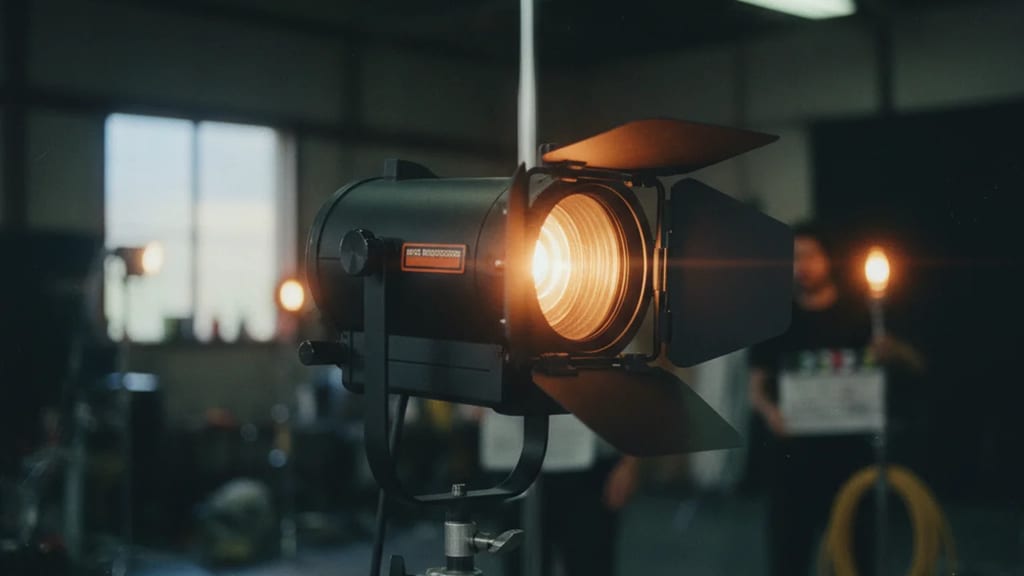
1000W Fresnel spotlight with 152mm lens, 4.5–6.5 kg. Spot mode 15°, flood mode 60°. Versatile accent light for portraits and fill lighting in interiors up to 40 m².

Technical Details

The Baby utilizes a 1000W halogen lamp (FEL socket, 3200K color temperature) and weighs between 4.5 and 6.5 kg depending on the manufacturer. The Fresnel lens has a diameter of 152mm (6 inches), and the spotlight measures approximately 28 x 23 x 35 cm. Light distribution is achieved through a variable focus system: in spot mode (15°), the Baby reaches 950 footcandles at 3 meters; in flood mode (60°), it is 240 footcandles. Modern LED variants offer 100W consumption with comparable light output and variable color temperature from 2700K to 6500K.

History & Development

Mole-Richardson developed the Baby in 1936 as part of their Fresnel series, based on the lighthouse technology of French optician Augustin-Jean Fresnel. The term became established in Hollywood in the 1940s as studio lighting became standardized. In 1965, Strand Electric introduced the European version. From the 1980s onwards, HMI Babies with 575W/1200W entered the market, and since 2010, LED Babies with app control and DMX protocol have dominated the market.

Practical Use in Film

The Baby serves as a versatile accent light for portrait shots, background illumination, or as fill light in interiors up to 40m². Cinematographer Roger Deakins extensively used Babies for the prison scenes in "The Shawshank Redemption" (1994) to create warm pools of light. In "Blade Runner 2049" (2017), Deakins employed LED Babies with orange gels for the dystopian interiors. The Baby is suitable for 16mm to 65mm productions, with its compact design allowing for tight shooting spaces. Disadvantages: High heat generation in Tungsten versions and limited light output for wide-angle shots.

Comparison & Alternatives

The Baby is positioned between the 650W Tweenie and the 2000W Junior. LED panels like the Litepanels Astra 6X offer similar light output at 75W consumption, but without the characteristic Fresnel shaping. SkyPanel S30-C and Orbiter achieve higher light output with color mixing but cost ten times as much. For documentary work, battery-powered LED Babies like the Aputure LS 60d often replace classic Tungsten variants. For large exterior shots, cinematographers opt for HMI Pars or LED walls.
From the crafts

Perspectives

Cinematographer

Ich nutze das Baby hauptsächlich als Portraitlicht mit CTB-Folie, wenn ich Tageslicht angleichen muss – die Fresnel-Charakteristik gibt mir diesen weichen, aber direktionalen Fall-off, den LEDs oft nicht hinbekommen. Bei Steadicam-Fahrten positioniere ich Babies als praktische Lichtquellen hinter Fenstern, weil sie klein genug sind, um außerhalb des Kameraschwenks zu bleiben, aber genug Power für eine f/2.8 bei 800 ISO liefern.

Director

Das warme 3200K-Licht des Baby nutze ich gezielt für emotionale Intimität – in Dialogszenen platziere ich es als Fensterlicht oder versteckte Raumquelle, um Charaktere vom Hintergrund zu separieren. Die stufenlose Fokussierung erlaubt mir, während der Probe die Lichtmotivik anzupassen: Spot für Drama und Isolation, Flood für natürlichere Raumbeleuchtung ohne Umbaupausen.

Producer

Ein Baby kostet in der Miete 15-25€ pro Drehtag, der Stromverbrauch liegt bei etwa 3€ täglich – damit ist es eines der kosteneffizientesten Tools im Lichtpark. Die kompakte Größe reduziert Transportkosten, und das 10kg-Stativ kann von einem Beleuchter allein getragen werden, was Personalkosten spart. LED-Babies kosten 80€ Tagessatz, amortisieren sich aber bei längeren Produktionen durch wegfallende Gel- und Folienkosten.

More in the lexikon

Related terms

Test your knowledge

Quiz

1. Zu welchem Department gehört „Baby"?

2. Wie viele verschiedene Fachperspektiven bietet dieser Eintrag?

Report an error
From the Filmfarm ecosystem

Understand visual language, budget productions, connect crew.

The Lexikon is part of the Filmfarm ecosystem — alongside budgeting (FilmBalance), an industry magazine (FilmCircus) and crew networking (FilmCall, CrewMesh). One shared vocabulary for the whole production.

FilmFarm FilmRadarComing soonFilmPulseComing soonFilmNumbersComing soonFilmCapitalComing soonFilmLabComing soonFilmBalanceComing soonFilmCircusComing soon