Filmlexikon.
Support
Baby Mole
Lighting · Equipment

Baby Mole

Murnau AI illustration
baby color temperature flow mole roll take

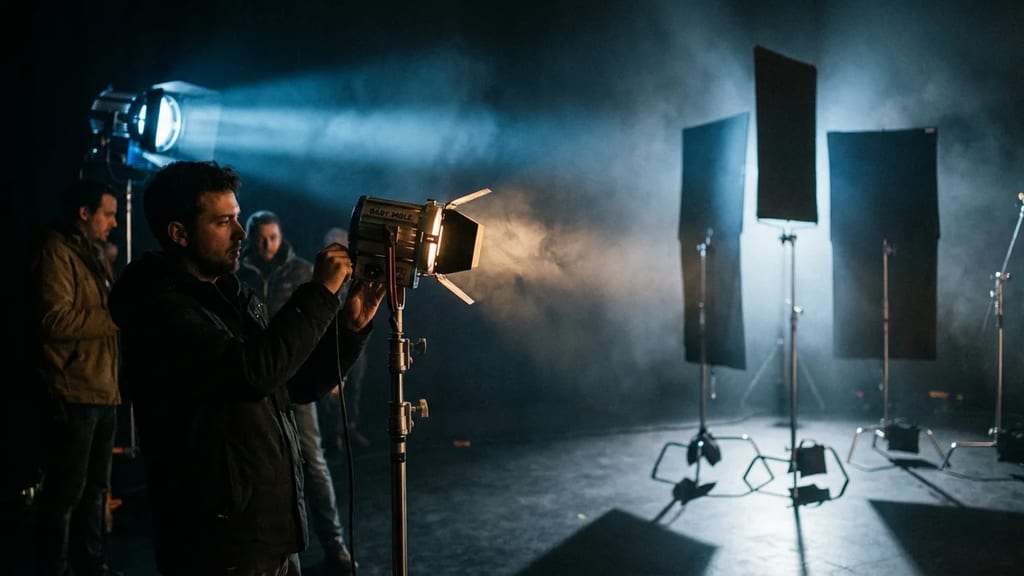
Compact 200W tungsten-halogen spotlight by Mole-Richardson with 125mm Fresnel lens; enables precise spot-to-flood focusing in confined spaces.

Technical Details

The Baby Mole measures 20 cm x 15 cm x 25 cm and weighs 2.1 kg, using a 200W Tungsten-Halogen lamp (FEV, G6.35 socket). The 125mm Fresnel lens allows continuous focusing from spot to flood position over an adjustment range of 110mm. The reflector is made of polished aluminum, and the housing is die-cast aluminum with a black hammertone finish. Versions for 120V/230V with corresponding plugs (Edison/CEE 7/7) are available as standard.

History & Development

Mole-Richardson introduced the Baby Mole in 1952 as the smallest variant of the successful Mole series, following the demand for more compact lighting in television productions. It was based on the 2K Junior developed in 1947 and was specifically designed for close-ups and accent lighting. In 1978, it was converted to Tungsten-Halogen technology, and in 1995, the improved "Type 4111" was introduced with optimized cooling and longer lamp life.

Practical Use in Film

Cinematographer Roger Deakins extensively used Baby Moles for facial accents in "No Country for Old Men" (2007), particularly in the hotel scenes with Javier Bardem. Its compact size makes it ideal for rigging in confined spaces. For "Her" (2013), Hoyte van Hoytema used six Baby Moles simultaneously on Joaquin Phoenix's apartment set. A typical workflow involves positioning them 1-2 meters from the subject, using barn doors for precise light shaping, and often employing ND filters or diffusion for intensity control.

Comparison & Alternatives

The Baby Mole differs from the 650W Tweenie by generating less heat and having a longer burn time, but it offers lower light output. Modern LED alternatives like the Arri L5-C provide comparable brightness with variable color temperature but cost four times as much. The Dedolight DLH4 achieves similar focusing with only 150W but lacks the characteristic Fresnel optics. For classic film look and precise shadow control, the Baby Mole remains unrivaled despite its 70-year design history.
From the crafts

Perspectives

Cinematographer

Das Baby Mole ist mein Präzisionsinstrument für harte Lichtkanten und definierte Schatten - die Fresnel-Charakteristik erzeugt genau den graduellen Übergang zwischen Licht und Schatten, den LEDs nicht replizieren können. Bei 3200K passt es perfekt zu meinen Tungsten-Prakticals, und durch die kompakte Bauweise kann ich es überall verstecken, wo größere Leuchten nicht hinpassen.

Director

Ich nutze Baby Moles gezielt für emotionale Momente - das warme 3200K-Licht verstärkt Intimität, während die scharfe Fokussierung Gesichtszüge dramatisch modelliert. In Dialogszenen positioniere ich sie oft seitlich auf Augenhöhe, um Charaktere je nach Story-Bedarf entweder verletzlich oder bedrohlich wirken zu lassen.

Producer

Mit 40 Euro Tagesmiete ist das Baby Mole extrem kosteneffizient, verbraucht nur 200W Strom und benötigt keine speziellen Kabel oder Dimmer. Die robuste Bauweise übersteht jahrelangen Einsatz ohne Wartung, und durch das geringe Gewicht spare ich Transportkosten - ein komplettes 6er-Set passt in eine Standard-Transportkiste.

More in the lexikon

Related terms

Test your knowledge

Quiz

1. Was beschreibt „Baby Mole" am besten?

2. Zu welchem Department gehört „Baby Mole"?

3. Wie viele verschiedene Fachperspektiven bietet dieser Eintrag?

Report an error
From the Filmfarm ecosystem

Understand visual language, budget productions, connect crew.

The Lexikon is part of the Filmfarm ecosystem — alongside budgeting (FilmBalance), an industry magazine (FilmCircus) and crew networking (FilmCall, CrewMesh). One shared vocabulary for the whole production.

FilmFarm FilmRadarComing soonFilmPulseComing soonFilmNumbersComing soonFilmCapitalComing soonFilmLabComing soonFilmBalanceComing soonFilmCircusComing soon