Technical Details
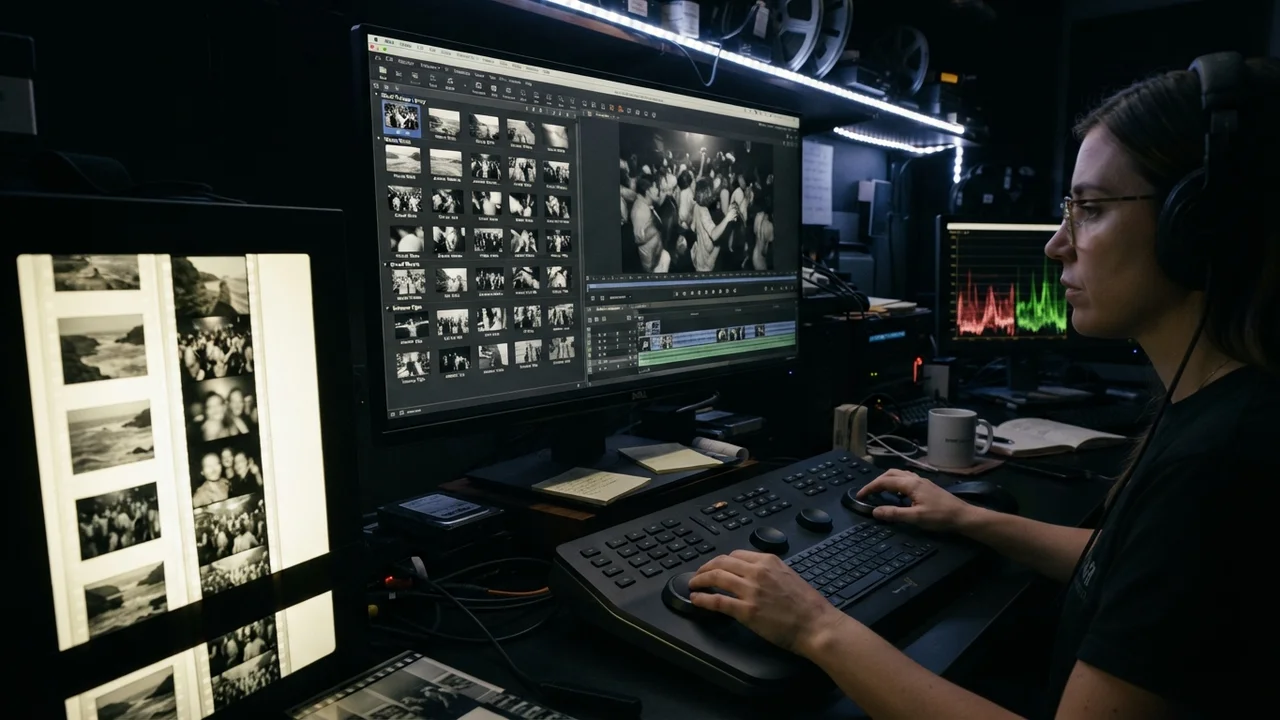
In digital productions, B-roll is typically recorded with the same camera settings as the A-roll footage: identical frame rate (usually 24p or 25p), resolution, and color profile. The ratio between A-roll and B-roll in documentaries is often 1:5 to 1:8, meaning for every minute of interview material used, 5-8 minutes of B-roll footage are needed. Technically, B-roll is distinguished by its lack of synchronization with the primary audio track and is placed as a separate video track (Video Track 2 or higher) in the timeline.
History & Development
The B-roll technique developed in the 1930s in the newsreel sector, where film editors used two 16mm projectors to switch between narrator material (A-roll) and archival footage (B-roll). In 1952, CBS News under Edward R. Murrow established the systematic use of B-roll in television documentaries. With the introduction of videotape machines in the 1970s, the A/B-roll editing technique became standard in television production. Today, integration is fully digital in non-linear editing systems.
Practical Use in Film
Werner Herzog's "Grizzly Man" (2005) uses over 100 hours of Timothy Treadwell's archival material as B-roll over Herzog's own interviews. Michael Moore's documentaries use B-roll specifically for ironic contrast: in "Bowling for Columbine" (2002), interviews with gun lobbyists are countered by footage of victims of violence. In feature film productions, B-roll serves as coverage for establishing shots or insert shots. A typical workflow: B-roll is recorded during main camera setups or by second unit teams parallel to the main production.
Comparison & Alternatives
B-roll is distinguished from stock footage by project-specific recording, whereas stock material comes from archives. Insert shots are narratively relevant close-ups; B-roll remains atmospherically supportive. Cutaways refer to reaction shots of people present; B-roll can also include completely independent material. Modern alternatives include motion graphics and animated infographics, especially in corporate videos and online content where B-roll material is cost-intensive or unavailable.