Filmlexikon.
Support
Angenieux Optimo
Camera · Equipment

Angenieux Optimo

hdgear.tv
angenieux optimo anamorphic angenieux optimo prime angenieux angenieux ez angenieux type ez flow para

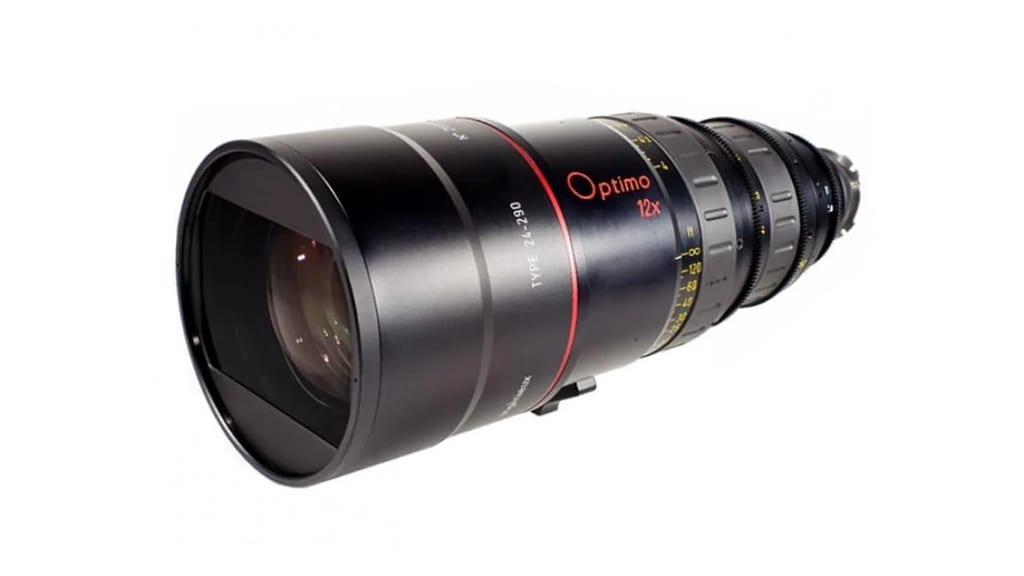
Cinema zoom with constant aperture across focal range. Focus breathing negligible, built for daily set use. Fewer lens swaps, more shooting time.

Technical Details

The Optimo series encompasses various focal length ranges: the Optimo 15-40mm T2.6, 17-80mm T2.2, 24-290mm T2.8, 28-76mm T2.6, and the extreme 28-340mm T3.2. All lenses feature constant T-stops (Transmission aperture values), 300° focus ring rotation for precise focus pulling, and standardized gear rings (0.8 module) for follow focus systems. The construction is based on aspherical elements and ED (Extra-low Dispersion) elements to minimize chromatic aberrations. Weight varies between 3.2 kg (15-40mm) and 8.5 kg (28-340mm).

History & Development

Angenieux introduced the first Optimo generation in 2001 with the 17-80mm, building on 60 years of experience in zoom development since the first Varifocal lenses in 1956. In 2004, the revolutionary 24-290mm with a 12:1 zoom ratio followed, which for the first time combined the focal length ranges of a complete lens set in a single lens. In 2013, the Optimo Style series expanded the portfolio with lighter, more compact variants. The latest generation, Optimo Prime (since 2018), combines zoom flexibility with prime lens quality.

Practical Application in Film

Cinematographers use Optimo lenses for continuous zoom moves without changing lenses, for example in "Gravity" (2013) for seamless perspective shifts in space or "1917" (2019) for the famous long takes. The extreme 24-290mm allows for shots from wide-angle to super-telephoto without interruption, significantly reduces setup times, and minimizes dust-busting in post-production. The constant aperture prevents exposure jumps during zooming, and the precise mechanics enable repeatable camera movements for VFX shots.

Comparison & Alternatives

In contrast to prime lens sets, Optimos offer extreme flexibility with slightly reduced optical sharpness. Modern alternatives like Canon CN20x50 or Fujinon Premista achieve similar zoom ratios, but usually at a higher weight. Zeiss Lightweight Zooms are more compact but cover smaller focal length ranges. For maximum image quality, Master Prime sets remain superior; for documentary work or tight shooting schedules, Optimos dominate due to their versatility.
From the crafts

Perspectives

Cinematographer

Ich schätze die Optimos für ihre mechanische Präzision – die Fokus- und Zoom-Ringe laufen butterweich und reproduzierbar, was bei komplexen Kamerabewegungen entscheidend ist. Das 24-290mm ersetzt praktisch einen ganzen Objektivkoffer, allerdings muss ich bei extremen Brennweiten minimal Schärfeverluste gegenüber Primes akzeptieren. Die konstante T2.8 über den gesamten Zoombereich gibt mir die Sicherheit, dass sich Belichtung und Schärfentiefe nicht ungewollt ändern.

Director

Mit einem Optimo kann ich spontan zwischen intimer Nahaufnahme und weiter Totale wechseln, ohne dass die Crew das Setup ändern muss – das erhält die Energie einer Szene. Besonders bei Dialogen nutze ich gerne langsame Zoom-Ins, um emotionale Wendepunkte zu unterstreichen, da das Objektiv so sanft läuft, dass die Bewegung fast unmerklich wird. Diese Flexibilität erlaubt mir, in der Montage zwischen verschiedenen Bildausschnitten derselben Einstellung zu wählen.

Producer

Ein Optimo-Set kostet zwar 200.000-400.000 Euro, aber ersetzt oft 8-10 Festbrennweiten und reduziert Drehtage erheblich durch wegfallende Objektivwechsel. Die Zeitersparnis am Set ist enorm – keine Setup-Pausen für Lens-Changes bedeuten mehr nutzbare Drehzeit pro Tag. Für internationale Koproduktionen sind Optimos praktisch Standard, was die Verfügbarkeit bei Rental-Houses weltweit sicherstellt.

More in the lexikon

Related terms

Test your knowledge

Quiz

1. Was beschreibt „Angenieux Optimo" am besten?

2. Zu welchem Department gehört „Angenieux Optimo"?

3. Wie viele verschiedene Fachperspektiven bietet dieser Eintrag?

Report an error
From the Filmfarm ecosystem

Understand visual language, budget productions, connect crew.

The Lexikon is part of the Filmfarm ecosystem — alongside budgeting (FilmBalance), an industry magazine (FilmCircus) and crew networking (FilmCall, CrewMesh). One shared vocabulary for the whole production.

FilmFarm FilmRadarComing soonFilmPulseComing soonFilmNumbersComing soonFilmCapitalComing soonFilmLabComing soonFilmBalanceComing soonFilmCircusComing soon