Technical Details
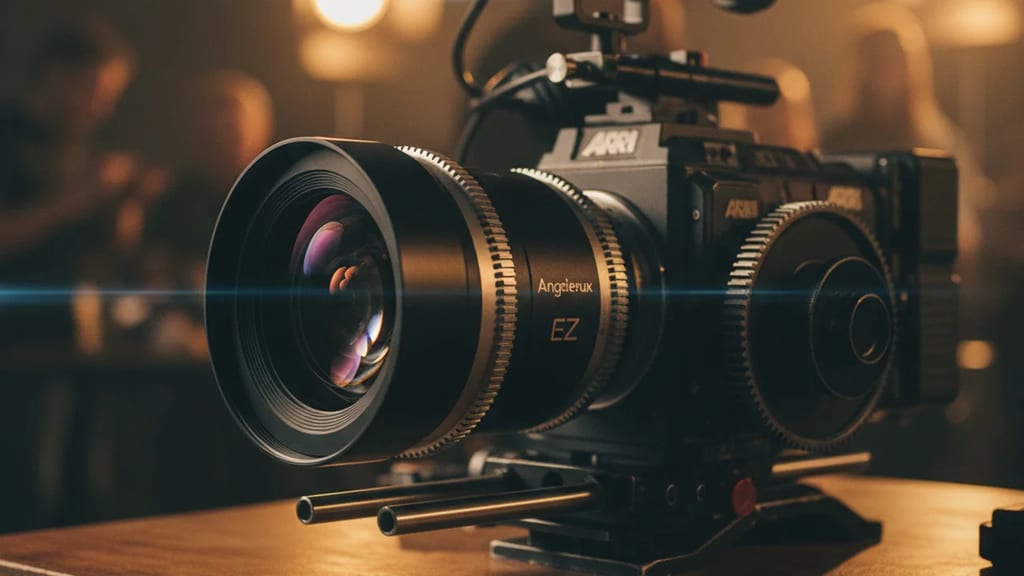
The EZ series consists of three main lenses: the EZ-1 (30-90mm T2), the EZ-2 (15-40mm T2.3), and the EZ-3 (22-60mm T2.8). All lenses feature a 114mm front lens diameter and a uniform 134mm filter thread. The zoom ring has a rotation angle of 340°, enabling precise focal length adjustments. Chromatic aberration is below 0.003% across the entire zoom range. Weight varies between 4.2kg (EZ-2) and 5.1kg (EZ-1). The lenses are equipped with a PL mount and are optionally available with an LPL mount for large-format cameras.
History & Development
Angenieux introduced the EZ series in 2012 in response to the growing demand for full-frame zoom lenses for digital cinema productions. The first model, the EZ-1, quickly established itself as a standard for Netflix productions requiring 4K quality. In 2016, Angenieux expanded the series with the EZ-2 for wide-angle shots, followed by the EZ-3 in 2018. The development was based on expertise from the Optimo series and feedback from cinematographers like Emmanuel Lubezki and Roger Deakins.
Practical Use in Film
"The Revenant" (2015) was shot entirely with the EZ series, with cinematographer Emmanuel Lubezki utilizing the constant T-stop for available light scenes. "Blade Runner 2049" (2017) used the EZ-1 for characteristic zoom movements in cityscapes. The series is particularly suitable for handheld shots due to its balanced weight distribution and for Steadicam use thanks to its consistent balance throughout the zoom range. The main advantage lies in the consistent image quality without loss of sharpness when zooming, while the high acquisition cost of 40,000-60,000 Euros per lens represents the main disadvantage.
Comparison & Alternatives
The EZ series directly competes with Canon CN-E and ARRI Alura zoom lenses. While Canon lenses are more affordable (approx. 25,000 Euros), they do not offer the same mechanical precision. ARRI Alura lenses achieve similar optical quality but are 30% heavier. For budget productions, Fujinon MK lenses serve as an alternative with comparable image quality at half the T-stop. The EZ series remains the first choice for high-end cinema productions, while Alura lenses are more frequently used in commercials.