Filmlexikon.
Support
Open Matte
Camera · Technique

Open Matte

Murnau AI illustration
compositing keying green screen blue screen chroma key roto rotoscoping clip on matte box

Presentation technique where the top and bottom of a theatrically matted image are opened to reveal additional vertical picture information for non-theatrical formats.

Overview

"Open Matte" (literally "opened matte") refers not to equipment or grip gear, but to a shooting and distribution technique. A film is exposed on a negative with an almost square aspect ratio (full aperture or Academy format). For theatrical distribution, the image is cropped at the top and bottom by a matte to the desired widescreen format. If this matte is removed for later distribution – classically for 4:3 television or home video – the image "opens" at the top and bottom, revealing more image height than the theatrical version. This is precisely what an open-matte version is.

Unlike pan-and-scan, which crops the image edges left and right to force widescreen material into a more square format, open matte adds unseen image material at the top and bottom. The technique is closely linked to "soft matte" exposure: the camera records the entire image field, and the final widescreen image boundary is only created by a matte in projection or post-production (as opposed to "hard matte," where the matte is already fixed within the image).

Involved Aspect Ratios

FormatAspect RatioRole
Silent Aperture (Full Frame)1.33:1exposed negative area / open matte
Academy1.37:1scan basis for many open-matte versions
Cinematic Widescreen1.66:1 / 1.85:1matted theatrical version
16:9 TV1.78:1common distribution format

Note: The exact ratios depend on the specific negative and distribution format; in Super 35 productions, open matte is often combined with pan-and-scan because visual effects shots were rendered in a wider format and cannot be easily opened up.

Relevance for Lighting and Grip

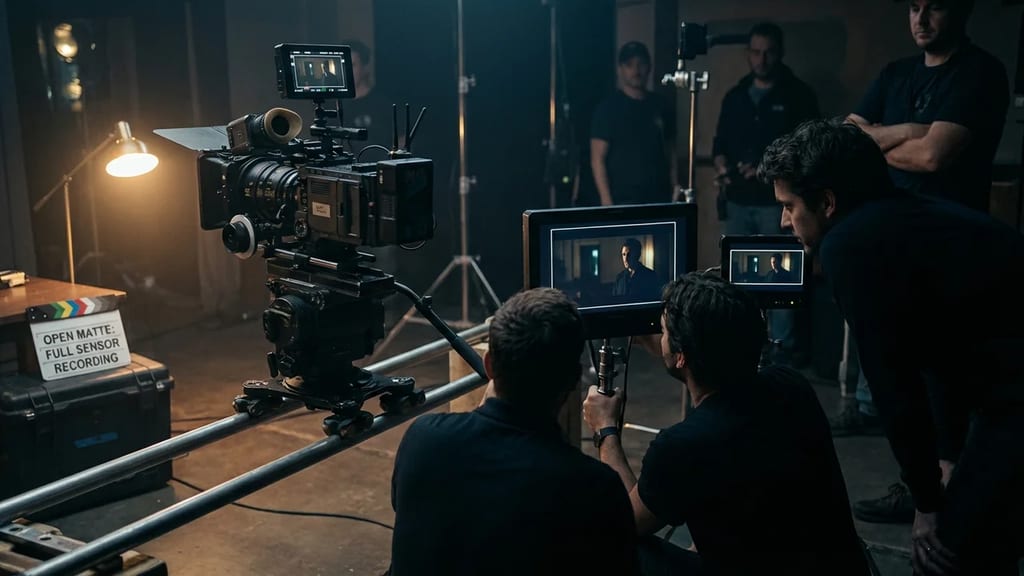
For set work, open matte is primarily relevant as a warning: the area above and below the visible theatrical image boundary is also exposed on the negative. What is set up within the "protected" matte area can suddenly become visible in an open-matte version – typically boom poles, microphone booms, stands, cables, top lights, or set edges. Anyone composing for widescreen must therefore know if an unmatted version is planned ("protect for open matte"): in this case, the entire exposed frame must remain clean, not just the theatrical image crop.

Viewfinders and monitors usually display the boundary via superimposed guidelines (frame lines / safe areas) for the cinematic format. However, when "cleaning" the image, lighting and grip should sensibly orient themselves to the full recorded image field, unless an open-matte distribution is explicitly ruled out.
From the crafts

Perspectives

Cinematographer

Als DoP muss ich bei Open-Matte-Produktionen permanent für zwei Formate komponieren – die Kinofassung und die erweiterte Version für Home Video. Das bedeutet, ich positioniere wichtige Bildelemente im sicheren Bereich des Scope-Formats, während ich gleichzeitig darauf achte, dass die oberen und unteren Bildbereiche keine störenden Elemente wie Mikrofonangelagen oder Set-Ränder zeigen. Meine Beleuchtung muss für den erweiterten Bildbereich ausgelegt sein, auch wenn dieser im Kino nicht zu sehen ist.

Director

Open Matte gibt mir die Flexibilität, eine Geschichte sowohl für die große Leinwand als auch für Heimkino zu optimieren, ohne auf die visuelle Wirkung von Scope-Formaten verzichten zu müssen. Ich kann intime Szenen für die Vollbild-Version komponieren, während actionreiche Sequenzen vom breiten Kinoformat profitieren. Bei der Inszenierung muss ich allerdings beide Bildausschnitte im Kopf behalten und kann bestimmte vertikale Bewegungen oder Kompositionen nicht verwenden, die nur in einem Format funktionieren würden.

Producer

Open Matte spart mir die Kosten für aufwendige Pan-and-Scan-Bearbeitungen und ermöglicht es, aus einem Drehtag Material für verschiedene Auswertungsfenster zu generieren. Der Mehraufwand beschränkt sich auf sorgfältigere Set-Gestaltung und längere Beleuchtungszeiten, da größere Bildbereiche ausgeleuchtet werden müssen. Für die Postproduktion benötige ich zwei separate Farbkorrektur-Sessions, was etwa 15-20% mehr Zeit im DI-Bereich bedeutet, aber deutlich günstiger ist als nachträgliche Formatkonvertierungen.

More in the lexikon

Related terms

Test your knowledge

Quiz

1. Was beschreibt „Open Matte" am besten?

2. Zu welchem Department gehört „Open Matte"?

3. Wie viele verschiedene Fachperspektiven bietet dieser Eintrag?

Report an error
From the Filmfarm ecosystem

Understand visual language, budget productions, connect crew.

The Lexikon is part of the Filmfarm ecosystem — alongside budgeting (FilmBalance), an industry magazine (FilmCircus) and crew networking (FilmCall, CrewMesh). One shared vocabulary for the whole production.

FilmFarm FilmRadarComing soonFilmPulseComing soonFilmNumbersComing soonFilmCapitalComing soonFilmLabComing soonFilmBalanceComing soonFilmCircusComing soon